PART 1: The Daughter Who Followed Her Dream of Flying
My name is Reagan Holloway.
I’m thirty-two years old, and I work as a cargo pilot based in Indianapolis, Indiana.
Flying has been my passion for as long as I can remember.
My father, Gordon Holloway, was sixty-eight years old when he passed away.
Long before he became a successful businessman, he had worked as a flight instructor.
Later, he established a thriving company in Ohio.
The business was called Holloway Woodland Retreats.
It managed wooded properties, vacation cabins, and nature-based tourism destinations throughout the Hocking Hills region.
My older brother, Wade, was thirty-nine.
He had worked with our father for almost twenty years, helping manage the family business.
Unlike Wade, I had chosen a completely different career.
And for the past nine years, I had lived with the painful belief that my father was disappointed in me.
Everything had started when I decided to leave my business administration program and pursue aviation instead.
Dad had always expected me to become part of the family company.
He believed I had a secure future waiting for me there.
So when I told him that I wanted to become a professional pilot, I could see how deeply my decision disappointed him.
He looked at me and asked,
“Reagan, you already have a future here. Why would you give all of that up?”
I understood what he was offering.
But I also knew that working in the family business wasn’t the life I wanted.
“Because I’ve dreamed of flying since I was a little girl, Dad.”
He didn’t answer immediately.
Instead, he turned his attention toward the window.
After a moment, he spoke quietly.
“Well, I guess you’ve already decided.”
A few weeks later, I left Columbus to begin building the career I had chosen.
I hoped that, with time, Dad would understand.
I thought that once he saw how serious I was about aviation, he might eventually accept my decision.
But the distance between us only seemed to grow.
Over the following years, our conversations became shorter and more uncomfortable.
Whenever we spoke, he rarely asked much about my life.
Sometimes, the entire conversation seemed to consist of only a few sentences.
“Are you still flying?” he would ask.
“Yes, Dad.”
“All right. Keep flying, then.”
And that would be almost everything.
I always hoped he might ask about my work or tell me that he was happy I had found something I loved.
But those words never came.
He never told me he was proud of me.
He didn’t attend my graduation.
As the years passed, even our occasional phone calls became less frequent.
I kept moving forward with my career, but a part of me still wanted my father’s approval.
No matter how much I accomplished, I wished I could share those moments with him.
Then Dad began experiencing serious heart problems.
When I learned that he was in the hospital, I went to visit him.
Seeing him so weak was difficult.
The man I had always known as hardworking and determined now had very little energy, and speaking for long periods was difficult for him.
I stayed beside his hospital bed for two days.
During those hours, I hoped we might finally have the conversation we had avoided for so many years.
I wanted to tell him how much I loved him.
I wanted him to understand that choosing aviation had never meant I cared any less about him or our family.
And more than anything, I wanted to know whether he had ever been proud of the life I had built.
But we never had that conversation.
Dad was too tired to say very much.
I left the hospital hoping I would have another opportunity to see him.
Before I could arrange my next visit, however, he passed away three days earlier.
I returned to Ohio with a heavy heart.
I believed my father had left this world still disappointed in the choices I had made.
I thought the years of distance between us were something we would never be able to repair.
But I was about to discover that I had misunderstood him in a way I could never have imagined.
PART 2
The Phone Call Before the Funeral
At seven that morning, while I was getting ready for the church service, my phone rang.
The caller introduced herself as Judith Marsh, the attorney handling my father’s estate.
“Reagan, your father asked me to contact you as soon as possible after his passing.”
I sat on the edge of the hotel bed.
“Is something wrong?”
“Your father updated his estate plan several months ago. You’re named as the primary beneficiary of his estate, which includes the family home, the company interests, and the Hocking Hills property.”
I struggled to understand.
“What about Wade?”
“Your father made separate provisions for him. We’ll discuss those when we review the documents with the family.”
She explained that the estate’s estimated value was approximately $9.5 million, although debts, taxes, ownership records, and the probate process still needed to be addressed.
Then her voice softened.
“There’s something else. Your father was concerned about how Wade might treat you after the funeral.”
Part 3
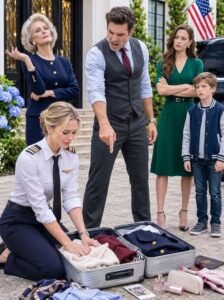
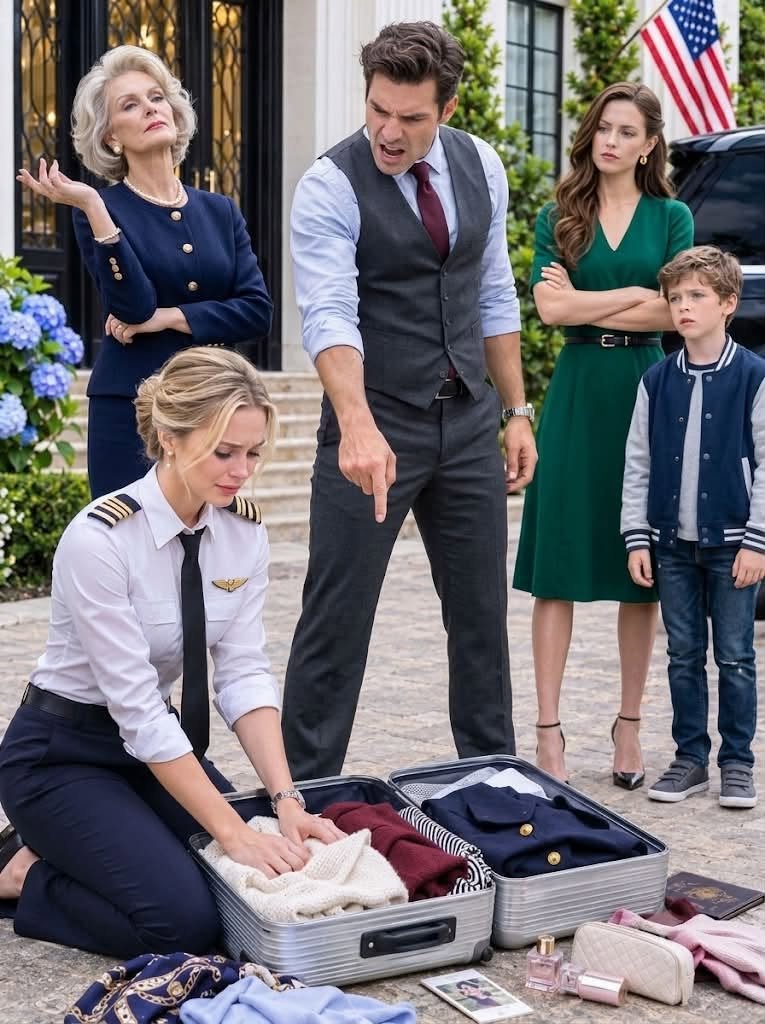
I finished packing, zipped the suitcase, and stood up. Wade was still on the porch, smirking. Aunt Rhonda had her arms crossed, enjoying herself.
“Need a ride to the bus station?” Wade asked.
“No,” I said. “I’ll call someone.”
I didn’t call a cab. I called Judith Marsh.
“They put my things on the lawn,” I told her. My voice was steadier than I expected.
“Where are you standing?” she asked.
“In front of the house.”
“Stay there. I’m ten minutes away, and I’m bringing the documents.” She paused. “Reagan, your father said this might happen. He said, and I’m quoting, ‘If Wade does it on the day of the funeral, don’t let Reagan fight him. Just let him finish.’”
I almost laughed. It was exactly like Dad to plan for an argument so he wouldn’t have to have one.
Judith’s gray sedan pulled up eleven minutes later. She stepped out in a black suit, carrying a leather briefcase, and glanced at the clothes still scattered across the grass.
“Mr. Holloway,” she said to Wade. “I’d like everyone inside, please. The reading of the will will take place today, at your father’s instruction.”
Wade’s smirk flickered. “Today? We just buried him.”
“He was very specific,” said Judith.
Part 4
We sat in my father’s study, the same room where he had once taught me to read a sectional chart. Wade took Dad’s leather chair, which he had never been allowed to sit in while Dad was alive. Aunt Rhonda settled onto the sofa like a woman expecting good news. I stood by the window, still in my uniform, with grass stains on the knees.
Judith opened her briefcase and set a small digital recorder on the desk.
“Your father recorded a statement three months ago,” she said. “He asked that it be played before the documents were read.”
She pressed the button.
My father’s voice filled the room, thin but clear. “If you’re hearing this, I’m gone, and one of my children has already done something I hoped they wouldn’t.”
Wade’s face went still.
“Wade,” Dad’s voice continued. “You’ve worked beside me for twenty years, and I love you. But last spring, I found the second set of books. Four hundred thousand dollars moved out of the company into an account in your name. I gave you six months to put it back. You didn’t.”
Aunt Rhonda turned her head slowly to look at him.
“That’s a lie,” Wade said. “He was confused. He was sick.”
Judith lifted a folder. “Your father’s physician documented his full capacity at the time of the update. I also have the forensic accountant’s report.”
The recording went on. “Reagan, if you’re listening, I owe you more than I can say here. I’ll leave a letter. Judith will give it to you privately.”
The recorder clicked off.
Nobody spoke. The clock above the fireplace ticked loudly.
Part 5
Judith read the terms in a flat, careful voice.
My father had left the family home, the controlling interest in Holloway Woodland Retreats, and the Hocking Hills acreage to me, about $9.5 million in total value before debts and taxes. Wade received a salaried position, if he chose to remain with the company under supervision, and a modest trust payable in installments over ten years. It would be revoked if he contested the will.
Aunt Rhonda received the lake cabin she had always loved and a monthly allowance. She had assumed the house would go to Wade, who had promised her a room.
“This is outrageous,” Wade said, rising from the chair. “She hasn’t worked a day in this company in nine years. She doesn’t know the first thing about running it. She’s a truck driver with wings.”
“Cargo pilot,” I said quietly.
“Same thing.”
“Mr. Holloway,” Judith said, “sit down.”
He didn’t. “You can’t just hand it to her. I’ve given my whole life to that place.”
“You also moved four hundred thousand dollars out of it,” Judith said, and tapped the folder. “Your father chose to give you a second chance instead of calling the authorities. I’d advise you to treat that as the gift it was.”
Wade stared at her. Then he looked at me, and something in his expression changed. It wasn’t anger anymore. It was fear.
“I need to go,” he said hoarsely, and walked out.
Aunt Rhonda stayed in her seat a long moment. Then she looked at my uniform, at the wings pinned over my chest, and said, in a small voice I had never heard from her, “I shouldn’t have laughed.”
“No,” I agreed. “You shouldn’t have.”
She left without another word.
Part 6
Judith waited until the front door closed. Then she handed me a cream envelope with my name on the front in my father’s slanted handwriting.
“I’ll give you some privacy,” she said.
I sat in his chair and opened it.
Reagan,
I was a stubborn man. I knew it, and I let it cost me nine years with my daughter.
When you told me you wanted to fly, I felt like I was losing you to something I didn’t understand. That was my fear, not your fault. I should have said so. Instead, I said “keep flying” and hung up the phone. You deserved better.
I want you to know something. I kept a log. Every flight you ever posted about, every route, every landing. I downloaded one of those flight-tracking apps and watched your little plane move across the map at night. I knew when you flew to Memphis, when you flew to Louisville, when you flew through that storm over Kentucky last March. I stayed up until you landed.
I never told you I was proud because I didn’t know how. I’m telling you now. I am proud of you, Reagan. More than I’ve ever been of anything I built.
I left you the company not because I think you must run it, but because you’re the one who can be trusted with it. You walked away from the easy road and did the hard thing for the right reasons. That is what this place needs. If you want to sell it, sell it. If you want to keep flying, keep flying. I only ask that you do what you think is right.
Your loving father,
Dad
P.S. The cabin at the back of the Hocking Hills property has a flat field behind it, just long enough for a small plane. I had it cleared two years ago. I always hoped you’d land there.
I read it three times. Then I put my head down on his desk and cried the way I hadn’t been able to at the funeral.
Final Part
I did not sell the company.
I kept flying for another year, then cut back to part-time, then handed my cargo route to a younger pilot I had trained. I hired a general manager, a quiet woman named Marian Ellis who had spent twenty years running a state park system, and I spent the first six months learning everything I had refused to learn at nineteen.
I discovered that my father had been right about one thing. The business wasn’t just a business. It was forests, and families, and people who worked sixty-hour weeks in July so strangers could sit on porches and watch the fog roll through the hills. I found that I loved it, in a way I never expected.
Wade stayed on the payroll under supervision. For the first few months, he barely spoke to me. He repaid the missing funds in installments, drawing down the trust Dad had left him, and he did it without being asked twice. One afternoon in October, he knocked on my office door.
“I wanted to say something,” he said, standing awkwardly in the doorway. “I threw your stuff on the lawn because I was scared. Dad found out what I did, and I thought if I got you out of the house, I could get ahead of it. I was wrong, and I’m sorry.”
I studied him for a long time.
“I’m not ready to say it’s fine,” I said.
“I know.”
“But I’m willing to start over, if you’re willing to do it the slow way.”
He nodded, eyes wet. “Slow’s fine.”
It took two years before we could eat dinner at the same table without tension. Aunt Rhonda sent a handwritten apology in the spring and mailed me a jar of her blackberry preserves, which I accepted and ate and did not mention.
On a bright morning in June, I flew a rented single-engine Cessna from Indianapolis to the Hocking Hills. The air was clear and smooth. Below me, the hills rolled out in green and gold, dotted with the roofs of our cabins and the thin silver thread of a creek.
I lined up on the grass strip behind the old cabin, the one my father had cleared with a bulldozer and a hope. The wheels touched down gently and rolled to a stop in the long grass.
I cut the engine and sat there in the silence, listening to the ticking of the cooling metal.
Then I climbed out, walked to the porch, and sat on the top step. In my jacket pocket was my father’s letter, soft now from handling. I didn’t need to read it again. I knew every word.
The wind moved through the trees, and for the first time in nine years, I felt that the distance between us had finally closed.
“I landed, Dad,” I said softly.
The leaves rustled, and the afternoon went on.
THE END