Part 1
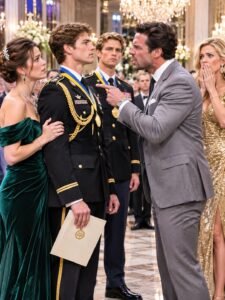
My name is Marianne Tate, and I hadn’t stood face-to-face with Stuart in thirteen years.
Then I spotted him at the registration counter.
Simone was standing beside him, looking perfectly calm, while their son wore a blazer from an expensive private school.
Stuart noticed me.
“Marianne?”
For a moment, he seemed genuinely stunned.
Then his expression turned cold.
“What are you doing here?”
Simone moved closer, wearing a faint smile.
“This is a private event.”
“It’s a state competition,” I replied. “That’s literally what it’s called.”
Stuart leaned toward me and lowered his voice.
“How dare you come here today?”
Several people standing nearby heard his words.
What he failed to notice were the two seventeen-year-old boys just a few feet behind me.
Or perhaps he did see them but simply had no idea who they were.
The last photograph Stuart had ever seen of our twins was taken during their christening.
“I’m here for my children,” I told him.
He laughed.
“Your children?”
His gaze swept over the boys, but there was no sign of recognition.
“This weekend is important to our son.”
“It’s important to mine as well.”
I chose not to continue arguing.
Thirteen years of birthdays, medical appointments, science fairs, school performances, homework sessions that stretched late into the night, and simple family dinners separated us.
“Come on, boys,” I said. “Registration closes in ten minutes.”
As we walked away, one of my sons leaned toward me and whispered, “Mom, that was him, wasn’t it?”
“Yes.”
“Our dad?”
“Yes.”
Neither of them spoke again.
I assumed they were still trying to process what had happened.
I was mistaken.
At four o’clock, the awards ceremony got underway.
When the announcer reached the applied mathematics category, my eldest son’s name rang out across the auditorium.
Gold medal.
I had barely caught my breath when they announced the winner of the physical sciences category.
My other son had won gold as well.
Then came another announcement.
He had achieved the highest raw score of any student in the entire state.
Two brothers.
Two gold medals.
The same surname.
I turned toward Stuart.
He was sitting several rows behind me.
I watched the realization slowly dawn on him.
First, he heard the name Tate announced twice.
Then he watched both boys stand up together.
Finally, my second son walked onto the stage and smiled in my direction.
His face was identical to Stuart’s.
The same eyes.
The same jawline.
The same expression.
A man sitting nearby leaned toward his wife.
“Who are those boys?”
She glanced down at the program.
“The Tate twins. Their mother raised them by herself.”
Then she added, loudly enough for everyone in our section to hear, “Honestly, she deserves an award of her own.”
Stuart heard every word.
His expression shifted.
That morning, he had walked right past his own sons without recognizing either of them.
Now the boys he had forgotten were standing among the top students in the state.
One of them had just earned a higher score than every other student in the room, including the boy Stuart had actually come there to support.
Then my son stepped down from the stage.
But rather than coming toward me, he turned around.
He walked directly toward Stuart.
Stuart slowly rose to his feet.
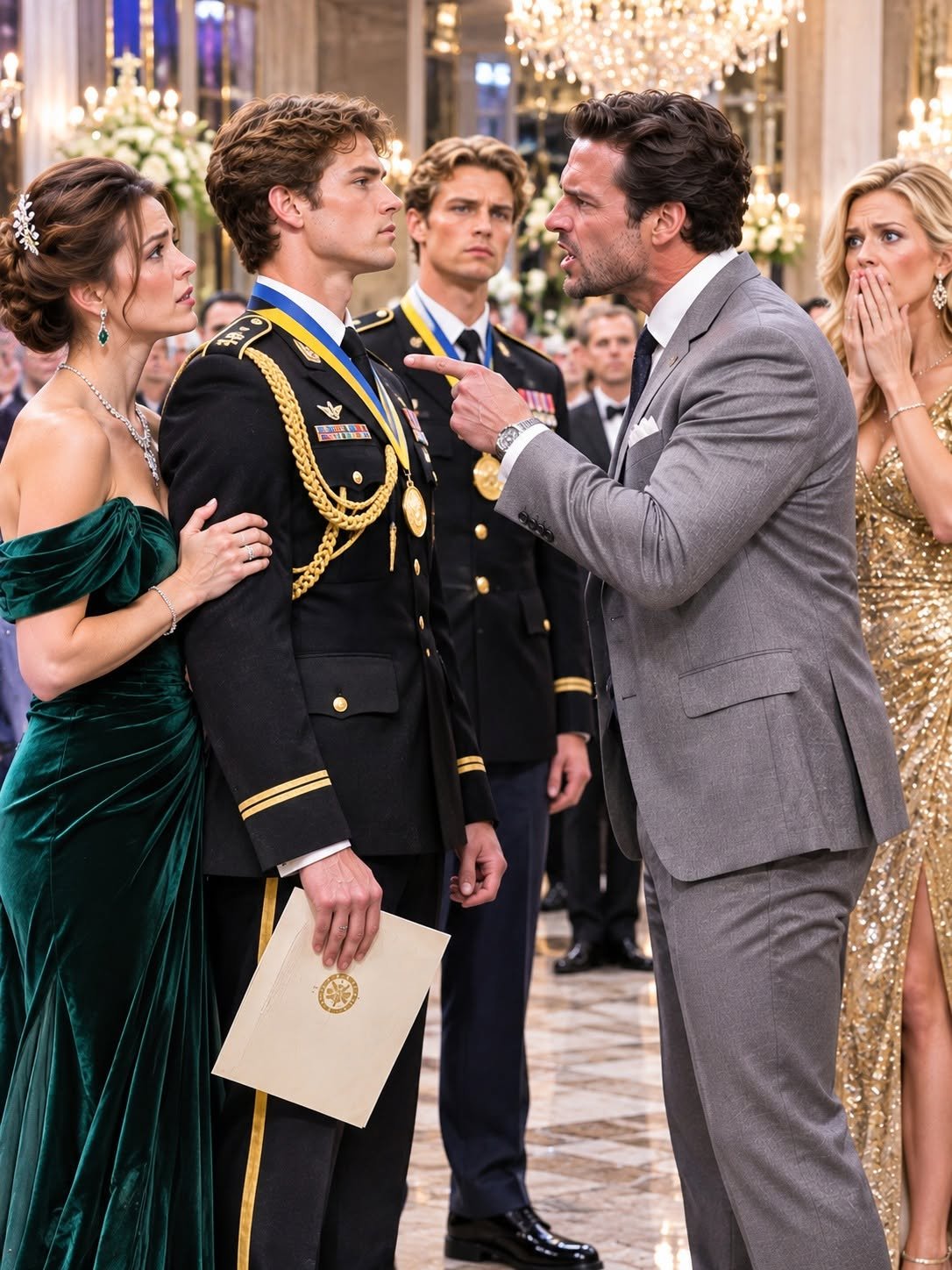
My son stopped in front of him, his gold medal still hanging around his neck.
Then he reached into his jacket and took out an envelope.
“Dad,” he said softly, “my brother and I have been waiting thirteen years to give you this.”
Part 2: The Envelope He Was Never Meant to Read
Stuart stared at the packet in Miles’s hand as if it were a fragile bomb that might detonate if he reached out to touch it. The vast hall was clearing out around us, but the lingering murmur of excited families still echoed through the rafters.
Parents were helping their teenagers fold up presentation boards near the exit doors. Teachers were shaking hands and exchanging congratulations across the aisles, yet Stuart seemed completely deaf to the surrounding noise.
His entire world had narrowed down to the thick cream paper held out by the son he had abandoned.
“Take it,” Miles said evenly. “It won’t hurt you.”
Stuart’s hand shook as he accepted it.
Callum had come up beside his brother, medal swinging against his chest. They stood shoulder to shoulder, the same height, the same stance, and the resemblance to the man in front of them was so plain that Simone, who had followed Stuart down the aisle, drew a sharp breath.
“Open it,” Callum said. “Not later. Here.”
Stuart slid a finger under the flap.
Inside were three things.
The first was a photograph of a hospital bracelet, tiny and faded, with two names printed on it.
The second was a letter on plain white paper.
The third was a folded legal document with a county seal.
Stuart read the letter first. I knew what it said, because the boys had written it at my kitchen table the night before, and I had not been allowed to change a word.
Dear Stuart,
You don’t know us, so we’ll introduce ourselves. I’m Callum. He’s Miles. We were born eleven weeks early, and you were there for the first four days. Mom says you held us once each, and then you stopped coming to the hospital.
We aren’t writing to make you feel guilty. We worked on this for a long time, and the first draft was angry. This one isn’t. We just want you to know a few true things.
When I was six, I broke my arm falling off a swing. Mom drove me to the ER with Miles screaming in the backseat. When Miles was nine, he got the lead in the school play and threw up from nerves, and Mom stayed up until two with him, running his lines. When we were twelve, the car died and she walked three miles to work for a month because she wouldn’t ask anyone for help.
She never told us you were a bad man. She only said you weren’t ready, and that the door wasn’t locked from her side. We’ve thought about that a lot.
We got into the state competition by ourselves. Nobody paid for tutors. We studied at the public library and at the kitchen table.
You don’t owe us anything now. We don’t want money. That’s what the other paper is for.
Stuart’s voice, when it came, was a croak. “What other paper?”
“Read it,” said Miles.
He unfolded the legal document and stared at it.
It was a notice of withdrawal. For years, a county court order had required Stuart to pay child support. He had ignored it, moved states, and changed jobs. The arrears, with interest, came to more than ninety thousand dollars. I had never pursued it aggressively, because chasing him had always felt like feeding something that didn’t deserve my attention.
But when the boys turned seventeen, they asked to see the file. They read every page. Then, together, they asked me to have the case closed.
Stuart looked up. “You’re forgiving the debt?”
“We’re closing the file,” Callum said. “It’s not the same thing.”
“Why?”
Miles tilted his head, and for an unsettling second he looked exactly like the man he was speaking to.
“Because we don’t want to spend our lives waiting for you to pay us back,” he said. “We’d rather spend them doing something else.”
Stuart opened his mouth. Nothing came out.
Part 3
Simone found her voice first.
“Stuart.” She was staring at the boys, and her face had gone gray. “You told me you had one child. You told me the first marriage ended without any children.”
“I…” He turned to her. “I thought it would be easier.”
“Easier for who?”
He didn’t answer. Behind her, her son Preston, a thin, serious boy of sixteen with his father’s coloring but none of his smugness, stood holding his own participant ribbon. He looked at Callum and Miles, then at the envelope, then at the man he had called Dad his whole life.
“Are they my brothers?” Preston asked.
Nobody spoke.
“Are they?” he said again, his voice breaking.
“Yes,” Stuart whispered.
Preston absorbed this with a stillness that made me ache for him. Then he turned to my sons.
“I’m sorry,” he said. “I didn’t know. If I had, I’d have said something.”
I watched Miles’s face soften.