Part 1
“Mommy… there’s no more water in the toilet… and Silas won’t wake up.”
The coffee mug slipped from my fingers and crashed onto the hardwood floor, scattering broken pieces across the kitchen. I barely registered the sound because my daughter’s frightened, exhausted voice had already sent a wave of terror through me.
I couldn’t remember picking up my car keys or putting on my shoes. Within moments, I was behind the wheel, racing toward Russell’s apartment with only one thought repeating in my mind: something was terribly wrong with my children.
I drove through Chicago in a panic, passing two red lights and repeatedly pressing the horn as I tried to get through traffic. Every passing second felt unbearable, and I kept replaying Piper’s words, desperately hoping I had misunderstood what she meant.
Using the car’s Bluetooth system, I called Russell again and again. Each attempt went straight to the same recorded voicemail greeting, delivered in his familiar, composed voice.
“I’m currently out of town on business…”
I couldn’t understand why my eight-year-old daughter would be trying to get drinking water from a toilet. Even more frightening was her statement that Silas wouldn’t wake up, especially when I remembered how faint and weak she had sounded during our brief conversation.
Russell was supposed to be responsible for the children while I was away, yet he wasn’t answering his phone. The possibility that Piper had been left alone with her infant brothers made my hands tighten around the steering wheel as I hurried toward the apartment.
When I finally reached Russell’s luxury apartment building, I abandoned my car outside and rushed through the entrance. Rather than waste precious time waiting for the elevator, I ran up four flights of stairs, barely noticing how hard I was breathing.
I reached Unit 4B and immediately tried the electronic keypad, but the screen remained completely dark. When I placed my hand against the apartment door, I was startled by how unusually warm its surface felt.
I entered the access code several times, but nothing happened. The keypad wouldn’t respond, and the door remained firmly locked despite my increasingly desperate attempts to open it.
“Piper! Sweetheart, can you hear me? It’s Mommy!”
There was no immediate answer, and the silence made my fear even worse. I looked around the hallway, searching for anything that might help me get inside before it was too late.
Then I spotted an emergency cabinet containing a fire extinguisher. I broke the protective glass, pulled out the heavy metal cylinder, and hurried back to the apartment entrance.
I struck the locking mechanism repeatedly, putting all my strength into each blow. After several attempts, the damaged lock finally gave way, allowing me to force the door open and rush inside.
A wave of oppressive heat hit me the moment I entered. The apartment was almost completely dark because the automated blackout blinds covered every window, preventing sunlight from reaching the rooms.
Nothing appeared to be functioning. The lights were off, the refrigerator had stopped running, and the air-conditioning system was silent, leaving the entire apartment feeling unbearably hot and airless.
“Piper! Where are you, honey? Answer me!”
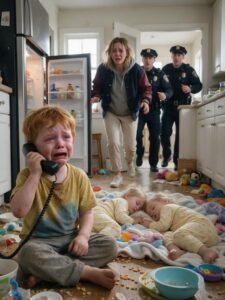
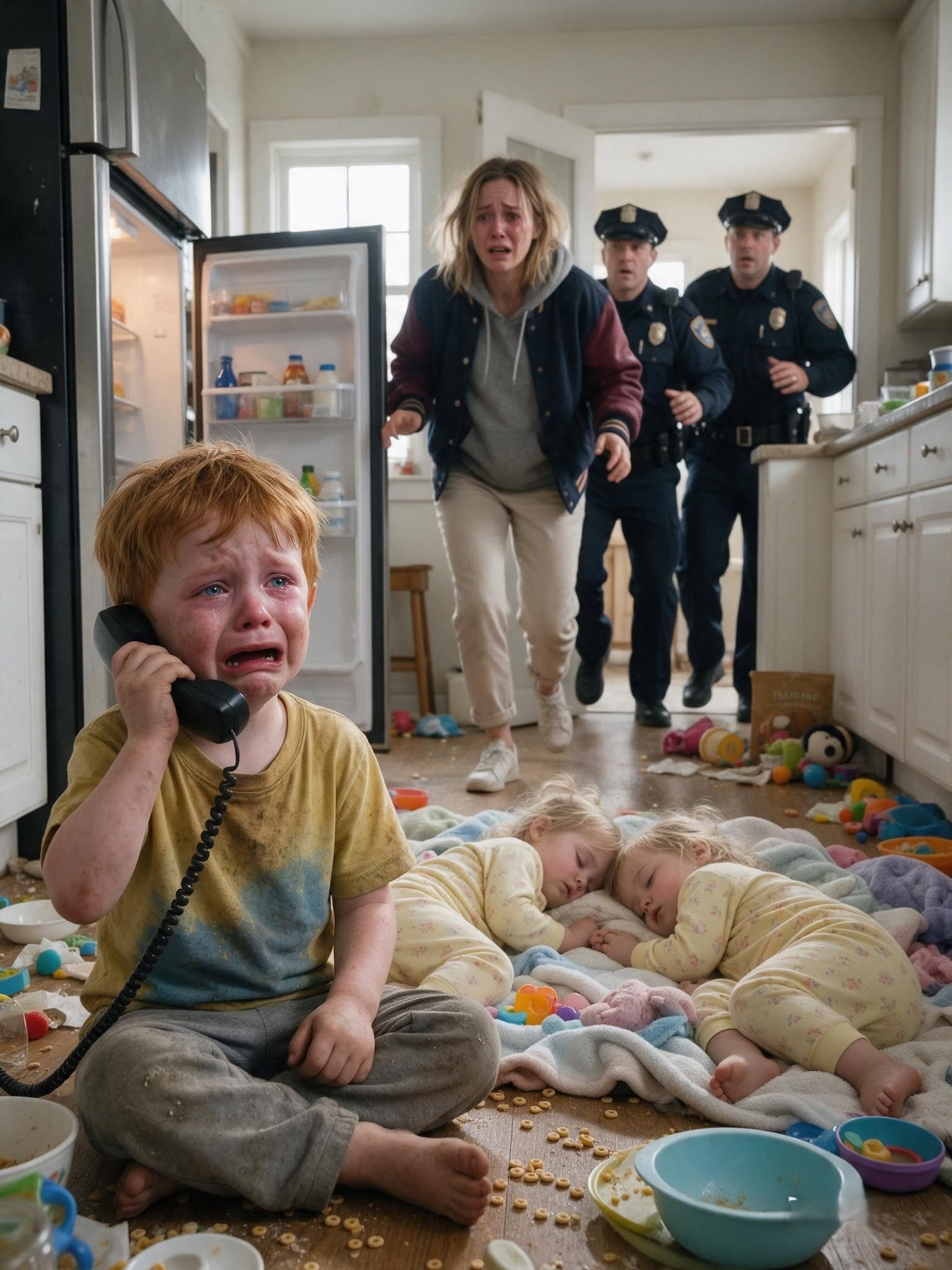
A faint movement near the kitchen island caught my attention. My daughter slowly stepped into view, clutching a dirty plastic cup with both hands as though she barely had the strength to hold it.
Her lips were severely dry, and her face looked pale and exhausted. She seemed unsteady on her feet, and the condition she was in told me that she had been struggling alone for much longer than I could bear to imagine.
“I tried, Mommy…” she whispered. “But the fridge stopped working, and all the milk went bad.”
My heart sank as I realized she had been trying to care for her baby brothers without electricity, refrigeration, or a reliable source of drinking water. I wanted to pull her into my arms, but I knew I had to find the twins immediately.
I rushed into the living room and found my two infant sons lying motionless inside their playpen. Neither responded when I called to them, and the sight of their still bodies sent a cold wave of fear through me.
I checked them as quickly as I could, relying on the instincts and training I had developed during my years as an intensive care nurse. Their pulses were frighteningly weak, and I immediately recognized that they needed emergency medical treatment.
There was no time to search the apartment for supplies or try to understand what had happened. I carefully gathered both babies into my arms and turned toward Piper, forcing myself to speak as calmly as possible.
“Piper, sweetheart, grab onto my shirt and stay right next to me. Whatever happens, don’t let go.”
She nodded weakly and clutched the fabric of my shirt as we hurried toward the damaged doorway. I kept the twins close against me, terrified by how little they were responding as we made our way into the hallway.
“Somebody help us!” I shouted. “Please call an ambulance! My babies need medical attention!”
My voice echoed through the corridor as I desperately called for assistance. While trying to monitor the twins and keep Piper beside me, I felt my phone vibrate with an incoming notification.
I glanced at the screen, expecting a message from the emergency services or perhaps a response from Russell. Instead, I saw an automated notice from the electric company concerning Unit 4B.
Power service terminated at Unit 4B on Friday at 6:00 PM, per customer request.
For a moment, I could barely comprehend what I was reading. The message indicated that the electricity hadn’t simply failed because of an unexpected outage or a technical problem.
Someone had requested that the service be disconnected, and the notice identified the exact time it had happened. My thoughts immediately turned to Russell, who controlled the apartment and knew how dependent its automated systems were on electricity.
I looked back toward the dark rooms, remembering the unresponsive keypad, the sealed windows, and the oppressive heat. If Russell had arranged the disconnection, then he had left our children inside an apartment where the most essential systems could no longer function.
The possibility was almost too horrifying to consider, but I couldn’t allow myself to become distracted while the twins were still in danger. I focused on getting all three children to safety, knowing that I would demand answers once they were receiving medical care.
At the hospital, the emergency team immediately took the twins for treatment. Doctors and nurses worked urgently to stabilize them while I remained nearby, terrified that the damage caused by their ordeal might be more serious than anyone could yet determine.
I was desperate to stay close to all three children, especially after seeing how exhausted Piper had become. Every time I looked toward the treatment area, I felt the same overwhelming fear that I might have reached the apartment too late.
I was still struggling to process everything when Detective Brennan entered the trauma department. His expression was unusually serious, and the moment he approached me, I sensed that he had discovered something important.
“Joanna, we’ve managed to locate your ex-husband’s phone. But there’s something you need to understand. Russell isn’t out of town on a business trip.”
I stared at him, unable to make sense of what he was telling me. Russell’s voicemail had repeatedly claimed that he was away, and I couldn’t understand why he would lie about his whereabouts while our children were facing a medical emergency.
“Then where is he?”
Detective Brennan hesitated, glancing briefly toward the treatment rooms before returning his attention to me. His expression grew even more troubled, making me fear that the answer would be worse than anything I had imagined.
“He’s staying at a hotel just three blocks from the apartment, Joanna… and I need you to come with me immediately.”
Part 2
Walking away from my children’s hospital rooms felt almost impossible. Every instinct I had as a mother urged me to stay beside them, but when I turned toward Dr. Okonkwo, the attending physician, the determination in his eyes reassured me that he understood how much their safety mattered.
“Go, Joanna. Your children are safe here, and I won’t allow anyone unauthorized through these doors. Find Russell and make sure he faces the consequences of what he’s done.”
I reluctantly followed Detective Brennan outside and climbed into the back of his unmarked police cruiser. As we drove through Chicago, the illuminated streets passed beyond the windows, but my thoughts remained fixed on the dark, overheated apartment where I had discovered my children.
The panic that had consumed me earlier was slowly transforming into a cold, overwhelming anger. I couldn’t stop picturing Piper’s exhausted face, the twins lying unresponsive in their playpen, and Russell’s repeated assurances that he was away on a business trip.
Detective Brennan opened a rugged Panasonic laptop positioned on the center console and began reviewing the evidence investigators had collected. After studying several financial and utility records, he turned toward me with a grave expression that immediately made my stomach tighten.
“Joanna, we’ve examined Russell’s financial records and the electricity account for Unit 4B. What happened in that apartment wasn’t an accident, and the power wasn’t disconnected because he forgot to pay a bill.”
I stared at him, struggling to understand what he was implying. Until that moment, I had believed Russell’s irresponsibility had allowed a terrible situation to develop, but the detective’s tone suggested that investigators had uncovered evidence of something far more deliberate.
He handed me a small earpiece and explained that the police had obtained a recording of Russell’s telephone conversation with the electric company’s customer service department. The call had been made the previous Thursday, shortly before the apartment’s electricity was shut off.
“Listen carefully, Joanna. We need you to hear exactly what Russell requested.”
I placed the earpiece against my ear and waited as the recording began with an automated greeting. A customer service representative answered, and moments later, Russell’s familiar voice came through, sounding so relaxed and confident that I felt a chill run through me.
“Hello, I’d like to have the electricity service at Unit 4B terminated immediately. There’s no need for a forwarding address because the apartment will be vacant for the next week.”
The representative apparently asked him to confirm that he understood how disconnecting the electricity would affect the apartment’s automated systems. Russell answered without the slightest hesitation, speaking as casually as though he were arranging a routine household service.
“Yes, I’m aware of how the smart locks function when the power goes out. Please proceed with the disconnection today at six o’clock this evening.”
I sat motionless, struggling to comprehend what I had just heard. Russell knew exactly how heavily his expensive apartment depended on electricity, and he had specifically acknowledged the consequences before instructing the company to disconnect it.
Nearly every essential feature inside the apartment was connected to an integrated smart-home system. The electronic door locks, motorized blackout blinds, intercom, ventilation, and temperature controls all relied on electricity to function properly.
When the power was disconnected, the electronic locking system automatically engaged a mechanical security mechanism that prevented the doors from being opened through their normal controls. The automated blackout blinds remained fixed in their closed position, while the ventilation and communication systems stopped operating.
That meant my eight-year-old daughter had been left inside an increasingly hot, dark apartment with her two infant brothers and no practical way to escape. Piper was far too young to override the security mechanisms, and she had no way of restoring the utilities herself.
I remembered arriving at Unit 4B and finding the electronic keypad completely unresponsive. I also remembered how much force it had taken to break through the apartment’s locking mechanism before I could finally reach my children.
Until that moment, I had assumed Russell’s negligence had created a dangerous emergency. Now, after hearing him calmly authorize the disconnection, I was beginning to understand that the circumstances might have been intentionally created.
“He knew what would happen,” I whispered, barely recognizing my own voice. “Russell knew exactly what would happen when the electricity was turned off.”
Detective Brennan remained silent, giving me time to process the implications of the recording. I looked toward him, desperately hoping he would tell me that I had misunderstood something.
“He knew Piper wouldn’t be able to unlock the doors. He knew the blackout blinds would stay closed, and he knew the apartment’s essential systems would stop working.”
The detective’s expression remained serious, and his silence made the truth even harder to ignore. The electricity hadn’t been disconnected because of an overdue bill, and the automated security system hadn’t simply malfunctioned without warning.
Russell had personally requested that the power be shut off, even confirming that he understood the consequences. Worse, he had told the utility company that the apartment would remain empty for an entire week, despite knowing that our three children were still inside.
I felt sick as I thought about what that meant for Piper and the twins. They had been completely dependent on the very systems their father had deliberately arranged to disable, with no adult present to help them when those systems stopped functioning.
“He trapped them in there on purpose,” I said, struggling to keep my voice steady. “He knew our daughter couldn’t get out, and he went ahead with it anyway.”
The realization became even more horrifying when I remembered that Russell had been staying at a hotel only three blocks away. He had been close enough to return to the apartment within minutes, yet Piper had spent days desperately trying to care for her younger brothers.
While our daughter struggled to find drinking water and keep the twins safe, Russell had remained nearby without coming to their rescue. The thought that he could have intervened at any moment made his actions seem even more incomprehensible.
I turned toward Detective Brennan, desperate to understand why Russell would knowingly place our children in such danger. My anger was now accompanied by a terrifying suspicion that the electricity disconnection had been only one part of something he had carefully planned.
If Russell had understood exactly what would happen when the apartment lost power, then I needed to know why he had wanted those conditions in the first place. I looked at the detective, struggling to finish the thought that had begun forming in my mind.
“He shut everything down and left our children trapped inside, just so he could…”
Part 3
“…just so he could win.”
Detective Brennan said it quietly, finishing the sentence I couldn’t. “That’s what the evidence says, Joanna. We think this was about custody.”
I stared at him. The custody hearing was in nine days. Russell had been furious when the judge refused to give him primary custody, and more furious when she ordered him to prove he could handle the children alone during my three-day nursing certification course in Milwaukee. It was supposed to be a test. He had smiled at me in the courthouse hallway and said, “You’ll see how well I do.”
“He wanted me to find them,” I said slowly.
“We believe so.” Brennan turned the laptop toward me. “Hotel security cooperated. Russell’s room is on the sixth floor, and the screen on his desk was still open to a camera app linked to the apartment. The cameras ran on battery backup for about eighteen hours. He watched until they died.”
I couldn’t breathe.
“His plan, as far as we can reconstruct it,” Brennan said, “was that Piper would call you. She has your number memorized, and he knew it. You’d panic, break into his apartment, and be photographed in the wreckage. Then he’d arrive with his lawyer and say you’d violated the parenting order, damaged his property, and put the children at risk by not calling 911 first.”
“He would have turned my rescue into evidence,” I whispered.
“He miscalculated. He thought the children would last a day. The heat, the dead refrigerator, and the days that passed turned it into something he never planned for. And once it got worse, he couldn’t come forward without destroying himself.”
I thought of Piper holding a dirty cup with both hands, and my vision went white at the edges.
Part 4
The hotel was a glass tower with a revolving door. Two uniformed officers met us in the lobby, and the night manager walked us to the elevator without a word.
I wasn’t supposed to go up. Brennan told me three times to wait in the lobby. But when the doors opened on the sixth floor, I saw Russell at the end of the hallway in a pressed shirt, a leather folder under his arm, talking calmly to a man in an expensive suit. His lawyer. They were heading for the elevator.
He saw me and stopped.
“Joanna,” he said, and he actually smiled. “What are you doing here? This is an inappropriate—”
“Where are our children, Russell?”
“They’re with the sitter. I arranged—”
“Mr. Hale.” Brennan stepped between us, badge in hand. “You’re under arrest for child endangerment and unlawful restraint of minors. You have the right to remain silent.”
The smile didn’t vanish. It slid away, as if someone had pulled a thread. His lawyer took one step backward, then another, and I understood in that instant he had never been told the truth.
“I want to speak to counsel,” Russell said hoarsely.
“He’s already stepping away from you,” said Brennan.
Russell looked at me, and for the first time in four years there was no performance in his face. I saw only fear, and under the fear, something worse: confusion, as though he truly couldn’t understand why I wasn’t grateful it had worked out.
“They were supposed to be fine,” he said. “Piper’s eight. She’s smart. I only needed a day.”
“Silas is eleven months old,” I said.
He had no answer.
The officers cuffed him in front of the elevator, in the soft hotel carpet quiet, and walked him out.
Part 5
The twins stayed in the pediatric ICU for four days.
Silas had it worse. He and his brother Theo had been severely dehydrated, with dangerously high sodium levels and heat exhaustion. Dr. Okonkwo explained it to me in the plainest words he could find, the way you do when you know a mother is holding on by a thread.
“We caught it in time,” he said. “Another twelve hours would have been a different conversation. But they’re stabilizing, and their kidneys are responding. Children that age are tougher than they look.”
I sat between the two cribs for ninety-six hours. I changed no diapers. I did nothing the nurses couldn’t do better. I just held a small hand in each of mine and counted breaths.
On the fifth morning, Silas opened his eyes, looked straight at me, and screamed for his bottle.
I laughed and cried until a nurse had to bring me tissues.
Piper had been admitted for observation and fluids. She slept for twenty hours straight. When she woke up, she looked at me with enormous, serious eyes.
“Mommy, I didn’t open the door,” she said. “Daddy said never to open the door to strangers.”
“I know, baby.”
“I tried to make the boys drink the water from the tub, but I was scared it was dirty.” Her voice wobbled. “Did I do it wrong?”
I climbed into the hospital bed beside her and held her face in both hands.
“You did everything right. You called me. You stayed with your brothers. You kept them together. You were the bravest person in that apartment.”
“I was scared the whole time.”
“That’s what brave means,” I said.
Part 6
The case moved quickly. The hotel footage, the utility recording, the battery-backed camera logs, and Russell’s own emails to his lawyer told the same story. A forensic accountant found that he had drafted the emergency custody petition two days before the power was cut, with blanks left only for “the date of discovery.”
The prosecutor, a calm woman named Ms. Delaney, offered Russell a plea. He refused it for six weeks, still certain he could talk his way out. Then his lawyer withdrew, and he took the deal.
He was sentenced to eleven years for felony child endangerment and unlawful restraint of minors. He lost all parental rights. The judge who had refused him custody months earlier read the order aloud herself.
“Mr. Hale,” she said, “you told this court you could handle your children alone. In my twenty-six years on this bench, I have rarely heard a statement more thoroughly disproven.”
Russell didn’t look at me when they led him out. I didn’t look at him either. I had spent too many nights looking at his face for answers that were never there.
Final Part
We moved in March.
Not far, only twenty minutes north, to a small brick house with a creaky porch and a maple tree in front. It had a kitchen window where I could see the backyard, a basement for the twins’ toys, and old-fashioned doorknobs with actual keys. No smart locks. No blackout blinds. I checked every window twice before we signed.
Silas and Theo grew fast. By summer they were crawling after the cat. By fall they were pulling themselves up on the coffee table and shrieking with triumph.
Piper went to therapy every Thursday with a gentle counselor named Dr. Marsh, who kept a jar of buttons and let her sort them by color. For the first few months, Piper wouldn’t sleep unless the hall light was on. She woke up screaming twice. She asked, again and again, whether the power might go out.
I bought her a lantern shaped like a moon. I showed her where it was, and where the flashlights were, and where the spare batteries lived. I taught her how to call 911 and then how to call me, and then how to call my sister, in that order, and I made her promise she’d never have to feel responsible for anyone’s life again.
“But I was good at it,” she said one night, in a very small voice.
“You were too good at it,” I said. “A kid shouldn’t have to be.”
On the first anniversary, we drove to the lake. The twins squealed in the sand and tried to eat it. Piper built a lopsided castle and stood guard over it like a queen. I sat on a blanket with a thermos of coffee and watched all three of them.
Piper came over after a while and flopped beside me, brushing sand off her knees.
“Mommy?”
“Yes?”
“I think I’m not scared of the dark anymore.”
I put my arm around her.
“Are you sure?”
She thought about it seriously, the way she thinks about everything now.
“Mostly,” she said. “But if I get scared, I’ll just tell you.”
“That’s exactly the right plan.”
She leaned into me. Out on the water, a sailboat leaned with the wind.
A year earlier, a coffee mug had shattered on my kitchen floor and I had run to a door that wouldn’t open. I had broken glass and metal and every rule of ordinary life to get through it. I would have broken a hundred more.
I never needed to ask what a mother is capable of. I only needed to hear one frightened little voice say Mommy, and I knew.
THE END