His last infusion landed on a Saturday.
The clinic runs a weekend schedule for maintenance patients, and ours had shifted to Saturdays back in the winter, which is how the biggest morning of my son’s life ended up sharing a calendar with my sister’s housewarming.
He woke up before me. When I came out of the little foldout chair I had slept in more nights than I could count, he was already dressed, sitting on the edge of the bed with the sign in his lap, tracing the letters with his finger like he was checking them for spelling.
The sign said, “I beat it. Grandma, are you coming?”
Blue marker, crooked capitals, a gold star sticker in the corner that he’d peeled off a reward chart from month three. He’d made it the night before while I pretended to read.
He didn’t ask me how to spell beat. He asked me how to spell coming. And I should have heard something in that, but I didn’t. I just spelled it for him.
Here is the thing you have to understand about my son. He is quiet. He draws instead of talks.
When the nurses asked him how his pain was on a scale of 1 to 10, he’d draw a little face instead of saying a number because a number felt like complaining, and he didn’t like to complain.
For 11 months, he had been the least dramatic person in every room he entered, including rooms full of adults. And this boy, who never asked for anything, had written a sign asking his grandmother a question.
“Can I do it twice?” he asked the nurse when she uncoiled the cord and put it in his hand.
“You can do it as many times as you want, buddy,” she said.
He rang it once hard, and the sound went down the whole hallway. Then he looked at me to make sure I’d seen and rang it again, softer, like the second one was just for us.
The nurses clapped. A dad from another bay clapped. A woman I’d never met cried a little, the way you

do in that place for a kid who isn’t yours.
My mother was not there. My father was not there.
In 11 months, neither of them had walked through those doors a single time. I had stopped expecting them to, but Ethan hadn’t.
He carried the sign out to the car like it was made of glass.
We got home a little afternoon. I made him grilled cheese because that was the one thing that had never made him sick during treatment.
And while it was in the pan, he stood next to me holding his phone and holding the sign, and he said, “Send it now, Mom. Before she leaves the party.”
He knew about the party. Everyone knew about the party.
My sister [snorts] Heather had bought a house out in Dublin, about 22 miles and 35 minutes from our apartment, and the housewarming had been on the family calendar for weeks. An afternoon open house that rolled into a dinner for the close circle.
My parents had been talking about it the way they used to talk about things Heather did, which is to say like it was history being made.
I had known for weeks that the two events might land on the same day. I had told myself it didn’t matter.
He’d ring the bell in the morning. They could celebrate Heather in the evening. There was room in one Saturday for both.
So, a little after 1:00 in the afternoon, I took a photo of my son holding his sign in our kitchen, the gold
star catching the light, and I sent it to the family chat.
I even wrote something soft under it. “He did it. Last one. He wants to know if you’re coming.”
Three dots appeared. Then they disappeared. Then they appeared again.
I want to be honest about what I hoped for because I think the hope is the part that people skip when they tell these stories, and the hope is the part that hurts.
I hoped my mother would call, not text. Call.
I hoped she’d put Ethan on speaker in front of the party and let a room full of people hear a 9-year-old say he beat cancer. I hoped for about 90 seconds, standing at my own stove, that this would be the thing
that finally cracked her open.
Then the reply came.
“Stop guilting us. We’re at your sister’s housewarming. Not everything is about your child’s drama.”
I read it twice. I read it a third time to see if there was a word I’d missed that would change it, and there wasn’t.
My son’s cancer. His 11 months. His bald head and his foldout chair knights and his little sign. That was your child’s drama.
That was a thing I was doing at her on purpose to guilt her.
Then my father added his line under hers because he always added a line under hers.
“He’s [snorts] alive. That’s already more than some kids get. What more do you want from us?”

I have thought about that sentence more than any other sentence in my life.
I know now that my father wasn’t being cruel the way you’d picture cruelty. He wasn’t sneering. He was doing the thing he’d done for 40 years, which was to reach for whatever phrase would end the
conversation fastest and make my mother’s answer sound reasonable.
He’s alive. Be grateful. Stop asking.
It’s the kind of thing people say when they stopped actually looking at you a long time ago and started
managing you instead.
But subtext doesn’t reach a child through a phone screen. Only the words do.
Ethan was still standing next to me with the sign. He couldn’t see the screen, but he could see my face.
And he had spent 11 months learning to read faces because when you’re sick, everyone tells you you’re fine, and you learn to check whether their face agrees.
“Well,” he said, “is she coming?”
I typed one word into the family chat.
“Understood.”
Then I put the phone face down on the counter, and I crouched down to his level. And I lied to my son to protect him for one more night.
“She’s got her thing tonight, bud. But you and me, we’re going to do something better. I promise.”
He nodded. He looked at the sign. Then he set it on the kitchen table. Careful, gold star up.
And then he turned away a little too fast and went to wash his hands for lunch, which is what a child does when he has decided to be okay so that his mother doesn’t have to worry about him being not
okay.
That was the moment, not the messages. That my son turning away too fast so I wouldn’t see his face.
That night, I thought that was the end of it. It wasn’t.
To understand why one word, understood, was the loudest thing I’d said to my family in years, you have to understand who I’d been to them before that.
I was the strong one. That was my job from the beginning, assigned to me the way some kids get assigned the dishes.
Heather was 5 years younger, and she was the one who felt things deeply. And I was the one who was so
mature for her age.
And both of those phrases meant the same thing in our house. Heather’s needs came first, and mine
could wait because I was strong enough to wait.
I have a memory from when I was 17. My high school graduation got scheduled, and it overlapped with a regional dance competition Heather had qualified for, and there was never actually a discussion about
which one my parents would attend.
There was just my mother saying, “You’ll be fine, Betty. You always are. Heather needs us there. You know how she gets.”
And I was fine. I drove myself. I have exactly one photo from my own graduation, and a stranger’s mom took it.
I could give you 20 of those. I won’t because they all resolve the same way. And one is enough to show
you the shape of the thing.
The shape was this. Love in our family was a limited resource, and it flowed toward Heather, and my role was to not need any so there’d be more for her.

I got good at it. I got so good at it that I mistook it for a personality.
So when I grew up and had Ethan, and when my marriage to his father Neil ended in 2021, quietly, no villains, just two tired people, I did the thing I’d been trained to do.
I kept the peace. I made myself easy.
I told myself that if I never made a scene, if I never forced my mother to choose between me and Heather, then my son would get to have grandparents.
That was the bargain I made privately without telling anyone, least of all them. I would absorb whatever I had to absorb.
And in exchange, Ethan would grow up in a family. He’d have a grandma. He’d have somewhere to go on
holidays that wasn’t just our small apartment. And me.
I want to be clear that this was not weakness, even though it looks like weakness from the outside. It was a mother doing math.
I had done the math and decided that my dignity was a fair price for my son’s sense of belonging. I would pay it and not tell him the price.
Then he got sick, and I found out what I had actually been buying.
He was diagnosed in May of last year. Non-hodgekin lymphoma.
I’m not going to walk you through the medicine because the medicine isn’t the story and because my
son is a person, not a diagnosis.
What matters for the story is the shape of that year. And the shape was this. It was me.
It was me at the hospital and me at my job. I work as a certified nursing assistant at a place called Maple Grove Care Center, which means I spend my days helping other people’s parents to the bathroom and
remembering how they like their coffee.
And then I’d clock out and drive to Riverside and spend my nights in a chair the color of an old bruise, learning to sleep sitting up.
My parents were 40 minutes away the whole time.
My mother’s reasons for not coming arrived like a subscription.
“I just can’t see him like that, honey.”
“It’s my blood pressure.”
“You know, hospitals and me.”
“The doctors said too many visitors, didn’t they?”
They hadn’t. I stopped correcting her.
My father said even less. He’d send a thumbs up on a photo now and then the way you acknowledge a coworker’s vacation pictures.
There was one night in the fall, a bad one, a fever that spiked at 2:00 in the morning. A scramble of nurses, a look on my son’s face that I don’t like to remember.
Once it had passed and he was propped up and shaky, he asked me if he could call grandma. Not me, her.
It was 3:00 in the morning, so I told him we’d call in the daylight.
And in the daylight, I texted her that he’d had a rough night and wanted to hear her voice. She didn’t call.

She sent a voice message. 20 seconds, bright as a greeting card.
“Grandma’s praying for you every single day, champ. You’re my brave boy. Give mommy a hug for me.”
Ethan played it four times. He made me save it.
For weeks after, on the hard nights, he’d ask to hear it, and I’d play 20 cheerful seconds of a woman 40 minutes away who would not get in her car, and he’d fall asleep believing she loved him too much to
bear seeing him sick.
That was the story he’d built to explain her because it was kinder than the true one. And children are merciful that way.
It is the reason he still believed, 11 months later, that if he just made a sign and asked her plainly, she would come.
She had taught him to hope for her from a distance. It was the crulest gift she ever gave him, and he
thought it was love.
I kept the wristbands. I don’t fully know why.
Every admission, they’d banned my wrist, the caregiver band, the one that lets you badge in and out of the unit. And every time we went home, I’d cut it off and I couldn’t make myself throw it away.
So they went into a drawer. By the end, there were 11 of them.
11 paper bands, one for each cycle. Each one printed with my name and his name and a date.
11 proofs that somebody had been there.
My mother had zero. That’s not a metaphor.
The hospital keeps a record of who badges into that unit, and if you had pulled it, you’d have found my name over and over and hers not once.
I didn’t know yet that this drawer of paper bands was going to matter. I thought they were just grief I
couldn’t file.
Somewhere in the middle of all this, I ran into an old neighbor of my mother’s at the grocery store, a
woman named Colleen Barnes from my parents’ church.
She squeezed my arm and got tearary and said, “Your mom’s been telling everyone how hard this has
been on her. You’re lucky to have her.”
I remember thinking it was a strange thing to say. Hard on her.
But I was so tired that I just said thank you and pushed my cart away. I filed it under people say clumsy
things.
I did not understand, standing there in the serial aisle, that I had just been handed the first loose thread
of the whole thing.
I wouldn’t understand for months.
That’s where I was on the night of April 11th. 11 months in, one word sent, 11 wristbands in a drawer, a
sign on the kitchen table, and a story about me out there in the world that I didn’t know existed yet.
At 9:00 that night, the second photo hit the family chat.
I wasn’t the one who sent it.
It came from Colleen Barnes, the same woman from the cereal aisle. Because Colleen was one of those honorary family members who ends up in the group chat through decades of church potlucks.
She posted it with a caption, and the caption is important because it tells you she thought she was doing something kind.
She wrote, “Sharon, you are the heart of this family. What a journey.”
The photo was of my mother.
She was standing at the front of my sister’s new great room, glass in hand, midtoast, mouth open,
absolutely radiant.
She looked wonderful. She looked healthy. She looked like a woman without a single blood pressure problem in the world.

And behind her, propped on an easel where everyone could see it, was a sign.
Not Ethan’s sign. Her sign.
A printed one, the kind you order online in a nice font, and it said, “Thank you all for being there through this difficult journey.”
I zoomed in because at first, my brain wouldn’t accept the words.
And when I zoomed in, I saw the second thing, the thing that made me put the phone down and pick it back up.
Taped to the corner of the easel, small, decorative, was a photo of my son, bald, mid treatment.
One of my photos, one I had sent to my mother privately months ago in a weak moment when I wanted her to feel something.
She had printed it and used it as set dressing for a toast about her own difficult journey.
Let me tell you what a difficult journey she’d been on. She had been to a housewarming.
That was the journey.
I sat with it for a second, and the thing I felt wasn’t the explosion you’d expect. It was quieter and colder
than that.
It was the feeling of two rooms that were never supposed to touch suddenly touching.
There was the room where my mother was the martyr grandmother holding a family together through a
child’s cancer, deserving of casserles and prayers and a toast.
And there was the room where I actually lived, where she had never once walked through a hospital door.
For 11 months, she had kept those two rooms apart. And Colleen Barnes, with her kind heart and her camera, had just knocked out the wall between them and dropped the whole thing into a chat where I was standing.
My phone rang before I’d even finished the thought.
Mom, the screen said.
I answered, and I didn’t say anything.
I could hear the party behind her, the music, a laugh, the specific echo of a room with new hardwood and no rugs yet.
“Betty,” she said, and she was crying.
“Betty, please. You have to. That photo, that’s not—you know, I’ve been there for him. Tell them. Please don’t do this to the family. Don’t make me look like a monster in front of everyone.”
I want you to notice what she was crying about.
Not Ethan. Not the bell she’d missed that morning. Not 11 months.
She was crying about a photo and about how she’d look and about what I might say.
She was crying because for the first time she could feel the two rooms touching, and she couldn’t get the wall back up alone.
She needed me to help her rebuild it the way I always had.
“Do what, Mom?” I said. “I only said understood.”
There was a silence.
And in that silence, something shifted that I don’t think either of us fully registered in the moment.
For 30 years, when my mother cried, I moved toward her. It was automatic, like flinching.
And I didn’t move.
I just stood in my kitchen and let her cry into the sound of my sister’s party.
And then I did a thing I had never once done in my life.
I hung up first.
I stood there for a while. Then I opened my laptop and I typed my son’s name into the search bar
because Colleen’s words in the serial aisle had finally connected to my mother’s sign, and a question had formed that I needed answered.
If my mother had been on a difficult journey, if the church had been there for her, then there was a version of this year happening somewhere that I had never seen.
And I wanted to know what was in it.
I didn’t find the answer that night.
I found it the next morning, and it started, of all places, with lasagna.
Rhonda vaugh texted me on Sunday around 10:00.
Rhonda runs the meal train at Grace Fellowship, my parents’ church. She’s the woman with the spreadsheet, the one who organizes who brings what to whom when someone is sick or grieving or has a new baby.
I barely knew her, so it was strange to get a warm, chatty text from her, and stranger still what it said.
“How did Ethan like the lasagna? I always worry the ricotta doesn’t travel. We sent meals to your mom
for you all year. I hope they were a comfort.”
I read it standing in my kitchen next to the sign, which was still on the table where Ethan had left it.
We sent meals to your mom for you all year.
I had not received a single meal. Not one.
In 11 months, no one from that church had brought food to my door. And I had assumed that was just
how it was because I drifted from that world years ago and figured I was off the map.
But I wasn’t off the map.
There had been a map the whole time, and there had been food on it, and it had gone somewhere.
I called Rhonda instead of texting back. I kept my voice very level because I’ve learned that people tell you more when you’re calm.
I said I wanted to thank her properly, and could she remind me everything the church had done because
it had been such a blur of a year.
She was delighted to.
That’s the thing about Rhonda. There was no malice in her anywhere.
She told me about the meal train, 40ome dinners across the year, a rotation of families. She told me about the gift card drive at Christmas.
And every time I asked gently where things had been dropped off, the answer was the same.
“Oh, we gave everything to Sharon. She said that was easier for you.”
And here Rhonda’s voice got a little careful, a little softer, the way people get when they’re repeating something they’ve started to feel funny about.
“She said the divorce had really knocked you flat and that you were too proud to accept help directly, so it was better if everything came through her.”
I asked her, still level, if I could see the signup sheet.
She said, “Of course,” she’d photograph it and send it over.
When it came through, it was exactly what you’d imagine: dates, dishes, names, and a column on the
right.
And at the top of that column, in Rhonda’s neat handwriting, three words that would end up mattering
more than she could have known.
Delivered to Sharon.
I thought about the pitying looks I’d been getting at church functions for a year. The ones I’d assumed
were sympathy for Ethan.
I was starting to understand they might not have been about Ethan at all.
And then, because Rhonda had mentioned a gift card drive and a Christmas fund and everything we raised, I went back to my laptop and I searched again, more specifically this time.
And there it was.
A fundraising page, public, active.
It had been up for 10 months.
The page was titled Help Sharon Care for Little Ethan.
The organizer was listed as Sharon W.
And the profile photo at the top, the face of the whole campaign, was my son’s bald head mid treatment.
The same photo from the easel.
My photo.
If you’ve made it this far and any part of this is landing in a place you recognize, a family that let one
person take the credit while someone else did the work, do me a favor and comment the word showed up so I know you’re out there, because what I found on that page was worse than the money and I need to show you exactly what she told a whole community about me.
Let me keep going.
I read every word of that page twice.
There were updates, 26 of them, spread across 10 months, each one written in the first person, each one
about her.
“Another hard week, but God is good.”
“Thank you for holding me up. I don’t know how I’d get through this without all of you.”
She wrote about sitting by his bedside. She wrote about the toll it was taking on her.
She wrote in one update from the fall about the long nights in that hospital.
I had spent those long nights in that hospital.
She had spent them at home 40 minutes away, writing about them.
The total raised, sitting there in cheerful green letters, was $8,900.
On top of that, from what Rhonda described, there had been roughly another 2300 in gift cards through the church.
Call it $11,200 raised in my son’s name, on my son’s face, over the worst year of our lives.
Not one dollar of it had reached us.
I know this the way you know your own bank account when it’s the only thing standing between your kid
and the pharmacy.
I had paid every co-ay off my CNA paychecks and a credit card that had gone the wrong kind of red in February.
I had counted co-pays at my kitchen table on the same nights she was counting donations online.
I sat there Sunday afternoon with both things open in front of me, my statement on one screen, her page on the other.
And the contrast was so clean and so cruel that I didn’t even have words for it.
I just sat with it.
I made myself read all 26 updates because I wanted to know exactly what had been sold.
One of them from October stopped me.
She’d written about holding his hand through the worst of it. The night his fever spiked, staying till morning.
October.
The fever night.
The one where he’d asked to call her and she’d sent 20 cheerful seconds instead of getting in her car.
She had not held his hand through that night. I had.
She’d been asleep in her own bed 40 minutes away.
And then, at some point after, she had sat down and written that night into her story as a scene she

starred in, and strangers had read it and reached for their wallets.
That was the update that took me from cold to something past cold.
It is one thing to skip the room.
It is another to sell a ticket to a night you were never in.
The last update on her page was dated April 9th, 2 days before the bell.
It said, “Praying for strength as we near the end of this journey.”
She’d been near the end of a journey she never took.
My phone lit up on the table.
A text from my sister, from Heather.
“Can we talk in person, please?”
I looked at that for a long time.
Heather and I did not talk in person.
Heather was the golden child, the beneficiary, the one who’d never had to see any of this because she’d never had to look.
Part of me assumed she was calling to manage me on our mother’s behalf, to do damage control, to tell
me to let it go for the sake of the family.
That was the role I’d have expected her to play.
But there was something in the wording.
“I should have shown you months ago,” she wrote before I’d even answered.
And that stopped me because you don’t say months ago if you’re calling to defend someone. You say
months ago if you’ve been carrying something.
I almost didn’t go.
I’m very glad I did.
Before I tell you what Heather showed me, I have to tell you what I learned in between because it’s the part that hurt the most, and it’s the part that explains why the money was never really the point.
Over that Sunday and into Monday, I made a few careful calls.
Not accusations. Questions.
I called the two church women I was still on decent terms with, and I asked them gently how they’d
understood our situation this past year.
And slowly, from three different directions, the same portrait of me assembled itself.
And it was a portrait I had never sat for.
There was a version of Betty Thomas living in that community.
And she was a disaster.
She was a single mother who was not really coping. [snorts] She was fragile, unstable, someone the divorce had broken.
She was a woman who, according to the story, could barely get her sick child to appointments.
So, thank God her mother had stepped in to manage everything, the money, the meals, the care.
One of the women told me kindly, trying to be gentle, that she’d been praying I’d finally agree to see
someone.
Someone had suggested more than once that I get into therapy. [snorts]
Not because I’d asked, but because my mother had told a room full of people I was falling apart.
I want to be precise about how this landed because I promised myself I’d be honest.
It wasn’t like being hit.
It was like finding out that a room you’d walked through a hundred times had a two-way mirror in it and
that people on the other side had been watching a version of you the whole time and feeling sorry for the woman who had to deal with you.
The pity in the serial aisle, the careful softness in Rhonda’s voice, the looks.

None of it had been for Ethan.
It had been for Sharon.
Poor Sharon, carrying her fragile daughter and her sick grandson all at once.
And then the whole thing clicked into a shape.
And the shape was almost elegant in the way that cruel things sometimes are.
She hadn’t just skipped the hospital.
She couldn’t just skip the hospital and also collect $11,000 and a year of casserles for being the devoted caregiver.
The math wouldn’t work.
Someone would ask why the mother wasn’t handling it.
So, she’d needed a reason.
She’d needed a broken daughter.
She’d needed me to be the problem she was heroically solving.
The lie about me wasn’t a side effect of the scheme.
The lie about me was the foundation the whole scheme was built on.
I took the drawer of wristbands out that night, and I laid all 11 of them on the kitchen table in a row next
to Ethan’s sign.
11 paper bands with my name and his name and the dates.
I don’t know what I was doing exactly.
I think I was just looking at the only evidence in the house of who had actually been in the room.
My mother had told everyone she’d stepped up for that boy.
Here was every single time I’d stepped up printed on hospital paper.
I sat there a long while.
Then I put them in an envelope because I had a feeling I was going to need them.
And I got in my car, and I drove to meet my sister.
Heather picked a grocery store parking lot, which told me something before she said a word.
She didn’t want to meet at her new house, and she didn’t want our mother to know we were talking.
She was already there when I pulled in, sitting in her car, and she got into my passenger seat instead of
having me come to hers.
And she had her phone in her hand like it was hot.
She didn’t do small talk.
That wasn’t like her.
She said, “There’s a chat, a family one. You’re not in it.”
I already half knew, but hearing it out loud did something anyway.
She turned her phone toward me and started scrolling slowly, letting me read.
It was a group thread. My mother, my father, Heather, an aunt, a couple of cousins.
And it was months of my mother, in her own words, doing the thing I’d only been able to reconstruct secondhand.
There was a message from the previous July.
“Don’t mention the fun to Betty. She’ll make it weird. She can barely keep it together as it is.”
There was one from the fall about how the poor thing had always been difficult and how someone has to
be the adult for that child.
There was one where an aunt asked how Ethan was really doing, and my mother answered with a paragraph about how exhausted she was and how little help she got from me.
Six messages really were the ones that mattered.
Six messages across 10 months in my mother’s own words that turned everything Rhonda’s spreadsheet and the fundraising page implied into something she’d said plainly on the record to her own family.
This wasn’t a misunderstanding.
This wasn’t me being sensitive.
This was a woman who had decided in writing that the story of my son’s cancer would star her and that I
would play the role of the reason she was needed.
“There’s one more,” Heather said. “From the day of my party.”
She scrolled to it.
It was timestamped 9:14 p.m., 6 minutes before my mother had called me crying.
It was my mother in the family chat writing, “Who let Colleen post that? Get it down before Betty makes a thing of it.”
9:14.
Before the tears. Before, “Don’t make me a monster.”
6 minutes before she called me, sobbing about the family, she was in a chat coordinating cleanup.
The crying wasn’t grief. It was containment.
She’d known exactly what that photo was and exactly what it
threatened, and she’d tried to bury it before she called to manage me.
The whole call had been a performance, and I’d hung up on it without knowing how right I’d been to.
I looked at my sister.
“Why are you showing me this now?”
She was quiet for a second.
Heather has never in her life been at a loss for words, and she was right then.
“Because I watched her stand up at my party,” she finally said,
“and thank a whole room for being there through a journey she never went on. And I clapped. Betty, I stood in my own house. And I clapped for her.”
Her voice did something.
“I’ve had the easy seat my whole life. I never had to look beca
use looking was your job. And I’m done. I’m not clapping anymore.”
She didn’t ask me to forgive her.
I want to give her that.

She didn’t turn it into a scene about her own guilt. Didn’t make me comfort her. Didn’t do the family thing.
She just held out her phone and said, “Tell me where to send these.”
And right there in the parking lot, she air dropped me every screenshot.
The six messages, the 914 message, all of it onto my phone, where they sat next to the fundraising page and Rhonda’s spreadsheet photo and 11 wristbands worth of proof.
For the first time, I had all of it in one place.
And my mother had no idea I had any of it.
That balance lasted until somebody told her I’d been asking questions.
I don’t know who.
The church is small, and news moves fast.
But by Monday afternoon, she knew I’d called Rhonda, and she called me.
Her voice was different this time.
Not crying.
“Careful, Betty. Honey, I think there’s been a lot of confusion, and I don’t want it getting out of hand and hurting the family.”
She let that sit.
“The fund was always meant for Ethan. Of course it was. I’ve just been holding it for the right time. Why don’t I write you a check this week? We put all this behind us, and we keep it between us. No need to drag the church into a private family thing.”
There it was.
A check offered the very moment the paper existed from a woman who had spent 10 months writing that there was no fund and that I was too broken to be trusted with one.
She wasn’t sorry.
She was negotiating.
She had read the board and understood correctly that the danger had never been me being hurt.
She’d survived me being hurt for 40 years.
The danger was the church.
So, she was trying to buy back the one room she couldn’t afford to lose.
And she was calling it protecting the family.
“I don’t want a check, Mom,” I said.
And I think meaning it surprised her more than anything because there was nothing she could offer me.
The thing she’d taken wasn’t money.
“And it stopped being private the day you put his face on the internet.”
She switched tactics inside of a single breath.
That fast.
“After everything I have done for that boy—” she began.
And I hung up for the second time in a week, and it was easier than the first.
That was when she went loud.
By Monday night, she’d posted in the wider family chat, the one I was in, a long wounded message about how she’d given up everything for that boy while I fell apart and how it broke her heart that I now
seemed to want to punish her for stepping up and how she’d always known I was jealous of Heather and this was really about that.
Three relatives left little supportive reactions.
An aunt replied, “You’re a saint, Sharon. Don’t let this get to you.”
I didn’t respond.
I want you to sit with that because it was the hardest thing I did in this entire story, and it looked like
nothing.
I read a message calling me a jealous, broken daughter who was punishing her martyr mother.
Watched relatives agree.
And I typed nothing.
Not because I didn’t have the words.
Because I finally understood that words were her medium, not mine.
She could out talk me in any room on earth.
What she couldn’t do was outdo me.
So I let her have the last word in the chat, and I kept my envelope, and I waited.
I didn’t have to wait long because the story had already started walking on its own legs.
Rhonda, it turned out, gone home after our phone call and looked at her own spreadsheet with new
eyes.
And Rhonda was a woman who took the meal train seriously as a ministry, which meant she took it
seriously that 40 families had cooked dinners for a boy who never got them.
She’d [snorts] taken it to the pastor.
And on Tuesday, I got a text from her, careful and quiet.

“The pastor is asking about the fund. Would you be willing to come Sunday just to help us understand? No pressure at all.”
I understood the invitation for what it was.
It wasn’t a trial.
Grace Fellowship isn’t a courtroom, and I wasn’t there to prosecute anyone.
It was a small church trying to figure out whether it had spent a year being lied to.
And the only person who could answer that was the mother of the boy on the poster.
I thought about not going.
I thought about how my mother would frame my showing up.
The jealous daughter airing laundry. Making a scene in the house of God.
And then I thought about 40 families and their 40 dinners and $11,000 and a 9-year-old who’d turned away from me too fast in the kitchen so I wouldn’t see his face.
And I decided that keeping the peace had already cost my son enough.
I was done paying.
I went on Sunday, not to the service, to the small meeting after in the fellowship hall.
The room with the folding tables and the industrial coffee.
Maybe 15 people.
The pastor, Rhonda, a few of the families who’d cooked.
My parents were there because of course they were.
My mother had gotten wind of it and arrived in full form, already talking as I walked in, already telling the room that this was a private family matter, that her troubled daughter was blowing up out of spite.
I didn’t argue with her.
I’ve told you I’d learned that arguing was playing her game.
I just waited until the pastor gently asked me directly whether it was true that I hadn’t received the meals
or the funds.
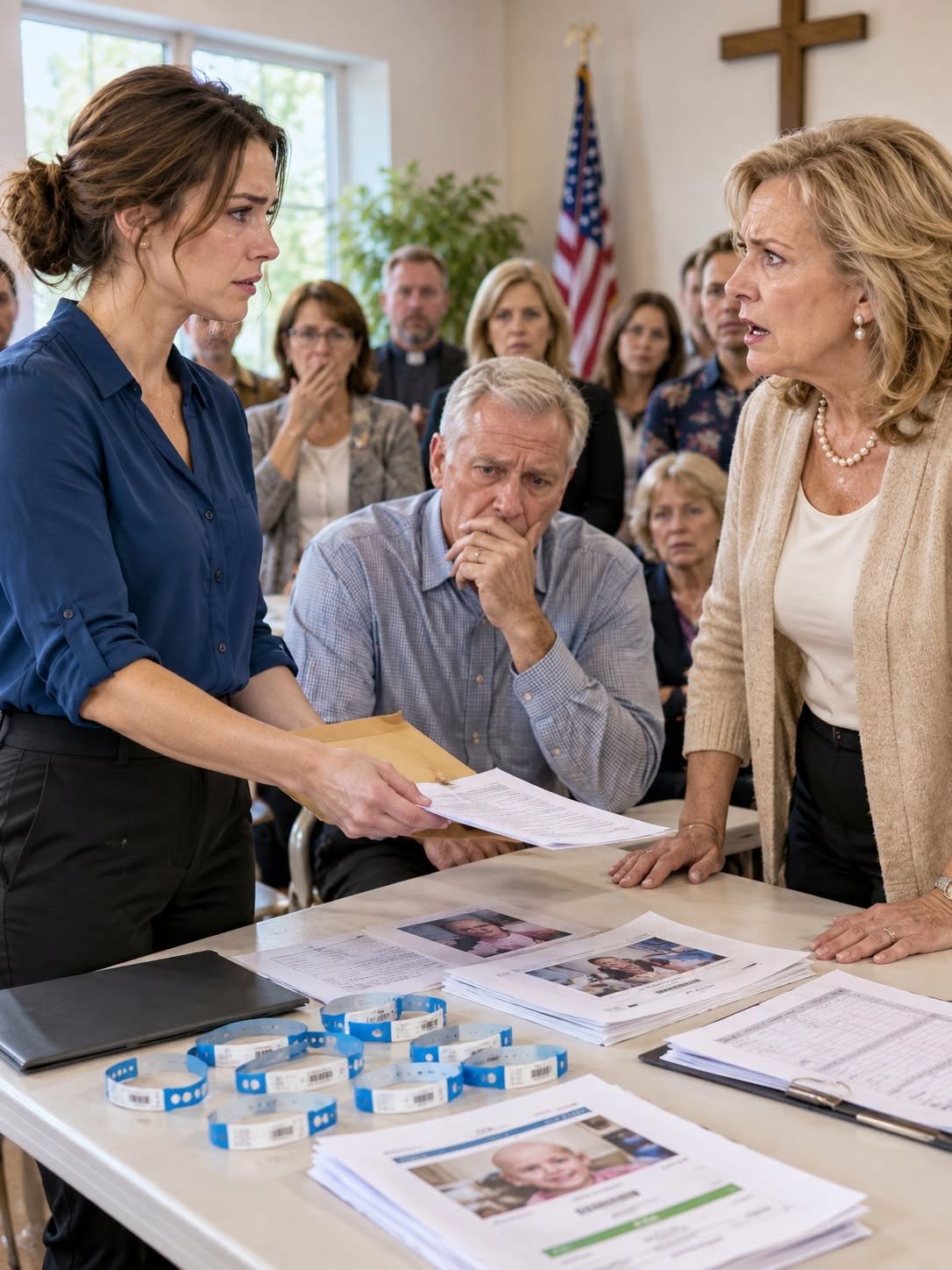
And instead of answering with a story, I put my envelope on the folding table and I opened it.
“I’m not here to make a scene,” I said.
And I meant it.
And I think the meaning is why they listened.
“I’m here because you asked. These are the records.”
I laid it out without heat.
Rhonda’s signup sheet, with her own handwriting in the right-hand column: delivered to Cheron.
The fundraising page printed out.
$8,900.
Organizer Sharon W.
My son’s face at the top.
My bank statements, the co-pays, the February red, and the 11 wristbands fanned out on the table.
Each one printed with my name and Ethan’s name and a date.
11 times I had badged into a hospital unit that had a record of every person who’d ever walked in and never once recorded hers.
I didn’t editorialize.
I didn’t need to.
Rhonda [snorts] leaned over her own sheet and read her own handwriting out loud.
“Delivered to Sharon.”
And then she went quiet.
And the quiet did more than any speech I could have given.
The room understood.
You could feel it understand.

Not because I’d told them what to think, but because the paper had.
My mother’s voice went up.
This was the counterattack, and I’ll give her this.
She didn’t fold easily.
“This is exactly what I warned all of you about,” she said, standing. “She twists everything. She’s always been Douglas. Gliss. Tell them. Tell them how she is.”
And that was her mistake, though she couldn’t have known it, because she turned to my father to do the
thing he’d always done.
The thing he’d done at my graduation and a hundred times since.
Back her up.
Add the line under hers.
End the conversation.
She turned to him the way you reach for a light switch in the dark, expecting it to be where it’s always
been.
My father didn’t stand up with her.
He was looking at the fundraising page on the table, at the $8,900, at the wristbands.
And when he spoke, it wasn’t to the room.
It was to her.
And it was very quiet.
And his hands were shaking a little.
“You told me she didn’t want us there,” he said. “All year. You [snorts] told me Betty didn’t want us at the
hospital. You told me he was doing fine. Douglas, you told me there was no fund.”
He looked up at her.
“Where did $11,000 go, Sharon?”
I need to be careful here because it would be easy to make my father a hero, and he wasn’t one.
He’d sent thumbs ups on hospital photos for 11 months.
He’d written, “He’s alive. What more do you want?” to a 9-year-old’s mother.
He wasn’t innocent.
But I understood something watching him at that folding table.
And it’s a true and complicated thing.
My father hadn’t been the architect.
He’d been the first person she lied to.
She’d managed him the same way she’d managed the church, feeding him a version of me and a version of the year that let him stay comfortable and uninvolved.
And he’d taken it because taking it was easier than looking.
And because he’d been taking whatever she handed him for 40 years.
His “He’s alive. What more do you want?” hadn’t come from cruelty.
It had come from a man who genuinely thought, because his wife had told him so, that his grandson was
fine and his daughter was difficult.
That doesn’t make it okay.
But it makes it human, and it made him at that folding table the second-to-last domino to fall.
“I said he’s alive,” my father said, mostly to himself now. “God help me. That’s what I said to you.”
He meant to me.
I was the one he’d said it to.
“I didn’t even ask how he was. I just—I didn’t even ask.”
The pastor asked my mother quietly if she’d be willing to account for the fund.
There were no lawyers in that room.
Nobody called the police.
This was never that kind of story, and it didn’t need to be.
It was a church discovering that a woman it had prayed for had built a shrine to herself out of a sick
child.
And a community’s regard is not a thing you can subpoena.
It just leaves.

I could see it leaving her in real time, face by face around that room.
Rhonda wouldn’t look at her.
The families who’d cooked wouldn’t look at her.
My aunt Marlene was there, too.
The one who’d called her a saint in the family chat two days earlier and told her not to let this get to her.
She had driven in specifically to stand by her sister.
I watched her pick up Rhonda’s signup sheet and read that right-hand column for herself slowly and set
it back down without a word.
She didn’t defend my mother.
She didn’t come after me.
She just went somewhere behind her own eyes and stayed there.
That silence from the one person who’d shown up expressly to take my mother’s side said more than I ever could have.
My mother said something about being persecuted, about ungrateful children, about how she’d only ever tried to help.
But the room had already tipped, and no amount of talking was going to tip it back.
And I think for the first time in her life, my mother felt what it was like to be in a room where her version simply didn’t work anymore.
Where the story didn’t need her permission to be true.
I didn’t stay to watch the end of it.
I’d gotten what I came for, which wasn’t her humiliation.
I stood up, put my wristbands and my papers back in the envelope, and I walked out into the parking lot.
And the April air was cold and clean, and I realized I wasn’t shaking.
I felt, of all things, quiet.
Two weeks later, still April, the trees just starting, we had a real party for Ethan.
It wasn’t at a country club, and there was no toast about anyone’s journey.
It [snorts] was in Rhonda’s backyard because Rhonda insisted, and it was the families, the real ones, the ones who’d cooked the 40 dinners meant for a boy they’d never met and were finally going to meet.
Maybe 30 people came.
Ethan’s charge nurse from Riverside came straight off a shift, still in her scrubs.
And when Ethan saw her, he made a sound I hadn’t heard him make in a year.
He stood in Rhonda’s backyard looking at all these people, and he leaned into me and said, so only I could hear, “Are they all here for me?”
“Every one of them, bud,” I said.
There was a cake with 11 candles on it.
Not nine for his age.
11, one for each month, which Rhonda had asked me about quietly beforehand, and which undid me a little when it came out of the kitchen.
And while Ethan was deciding whether he was allowed to be this happy, my father came through the back gate alone.
No Sharon.
He stood at the edge of it like a man who wasn’t sure he’d be let in.
And he was holding something.
He’d brought Ethan’s sign.

The original one.
“I beat it. Grandma, are you coming?”
The one that had sat on our kitchen table.
He’d gone and gotten it, and he’d had it framed.
I don’t know when.
I hadn’t asked him to.
He came over to Ethan slowly, and he crouched down to the boy’s level the way I’d crouched down two weeks earlier.
And he said, “I owe you about a 100 hospital visits, son. I can’t undo that. I’m not going to pretend I can. But I’m here now, if you’ll have me.”
Ethan looked at him.
My son is a careful person.
He doesn’t hand out trust because an adult wants it.
He looked at my father for a long moment, and then he looked at the cake.
Then he said, “You can help me blow out the candles.”
I have replayed that sentence more times than I can count.
Not forgiveness. Exactly.
A 9-year-old doesn’t have the machinery for forgiveness yet.
It was something simpler and, I think, wiser.
It was a boy offering a man a small, specific job.
Help me with the candles.
As a way of saying, you can start here and we’ll see.
My father’s face when he stood back up is not a thing I’m going to try to describe because some things you shouldn’t reach for words for.
Later, when it was winding down, Ethan asked me the question I’d been waiting two weeks for.
“Is grandma coming?”
And this was the moment I’d been most afraid of because there’s a version of me that would have made
him a weapon.
That would have said something bitter and true and let him carry it.
I didn’t want to lie to him again either.
So I crouched down one more time, and I told him the truest thing I could make small enough for him to hold.
“No, baby. Grandma’s not coming.”
He started to nod.
That too-fast nod.
“But listen to me. Grandma tells people she was here. These people—”
I looked around the backyard at the nurse and Rhonda and the families and his grandfather.
“These people just were here. They didn’t tell anybody. They just showed up. That’s the difference between them. And it’s the most important difference there is. And you’re the one who gets to decide
who gets a seat at your table now. Not me. You.”
He thought about that the way he thinks about everything.
Carefully.
And then he did something I didn’t expect.
He went to the picnic table, and he took a piece of paper and the blue marker Rhonda had put out for
the kids.
And he wrote something.
And he folded it.
And he brought it back and handed it to me face down.
“Read it later, Mom,” he said.
And then he went to help my father with the candles.
A few weeks later, the end of April, everything green now.
Here is where things actually stand because you deserve the real ending and not a tidy one.
The church asked my mother to account for the fund.
She never fully did.
Some of it, under pressure, got returned.
The rest is a question she’ll be living with in that community for a long time because a small church has a
long memory, and hers is not the memory she spent 40 years building.
She lost the thing she’d been mining the whole time.
Not the money.
The money was almost incidental.
She [snorts] lost her standing.
The role of the saint doesn’t survive contact with a spreadsheet.
I’m low contact with her now.
Not out of revenge and not out of drama.
Just because I finally stopped paying the price I’d been paying.

And it turned out the whole relationship was that price.
When you stop paying, you find out pretty quickly what you were actually buying.
My father comes by on Sundays.
Just him.
He doesn’t say much.
He never has.
But he shows up, and he’s learning at 66 how to ask my son how he actually is and then wait for the real answer.
He’s got a lot of hospital visits to make up and not enough Sundays to do it in.
And he knows that, and he shows up anyway.
It’s not nothing.
In my family, showing up when there’s nothing to post about turns out to be almost everything.
Heather and I talk now.
In person, even.
She gave up the easy seat, and it cost her.
Our mother doesn’t have much use for a daughter who won’t clap anymore, and she paid that willingly, which is more than I ever expected from her.
We’re not close.
Not yet.
But we’re honest.
And honest is a foundation you can build on.
Clapping never was.
And Ethan.
Ethan is nine, and he is cancer-free.
And he came back to Riverside last week to wave at the nurses, which had been the plan the entire time.
He is quiet, and he draws, and he still checks people’s faces to see if they match their words.
And I don’t know if that’s a wound that will heal or a gift that will serve him.
Maybe both.
But he knows something now that I didn’t know until I was 40.
And it took me a whole life and him a single spring.
He knows the difference between people who tell you they were there and people who just were.
And he knows he gets to choose.
He knows he doesn’t have to earn a seat at anyone’s table by being sick enough or grateful enough or quiet enough or small enough.
He gets to be the one who decides.
We do small things now on Saturdays that aren’t milestones.
That’s the part nobody warns you about after a year like ours.
How strange and enormous an ordinary Saturday feels when you finally get one back.
Last weekend, Ethan drew for 3 hours at the kitchen table the way he used to before any of this and asked me if we could get a dog and got frustrated because he couldn’t get the shading right on the dog he was drawing to convince me.
Nothing about it was worth a photo.
No one would have funded it.
It was just my son at a table, being nine, wanting a dog, alive in the plain, unremarkable way.
That is the only thing I ever actually asked anyone to show up for.
That, it turns out, was the answer to my father’s question.
“He’s alive. What more did I want?”
That.
Exactly that.
A boring Saturday and someone to want it with him.
The note he handed me at the party is on my refrigerator now, and I finally want to tell you what it said because it’s the only ending this story has.
The 11 wristbands are in a wooden box on my shelf now, next to the framed sign my father brought.
The old one.
The blue marker one.
“I beat it. Grandma, are you coming?”
That question never got the answer my son wanted.
She never came.
She was never going to come.
But two weeks later, in a borrowed backyard, 30 people who owed him nothing came instead and answered a question he hadn’t even thought to ask.
And on my refrigerator is his note in blue marker, a second gold star in the corner where the first sign had one.
It says, “I beat it. And everyone who matters came.”
He’s right.
They did.
If your family ever asked you to keep the peace while they hurt your child, if you were ever the one who showed up in the room while someone else took the applause in the hallway, I’d like to hear where you finally drew the line.
Leave it in the comments.
Somebody scrolling past tonight needs to know they’re allowed to draw it, too.
And if this story meant something to you, stay a while.
There’s another one I need to tell you.
The people who love you don’t send a photo of themselves.
They show up when there’s nothing to post.