Part 1
“Excuse me, sir. Could you be my dad just until they call my name?”
Vincent Calloway stopped walking.
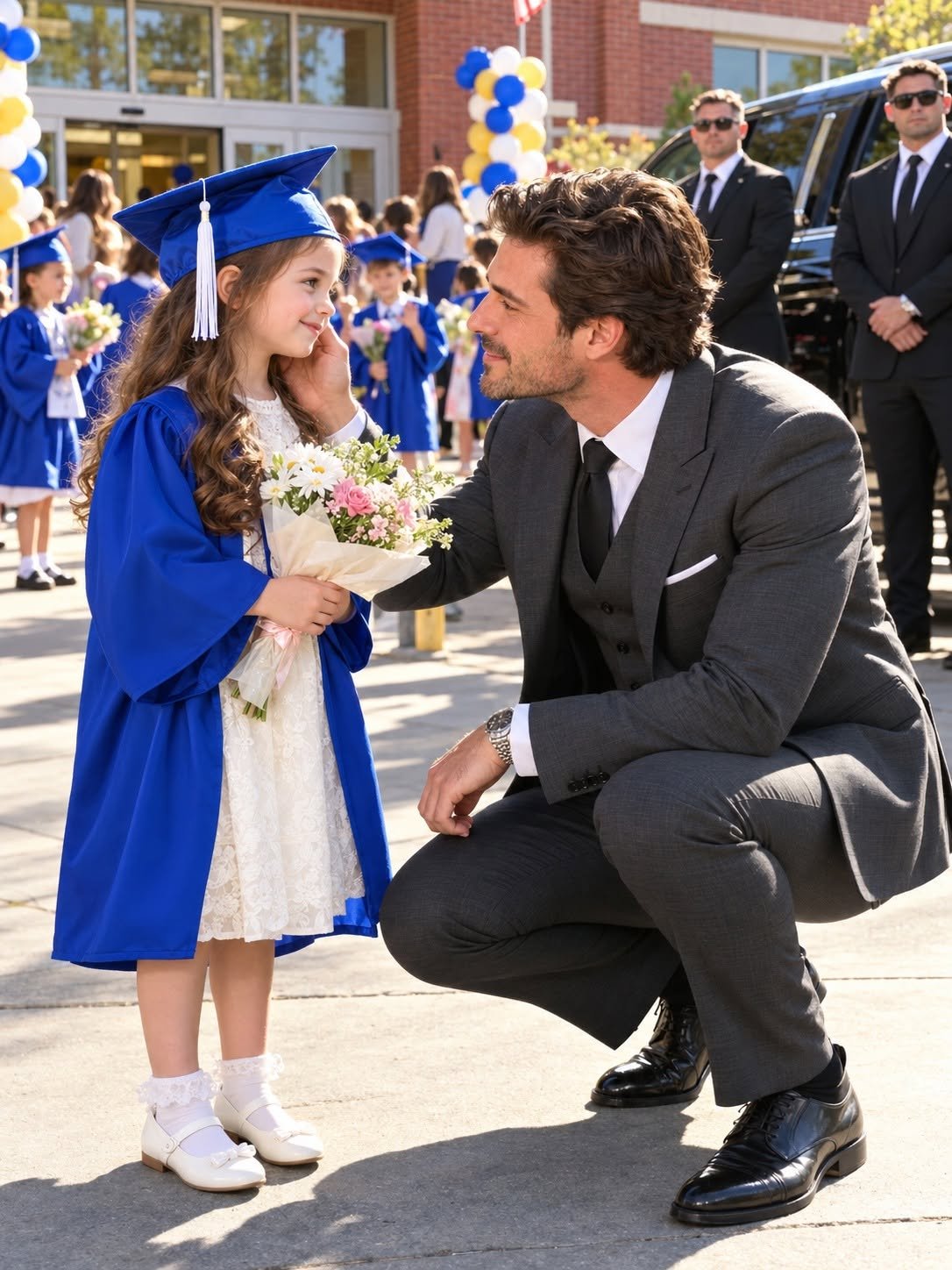
The little girl standing outside the elementary school auditorium couldn’t have been more than seven. She wore a white dress, scuffed shoes, and a blue ribbon in her hair. A crumpled graduation program trembled between her fingers.
Behind Vincent, two bodyguards waited beside a black Mercedes.
At forty-six, Vincent controlled a shipping empire along the New Jersey waterfront. Powerful businessmen feared him. Competitors knew refusing his demands could have consequences.
But this little girl looked straight into his eyes.
“My name is Sophie Bell,” she explained. “You don’t have to do anything special. Just sit in the family chair. When they call my name, you can clap.”
Vincent glanced toward the auditorium.
“Where’s your family, Sophie?”
“My nana has a heart doctor appointment. Aunt May went with her.”
“And your parents?”
Her fingers tightened around the program.
“My mommy died last winter. My daddy died before I was born.”
She tried to smile.
“Everybody else has someone coming. I told a girl in my class that my dad would be there.”
Vincent said nothing.
“You only have to pretend for forty-five minutes,” Sophie whispered. “Maybe fifty, because the second graders sing two songs.”
One of his bodyguards checked his watch.
“Boss, we’re late.”
Across town, three men were waiting for Vincent to discuss a multimillion-dollar freight agreement.
“I have an important meeting,” Vincent finally said.
Sophie’s smile disappeared.
“Oh. That’s okay.”
She folded her program carefully.
“Thank you for listening.”
Then she turned toward the auditorium.
But before disappearing inside, she looked back.
“If you change your mind, there’s an empty chair in the third row. On the left.”
She swallowed.
“I saved it.”
Vincent watched her leave.
Something about those words brought back a memory he hadn’t allowed himself to revisit in nearly thirty years.
He was seventeen again, sitting at his own school ceremony, staring at an empty chair.
His father had promised to come.
He sent a driver instead.
Vincent had spent his adult life making sure nobody could ever make him feel that powerless again.
Now a child had asked him for less than an hour.
And he’d turned her down.
His phone rang.
Warren Slate, his most trusted executive, wanted to discuss a contractor who had refused their terms.
“We spoke with his brother,” Warren said. “He’s reconsidering.”
Vincent knew what that meant.
For years, he’d allowed intimidation to settle disagreements.
But suddenly, Sophie’s disappointed face wouldn’t leave his mind.
“Leave the man’s family alone,” Vincent ordered.
Warren went silent.
“Vincent, that’s not how we operate.”
“Then we’re changing how we operate.”
He ended the call.
Then he turned to his bodyguard.
“Cancel my meeting.”
“Boss?”
“I’m going back.”
Minutes later, Vincent stood outside the auditorium again.
A teacher stopped him.
“Sir, are you family?”
“No,” he admitted. “But Sophie Bell asked me to come.”
The teacher contacted Sophie’s grandmother, June, who cautiously approved one supervised visit for the ceremony.
Vincent signed in, bought six daisies from the school fundraiser, and entered quietly.
Third row.
Left side.
One empty chair.
He sat down.
When Sophie spotted him, her eyes widened.
Then came a smile he would remember for the rest of his life.
And when the principal called “Sophie Elizabeth Bell,” Vincent stood and applauded.
Afterward, Sophie ran toward him.
“You really came back!”
“I did.”
She looked at the flowers.
“Are those for me?”
“Yes.”
She smiled.
Then, unexpectedly, she asked whether he would visit her grandmother’s little blue house.
June invited him for tea, with Aunt May present.
But when Vincent handed June his business card, her expression changed.
She read the name twice.
“Calloway Logistics?”
“Yes, ma’am.”
“The company that owned the Harbor Point warehouse?”
Vincent felt the warmth leave the room.
“Yes.”
June slowly placed his card on the table.
Then she looked directly into his eyes.
“My son died there.”
Part 2
The kitchen in the little blue house smelled of chamomile and old wood. Sophie sat at the end of the table, swinging her feet and eating a cookie, unaware that the air around her had gone still.
“My son’s name was Thomas,” June said. Her voice was steady, but her hands were wrapped so tightly around her teacup that her knuckles had turned white. “Tommy Bell. He was a safety inspector for the port authority. Nine years ago this October, he walked into the Harbor Point warehouse to finish a report. The roof of the loading bay came down on him.”
Aunt May reached over and covered her sister’s hand.
“They told us it was an accident,” June went on. “Old building, bad luck, nobody’s fault. Sophie’s mother was five months pregnant. She never got to hear him say the baby’s name.”
Vincent’s mouth had gone dry. He remembered the Harbor Point collapse the way a man remembers a headline. Insurance had handled it. His lawyers had handled it. He had signed the settlement papers without reading past the first page, and he had not thought of it since.
“Mrs. Bell,” he said quietly, “I am sorry. I didn’t know your son’s name until this moment.”
“No,” June said. “I don’t suppose you did.”
Sophie looked up from her cookie. “Nana, are you mad at Mr. Vincent?”
June’s expression softened instantly. “No, baby. Why don’t you and Aunt May go and water the tomatoes?”
May stood, took Sophie’s hand, and led her out through the back door. Through the window, Vincent watched the child skip across the small yard with her ribbon bouncing.
June waited until the screen door clicked shut.
“I didn’t invite you here to hurt you, Mr. Calloway,” she said. “I invited you because my granddaughter asked me to, and because I wanted to see your face when you heard his name.”
“What did you see?”
“A man who didn’t know.” She rose slowly, crossed to a hutch in the corner, and took out a worn canvas folder. “That’s the only reason you’re still sitting in my kitchen.”
She set it on the table between them.
“Tommy kept a logbook. Everything he inspected, every violation he found. He was a careful boy. After the funeral, I found this in the glove box of his truck. I read it once and put it away, because I didn’t know what to do with it. I was a widow with a grieving daughter-in-law and a baby on the way. Who was I going to tell? A man like you owns half the waterfront.”
Vincent opened the folder with unsteady hands.
The handwriting was small and neat. Page after page of dates, measurements, and photographs held in place with paperclips. Roof trusses, east bay: corrosion at load-bearing joints. Recommend immediate closure. Then a note beneath it, dated three weeks before the collapse. Reported to Mr. W. Slate, facilities. He says repairs are scheduled. No work seen. A week later: Slate says the budget is frozen. Told him I’d file with the port authority Friday.
The last entry was dated the day he died.
Filing tomorrow. Whoever owns this building needs to know. If they knew, they’d fix it.
Vincent read the final line twice. His vision blurred.
Warren Slate. His most trusted executive, the man who had called him that very morning to talk about threatening a contractor’s family.
“Mrs. Bell,” he said, and his voice cracked, “I never saw these reports. I swear to you.”
“I believe you,” June said. “That’s the part I can’t forgive, and the part I can’t hate. You didn’t know because you built a company where nobody would dare tell you.”
The words landed harder than any accusation could have.
“There’s a second thing,” she added. “I called a lawyer last year, after Sophie’s mother passed. She told me that if this logbook ever reached the right people, it could reopen the case. Criminal negligence. Maybe worse. It could bring down your whole company, Mr. Calloway. It could put you in prison.”
“Yes,” Vincent said. “It could.”
“So I’ll ask you plainly.” She sat back down and met his eyes. “Why did you come back to that school today?”
He thought of the empty chair, and the driver who had arrived in his father’s place thirty years earlier.
“Because a seven-year-old asked me for forty-five minutes,” he said, “and I realized I’d never given anyone that in my life.”
June studied him for a long moment. Outside, Sophie laughed at something May had said.
“Then here’s what’s going to happen,” she said at last. “You’re going to take those pages home and read every one. And then you’re going to decide what kind of man you actually are.”
She slid the folder across the table.
“I made copies,” she added mildly. “In case you were wondering.”
Part 3
Vincent did not sleep that night.
He sat alone in his penthouse above the harbor, the canvas folder open on the glass table, and read Tommy Bell’s logbook from the first page to the last. By dawn, he knew the young inspector’s handwriting the way he knew his own.
Then he started pulling his own company’s records.
It took four hours. Maintenance requests for Harbor Point, flagged and denied. Budget memos with a familiar initial at the bottom. Emails from the facilities department asking for approval to close the east bay, each one answered the same way. Not now. Keep it running. W.S.
And one email, dated six days before the collapse, from Warren Slate to a man named Kessler at the insurance carrier. Make sure the policy covers structural failure on all Harbor Point properties. Effective immediately.
Vincent leaned back in his chair and closed his eyes.
Warren had known the building would fall. He had not wanted it to, but he had known, and he had chosen the policy over the repairs. When Tommy Bell threatened to file his report, Warren had simply gone on waiting.
At nine o’clock, Warren walked into the office as if it were any other morning, carrying two coffees.
“You canceled the meeting yesterday,” he said, setting one down. “The freight people were not happy. And you want us to drop the contractor entirely? Vincent, I have to say, this sudden softness…”
“Sit down, Warren.”
Something in Vincent’s tone made him pause. He sat.
Vincent turned the laptop around. On the screen was the insurance email.
Warren read it. For one second his face went perfectly blank. Then his expression rearranged itself into something smooth and reasonable.
“That’s routine,” he said. “Standard coverage. Any logistics firm would…”
“Tommy Bell,” Vincent said.
Warren stopped.
“The inspector who died at Harbor Point. You remember him?”
“Vincent…”
“He told you the roof was failing. He told you three times. And you told him the budget was frozen.” Vincent’s voice was very quiet. “I never froze the budget, Warren. I never saw the request.”
“You didn’t want to see it,” Warren said, and for the first time his voice sharpened. “You wanted margins. You wanted expansion. I protected you from every decision you’d have hated making. Everything I did, I did for you.”
“A man died.”
“A man died in an old building. It happens on the waterfront. It has always happened. You think your father ran this port with clean hands?” Warren leaned forward. “You’re about to burn everything over one accident and a little girl’s school play.”
Vincent stood.
“His daughter was born four months after the funeral,” he said. “She saved me a chair.”
Warren stared at him. Then, slowly, he understood.
“You can’t,” he said. “If this goes to the authorities, you go down with me. Your signature is on the company.”
“I know.”
“You’ll lose everything.”
“Probably.” Vincent picked up his phone. “But I’d rather lose it honestly than keep it the way my father did.”
Warren didn’t try to stop him. He only sat very still and watched the man he had served for fifteen years dial a number that wasn’t his lawyer’s.
It was June’s.
The next three weeks were the hardest of Vincent’s life.
He hired an independent attorney, a stern woman named Ellen Marsh, who told him in their first meeting that he was making every possible mistake from a legal standpoint and that she respected him for it. He handed over the complete Harbor Point records. He gave a recorded statement to the federal prosecutors. He fired Warren Slate and sat across the table as Warren’s own lawyers tried, and failed, to shift the blame onto a dead man’s logbook.
His board begged him to reconsider. His men grew nervous. Two of his oldest associates quietly stopped returning his calls. One night, someone left a dead fish on the hood of his Mercedes, and Vincent simply stood looking at it before asking a bodyguard to throw it away.
“Boss, we could handle this,” the man said carefully. “The way we used to.”
“No,” Vincent said. “We’re done handling things.”
On a gray Thursday in November, Ellen Marsh called with the final terms. Because he had come forward voluntarily and cooperated fully, the government would not seek the harshest charges. Vincent would plead guilty to criminal negligence and obstruction relating to the Harbor Point warehouse. He would give up his controlling interest in the company. He would pay a settlement fund to the families of the victims, and the logbook would go into the record under Tommy Bell’s name.
Warren Slate would stand trial.
“What’s my sentence?” Vincent asked.
“The prosecutors will recommend three years. The judge will likely follow.” Ellen paused. “Vincent, you could still walk away. You could argue the paper trail was Warren’s alone.”
“It was mine too,” he said. “I built the place where he could do it.”
He hung up and sat for a while in the gray light.
Then he drove to the little blue house.
June opened the door before he knocked.
“I’m taking the plea,” he told her. “I wanted you to hear it from me.”
She looked at him for a long moment, then stepped back from the doorway.
“Come in,” she said. “Sophie is doing her reading homework. She’ll want to show you.”
Final Part
The sentencing was in January.
Vincent wore a plain gray suit and stood beside Ellen Marsh as the judge read the terms into the record. Three years in a federal facility in Pennsylvania, followed by supervised release. The company’s assets would be restructured into the Bell Family Fund, with a portion reserved for every worker injured or killed under his watch, named or not.
June attended, wearing her church coat, with Aunt May beside her. Sophie had not been allowed in the courtroom.
When the judge finished, Vincent turned and found June watching him from the second row. She did not smile. She simply nodded once, the way a person nods at someone who has finally finished something difficult.
Outside, in the cold, she stopped him on the courthouse steps.
“Sophie wanted me to give you this.”
She pressed a folded piece of paper into his hand. Vincent opened it.
It was a drawing in crayon. A tall man stood beside a little girl in a white dress, and between them was a chair, colored in carefully with blue. At the top, in uneven capital letters, she had written: MR. VINCENT’S SEAT.
His throat closed.
“She doesn’t understand all of it,” June said. “She knows you made a mistake a long time ago, that you’re fixing it, and that you’ll be gone a while. I told her that people who fix their mistakes are worth waiting for.”
“Mrs. Bell,” Vincent said, “I can’t ask you to…”
“You haven’t asked me for anything.” She drew her coat tighter. “That’s what I noticed first. Most men in your position would have asked.”
A pause settled between them. A bus rumbled past.
“I’ll bring her to visit,” June said. “Not every month, and not until I decide she’s ready. We’ll see how it goes.”
“That’s more than I deserve.”
“Yes,” she agreed. “It is.”
Vincent served twenty-six months.
He worked in the prison library. He taught a night class for men who had never learned to read, which he discovered he was good at, and he sent the first of many letters to Sophie in a plain envelope with a stamped return address that was not his own.
Dear Sophie, I hope second grade is going well…
She wrote back in pencil, in sentences that drifted uphill. She told him about a field trip to the aquarium, a lost tooth, and a boy named Everett who had thrown up on the bus. She told him her grandmother’s heart doctor said the new medicine was working. She told him she had kept the blue ribbon.
June brought her to visit in the spring. Sophie ran across the visiting room, then stopped, suddenly shy, three feet from his chair.
“You look different,” she said.
“I have less hair than before.”
“No, it’s that you look like a regular person.”
Vincent laughed so hard that a guard glanced over.
By his release, he had no company, no Mercedes, and no bodyguards. He had a small apartment in Newark, a job at a dockside safety nonprofit that agreed to hire him after reading Tommy Bell’s logbook, and a probation officer who asked him every Tuesday how he was doing, and seemed to mean it.
Warren Slate had been convicted on three counts. Vincent did not attend the sentencing, and did not feel the way he’d expected to.
On a warm day in June, he stood in the back of the school auditorium where it had all begun.
Sophie was in fourth grade now. The program had changed: a spring concert instead of a graduation, folding chairs instead of the old wooden rows. The principal was new. The teacher at the door, a young man with a lanyard, checked his name against the list and handed him a visitor’s badge.
“Mr. Calloway? Mrs. Bell said you’d be coming.”
Vincent followed the aisle slowly. His heart was pounding in a way it hadn’t for years, not since a certain morning on a school sidewalk.
Third row. Left side.
June sat at the end, in her good dress, her cane propped beside her. Aunt May was next to her. And between them, deliberately, firmly empty, was one folding chair with a small hand-lettered card taped to the back.
SAVED.
He couldn’t speak. June looked up at him with the faintest suggestion of a smile.
“Sit down, Vincent,” she said. It was the first time she had used his first name. “You’re blocking the view.”
He sat.
On stage, the fourth graders filed in, shuffling and giggling, tugging at their collars. Sophie was in the second row of the chorus. She spotted him instantly, and her whole face broke open.
She waved, a small, furious wave, and then remembered where she was and held her hands rigidly at her sides, grinning so widely it looked as though it might hurt.
The music began. The children sang something about rivers and tides, off-key, and Vincent thought he had never heard anything so beautiful.
Halfway through, June leaned toward him.
“Tommy would have hated you,” she murmured. “At first.”
“I know.”
“He’d have come around.” She kept her eyes on the stage. “He always did, with people who tried.”
Vincent said nothing. He could not have spoken if he’d wanted to.
When the concert ended, the children poured into the aisles, and Sophie shot between the chairs and crashed into his chest with all the force of a small cannonball.
“You came back!”
“I told you I would.”
“You told me seven years ago!”
“It was twenty-six months.”
“That’s the same.” She pulled back, studied him seriously, and then reached into her pocket and produced something small and crumpled.
The blue ribbon.
“I kept it for you,” she said. “For when you came. So you’d know you were always supposed to be here.”
Vincent knelt there in the aisle, in a rented suit, holding a seven-year-old ribbon in a hand that was shaking, and understood that he had been forgiven, not entirely and not cheaply, but truly.
June had risen behind them, leaning on her cane. She laid one hand lightly on his shoulder.
“Come on, you two,” she said. “I made a pie. And May’s bringing the tea.”
Sophie slipped her hand into his and tugged.
Vincent stood.
For the first time in his whole life, he walked toward a family table not because he owned the room, but because someone had saved him a place at it.
THE END