“It’s an empty acre, folks,” Mayor Dick Farris said. “Nobody is buried back there. We’ve been mowing grass for fifty years for nobody.”
He said it kindly. The way you’d explain something to a child. And he was looking straight at my mother when he said it.
There were maybe fourteen of us in the folding chairs at city hall that Monday night. The coffee
maker on the back table was ticking as it cooled. Mr. Stroud, who owned storage units in two other towns in the county, sat in the front row with his cap on his knee and a folder tucked under it.
“Eighteen thousand dollars,” Dick said. “The cemetery fund has twenty-one hundred in it, and the mower is nineteen years old. I don’t know how to make that math work any other way.”
My mother, Wilma Krause, was seventy-nine years old. She had sat on that council for eleven years.
Her hands were folded on the table in front of her.
“There are sixty-one people in that ground, Dick,” she said.
“Wilma, with respect. That acre was never platted as cemetery. It came to the town from the county in 1931, when the poor farm closed, as a plain lot. I had the clerk pull the deed. No lots. No burials. Not one stone.”
“There’s not a stone because nobody ever bought them one. The poor farm buried its dead back there for forty-four years.”
“Then there’d be a record at the courthouse. And there isn’t.”
“The county’s burial register burned with the old courthouse in thirty-four. You know that as well as I do.”
“What I know,” Dick said, “is that on paper, it’s empty ground. I can’t run a town on what
somebody remembers hearing.”
“I didn’t hear it,” my mother said. “I read it.”
“Then I’d have to see it in something official.” He looked down the table. “Is there a motion?”
There was. There was a second.
Carrow, Nebraska has six council seats. Two to a ward. But Gene Pruitt was up in Lincoln that week with his wife’s hip surgery, so only five voted.
“Voss.”
“Aye.”
“Beck.”
“Aye.”
“Timm.”
“Aye.”
“Kolar.”
“Aye.”
“Krause.”
“No,” my mother said.
“Four to one. Motion carries.” Dick tapped his pen on the table. “Let the minutes show Mrs. Krause objects.” He smiled a little. “She usually does.”
Somebody in the back laughed.
It wasn’t a mean laugh. It was worse than mean. It was the laugh you give something that doesn’t matter.
My mother didn’t turn around. She wrote something on her agenda in small, neat letters. She capped her pen. And she waited for the motion to adjourn like nothing had happened.
I had driven her that night. She gave up driving after dark when her cataracts got bad. In the car
she held her purse in her lap with both hands and stared out at the lights on the grain elevator. It was the second week of October, and the grain dryers were roaring. You could hear them right through the glass.
“Mom,” I said.
“Not tonight, Beth Ann.”
So I didn’t say anything else.
I pulled into her driveway. Before I even had the car in park, she was out of it.
She didn’t go up the porch steps. She went around the side of the house in her church shoes, with the little flashlight off her key ring, to the shed.
I sat in the car with the engine running and watched the beam of that tiny flashlight bob across the yard.
She came back out with her garden trowel in one hand and a coffee can in the other. The big red
three-pound kind. My father used to keep nails in it.
She set them both on the porch step. Side by side. The way you lay out your clothes the night before something important.
Then she went inside and turned off the kitchen light.
I live four blocks from my mother. That month my husband Jeff was running the grain cart for his brother, which meant he was gone before five in the morning and home after dark. I was doing

the books at the co-op through harvest, which meant about the same for me.
I walked over to her house at six-thirty the next morning with my coffee still in my hand.
She was out on the porch in my father’s old canvas barn coat. She was pouring white paint out of
a half-gallon bucket into the coffee can. It was the exterior white left over from when she painted the porch rail two summers ago.
“What are you doing?”
“Thinning this. It skinned over.”
“Mom.”
She stirred it with a paint stick and didn’t look up.
Beside her on the step sat the trowel. A two-inch brush. A little jar of black enamel. A stenographer’s notebook with a green cover worn soft as cloth. And my father’s tile probe. That’s a steel rod about four feet long with a T-handle on top. Farmers use them to find old drainage
tile underground.
“I’m going out to the cemetery,” she said. “I’ll be back by supper.”
“To do what?”
“What I told them I’d do. If they’d listened to the end of the sentence.”
There was a little red wagon at the bottom of the steps. Kayla’s old wagon, from when she was small. In it were four rough fieldstones, each about the size of a loaf of bread.
I knew those stones. They were the border from her peony bed. My father picked those rocks out of the north quarter of the farm every spring for forty years, and she had laid them around her peonies one at a time.
“You can’t pull that wagon a mile.”
“I’m not going to. I’m going to put it in the trunk.”
“You can’t lift those into a trunk.”
“I already did it once,” she said. “To see.”
So I helped her load the car. I helped her the way you help somebody do a foolish thing. And I let her see on my face exactly what I thought of it.
She saw it. She didn’t say a word.
She drove off at twenty miles an hour.
I went to work. I made it until noon.
Carrow Cemetery sits on a little rise a mile north of town, with a line of old cedars along the west fence.
The front part is the part everybody knows. The good granite. The family names. The flagpole the
Legion put up. But behind the last row of stones there’s a strip of plain, mown grass. About an acre. It runs all the way back to the corner where the fence meets a cornfield.
My mother was in the far northwest corner of it.
Her car was parked on the lane with the trunk wide open. The red wagon sat in the grass next to her with the four stones still in it.
She wasn’t on her knees. She was sitting flat on the ground with her legs straight out in front of
her, like a little girl in a sandbox. Next to her was a square hole where she’d cut out a piece of sod.
I ran the last part.
“Are you hurt?”
“No. I’m waiting.”
“Waiting for what?”
“For my knees to decide.” She said it like she was talking about the weather. “It’s been about twenty minutes. They’re coming around.”
I got her up. I walked her to the car and sat her on the edge of the open trunk. And then I said
everything, with the wind blowing across the corn stubble.
“You are going to hurt yourself out here, and nobody will find you until dark. You are seventy-nine years old. You have one hole dug. There are sixty-one. At one a day, you’d be done at Christmas.
Mr. Stroud closes on the fourteenth of November, and he wants his rock down before the ground freezes. You cannot win this with a trowel.”
“I know what the arithmetic is.”
“Then call somebody. Call the state. There have to be laws about this.”
“I called Lincoln in August, when Dick first floated the idea.” She brushed some grass off her coat. “A very nice young man told me to put a request in writing, and they might get somebody out
here to look in the spring.”
She looked at me.
“Spring is after November.”
“Then get a lawyer.”
“With what, Beth Ann? And to say what? The dead are not a legal question.”
“Then what are they?”
“They’re a question of whether anybody remembers.”
I was angry enough by then to say the next thing.
“You have a book. I saw it on the step this morning. Why didn’t you just show it to somebody
before it ever came to a vote?”
“I did.”
That stopped me cold.

“I took it to the county clerk in August. She was very polite. She said the county’s register burned in thirty-four, and she couldn’t enter a handwritten copy of a book nobody can produce. Then I took it to the newspaper. They said they couldn’t print sixty-one graves on the strength of a
notebook.”
She looked down at her hands.
“A notebook is not a record. Two very nice people told me so before Dick ever opened his
mouth.”
“Then what good is a rock?” I said.
She nodded back toward the corner.
“Nobody argues with a stone that has a name on it. They have to walk out here and stand in front
of it first. I can’t make them vote right, Beth Ann. But I can make them look.”
“And if nobody comes?”
“Then on the fourteenth of November, there’ll be thirty-some names that man has to drive his
gravel truck over. I’d like to see the man who can do it.”
She reached behind her into the trunk and handed me the green notebook.
It was her handwriting. But younger. Round and careful, in blue ballpoint. At the top of the first
page it said:
Burial Record, County Poor Farm. Copied from the Superintendent’s book, June 1968. W. Becker.
Becker was her name before she married my father.
“I was twenty-one,” she said. “I was the junior girl in the county clerk’s office. The superintendent of the poor farm had kept his own book at home, separate from the county’s. When his daughter died that spring, her family carried his papers into the courthouse in apple boxes. They thought
the county would want them.”
“Did it?”
“No. That book was headed for the dump. The cover had come off. The mice had been at it.”
“So you copied it?”
“On my lunch hours. It took me nine days.”
I turned the pages. Every entry looked the same. A number. A name. An age. A date. A cause of
death. And at the end of each line, a row and a place.
No. 1. Peter Hale, laborer, aged 66. Died November 4, 1887. Lung fever. Row 1, place 1.
No. 2. Mrs. Anna Novak, widow, aged 71. Died January 1888. Old age. Row 1, place 2.
Six pages of it. All the way to Number 61, in 1931.
“They had wooden crosses once,” my mother said. “Painted white. A grass fire took most of them in the fifties, and nobody put them back. After that it was just lawn.”
“Mom, how do you even know they’re where the book says? It’s been a hundred and forty years.”
“Go look inside the fence corner.”
I walked over. Almost hidden in the tall brome grass was the gray stub of an old hedge post.
Cut off a foot above the ground, and hard as iron.
“The book says row one starts eight feet east of the corner post,” she said. “Nobody pulls a hedge post if he can help it. They’ll outlast all of us.”
She pointed at my father’s tile probe lying in the grass.
“Now take that, and push it in where nobody is. Over there.”
I picked it up. I leaned on the handle. The rod went in about ten inches and stopped dead, like I’d
hit a board.
“That’s ground nobody ever dug,” she said. “Clay. Now come four feet south of my hole and try again.”
I moved. I leaned on it again.
The rod sank all the way past my wrists.
I stood there holding it.
“That’s a place that was opened once and filled back in,” my mother said. “It never packs the same. Your dad found every tile line on the home place that way.”
I pulled the rod out slowly. My hands were cold.
“And come back in the morning,” she said. “When the sun’s low. Look across the grass.”
I did. I came back the next morning before work and stood at the corner post with the sun just coming up over the corn.
With the light lying flat across the grass, I could see them. Faint. Like the dents a heavy quilt leaves on a made bed. Long, shallow dips in the ground, one after another, in rows. Pine boxes don’t hold up forever. When they give way, the ground settles a few inches. And it stays that way.
They had been there my whole life. I had walked past them every Decoration Day since I was born.
But that was the next morning. That first noon, I was still angry.
I got down on my knees anyway, in my good office slacks. I squared up the hole she’d cut. I

lifted the first stone out of the wagon and bedded it in tight, the way you’d set a stepping stone, and she told me when it was level.
Then she had me help her down beside me. She wouldn’t paint a person’s stone standing over it.
She said it wasn’t decent.
She dipped the brush in the coffee can and painted the stone white on every side that showed. The grass around it ended up speckled.
“Peter Hale,” she said quietly. “I’ll letter him tomorrow, when the white’s cured.”
I went back to work and added up the same column of scale tickets three times and got three different answers.
That night I couldn’t sleep. Jeff was snoring beside me after sixteen hours in a tractor cab. So I got up and sat at the kitchen table in my robe.
My mother had sent the notebook home with me. I hadn’t asked for it. She’d just set it on the
passenger seat of my car while I wasn’t looking.
I read every line.
No. 19. Infant son of Mary Dolan. Lived two days. Died March 1919. Row 2, place 6.
I stopped there for a while.
No. 27. Unknown man, taken off the freight. About 40. Died December 1924. Row 3, place 1.
No. 33. Clara Timm, aged 19. Died in childbed, 1926. Row 3, place 7.
Timm.
Larry Timm had voted aye on Monday.
No. 41. Emil Stroud, farmhand, aged 44. Brought from the county jail sick. Died January 1928. Row
4, place 2.
I read that one twice. Then a third time.
And seven lines further down:
No. 48. Ida Marie Becker, widow, aged 58. Died March 9, 1930. Heart. Row 4, place 9.
There was a small penciled star in the margin beside it.
It was the only mark like that in the entire book.
I was on her porch at six the next morning in my chore boots.
“Becker,” I said. “Row four, place nine. Who is that?”
“There were Beckers all over this county.”
“Mom.”
“We’ll get to row four when we get to row four.” She held out the trowel to me. “You cut. I’ll find.”
So that’s how we did it. Every morning before I went to the co-op.
She found the place with the book and the probe. I cut the sod and carried the stone and bedded it. Then I got her down onto the grass beside me, and she lettered yesterday’s name in black enamel with a little sign-painter’s brush, and painted today’s stone white.
I wasn’t angry anymore. I had read the name of a two-day-old baby at one in the morning in my kitchen, and it had gone right out of me.
We did one a day. Getting her down to the ground and back up once was all her knees could
stand, and she would not let it be done without her there.
I offered to set a second and a third by myself.
“Not until the first one’s lettered,” she said. “I won’t have a blank white rock sitting on somebody
overnight if I can help it. That’s what they’ve had for a hundred years. Nothing.”
On Friday night Jeff came in from the field. He ate standing up at the counter, the way he does during harvest. Then he said, without looking up from his plate, “How many rocks does she
need?”
“Fifty-seven more.”
“Then she’s out of flower bed.” He drank his milk. “Dale’s got a rock pile in the fence corner down
by the creek. Been there since his granddad. I’ll bring a load Sunday. We don’t run Sunday mornings anyhow.”
He brought them after church in his work pickup, with the tailgate down and the springs riding flat.
He had gone through that whole pile and picked them for shape. Flat on the bottom. Rounded on top. He unloaded every single one himself and set them in a line along the cedars, biggest to smallest. And he didn’t say one word about whether any of this was a good idea.
Before he left, he walked out to the corner and read the five names that were down. Then he picked up the tile probe and pushed it into the next place over. I watched it drop. He handed it back to my mother.
“Yep,” he said.
That was his whole speech. And my mother liked it better than anything I’d said all week.
Our daughter Kayla came home that same weekend. She’s twenty, in her second year at the college
down in Peru, about forty minutes off. She showed up Saturday noon with a laundry basket and a sack of art brushes.
Kayla has the good handwriting in our family. She lettered two stones that weekend. Then she
asked her grandmother which one was next in the book.
“Row two, place six,” my mother said. “But that’s a week off yet.”
Kayla read the line in the notebook.

Infant son of Mary Dolan. Lived two days.
She didn’t say anything. She closed the notebook and walked down the line of Jeff’s stones along the cedars until she found the smallest one. Not much bigger than a hymnal.
“This one,” she said. “I want to do it now.”
My mother let her.
She painted it white herself. And on Sunday, before Kayla drove back to school, she lettered it.
Infant Son of Mary Dolan. 1919.
Then she sat back on her heels and looked at it for a long time. And under the year, very small, she painted a lamb.
It wasn’t a good lamb. It looked more like a cloud with legs.
My mother stood over her for a long minute.
“He was two days old,” Kayla said. She didn’t look up. “He ought to have something.”
My mother put her hand on top of Kayla’s head. The way she used to when Kayla was small enough to stand under it. And she left it there.
I never did find out who called the newspaper.
It was the same paper that told my mother in September that a notebook wasn’t a record. But on the second Tuesday, a young woman named Kim drove out to the cemetery with a camera. I suppose a woman on her knees setting a stone is something you can print without swearing to
anything.
Kim asked if she could take a picture. My mother said she supposed so, as long as she didn’t have to stop working.
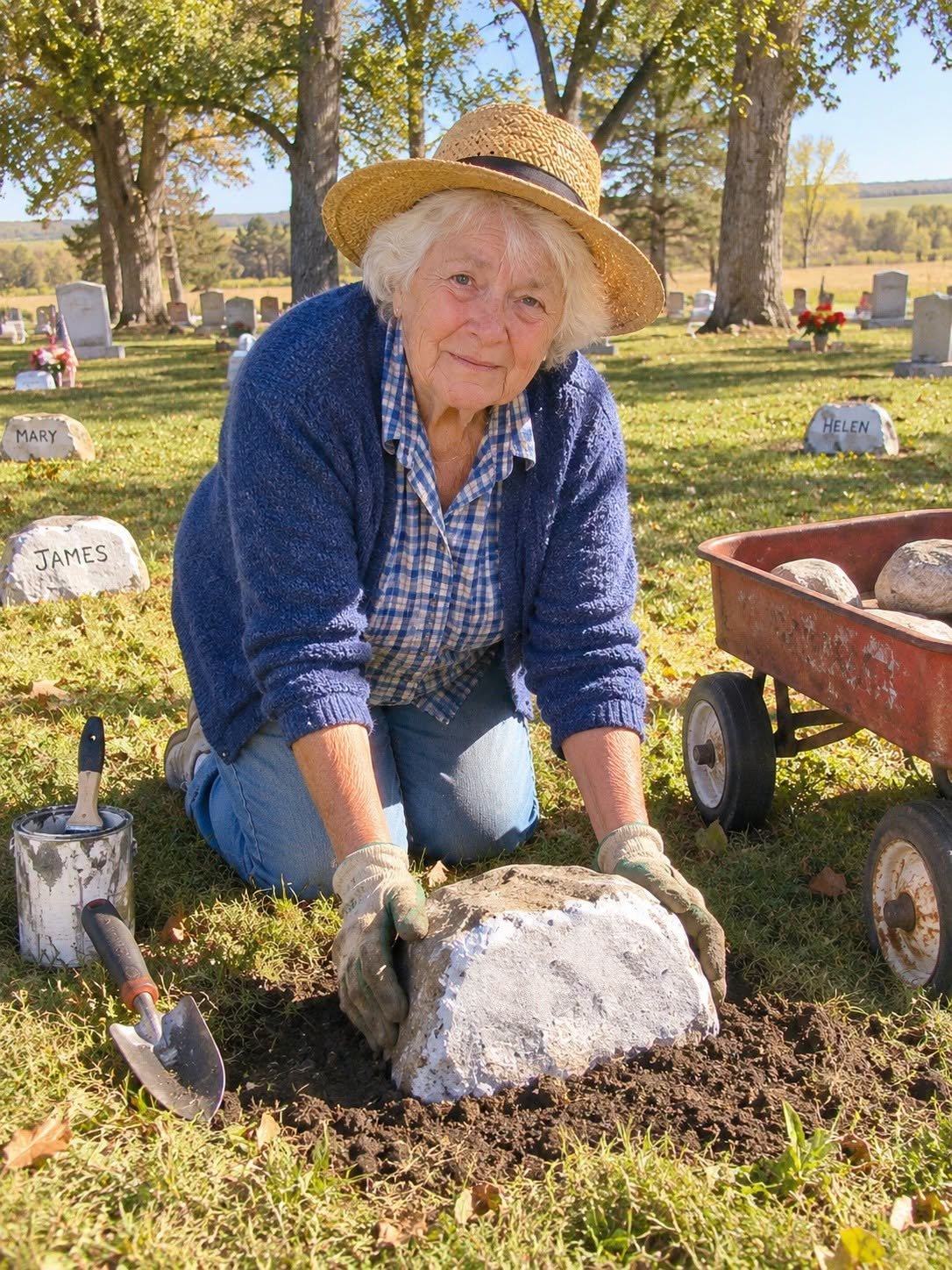
It ran that Wednesday, the twenty-first. Front page, under the fold. One picture. My mother on her knees in my father’s barn coat, with the coffee can and the red wagon in the grass beside her. And behind her, a row of seven white stones.
There was no story. Just a caption.
Wilma Krause, 79, sets a marker in the back acre of Carrow Cemetery, where she says the county poor farm buried 61 people between 1887 and 1931. The city council voted Oct. 12 to sell the
acre.
By Thursday noon, there was a pickup on the cemetery lane I didn’t recognize.
A boy of about sixteen was helping an old man climb down out of the cab. The old man had a
cane and a seed corn cap. He came across the grass a few inches at a time.
“Walt,” my mother said.
“Wilma.”
Walt was ninety-one. His people had farmed the section right next to the old poor farm ground.
“I saw the paper,” he said. “I told the boy, drive me out there.”
He stood at the end of the rows, leaning on his cane, and looked at the white stones for a long
time.
“They were white,” he said finally. “The crosses. My dad and I came by here with a team of horses when I was little. I asked him who they were. And he said, those are the ones who didn’t have
anybody.”
He raised his cane and pointed. Right at the corner. Exactly at the stub of the old hedge post.
“First one was right there.”
My mother didn’t say I told you so. She didn’t say anything at all. She just let him stand there and be right with her.
On Friday, Tom Yoder came out.
Tom runs the monument works out on the highway. It was his father’s before him. He walked the row with his hands in his jacket pockets. Then he crouched down and ran his thumb across my mother’s black lettering.
“Paint’ll give you two winters, Wilma. Maybe three.”
“I know it.”
“I’ve got a stack of gray granite remnants behind the shop. Ends off bigger jobs. I could cut you
flush markers out of those. Eight by sixteen. Name and year.” He stood up. “Forty-five dollars apiece. That covers my stencil and my sand and the saw blade. I’m not charging for me.”
My mother did the multiplication in her head. “Twenty-seven hundred and forty-five. For sixty-one.”
“I can’t cut sixty-one by the fourteenth of November. I’m one man, and I’ve got paying work promised.” He looked down the long strip of grass that still had nothing on it. “But I can bring you a dozen a week from tomorrow, working nights. The other forty-nine you’ll have by spring.
You have my word.”
“A dozen is a dozen more than they’ve got,” my mother said. “Kayla will type you the names.”
By Saturday, there was a coffee can on the counter at the cafe, right next to the register. A strip of
masking tape on the side said Back Acre.
On Monday, Darlene Voss came in for pie. Darlene had voted aye. She stood at the register for a second. Then she pulled a twenty out of her purse and put it in the can without looking at
anybody.
Fifteen people came out that first Saturday.
They brought their own trowels and their own kneeling pads. Two of the Legion men brought tile
probes. Somebody from the co-op brought a bundle of those little orange wire flags they use to mark gas lines.
My mother gave up her one-a-day rule that morning.
She stood at the corner post with the green notebook open and read out the row and place, one after another. The men paced it off and probed. When the rod dropped, they pushed in a flag.

By noon, there were sixty-one orange flags standing in the grass. Four long rows and part of a fifth.
Nobody said much after that.
It’s one thing to read a number in a notebook. It’s something else to stand at the end of a field and count the flags with your own eyes.
We set and painted nineteen stones that day. Kayla lettered until her hand cramped up. A girl from
the high school art class took over the brush, and Kayla sat in the grass shaking out her fingers.
The next Saturday was the thirty-first. Cold and bright. When I turned onto the cemetery lane at eight in the morning, I had to park out on the road.
I counted forty people before I gave up counting.
Tom Yoder’s flatbed was backed up against the cedars. Twelve gray markers lay on a tarp
Eleven of Tom’s markers were the first eleven names in the book.
The twelfth was out of order. It said:
Unknown, 1924. Known to God.
“I didn’t want that fellow waiting till spring with nothing but a number,” Tom said. “The last line’s on
me.”
Each gray marker went at the head of its place, flush with the ground, bedded in sand. The white fieldstones stayed where they were, at the foot. Nobody wanted to be the one to pull up a stone my mother had set.
Darlene Voss knelt at row one, place two, and bedded the gray marker for Anna Novak, widow, aged seventy-one. She did it carefully. She didn’t talk to anybody while she did it.
Everybody else got a white stone that day, with a name painted on it. All the way down to the end
of row five.
Larry Timm was there.
He came alone, and late. He stood off by the fence for a long while in his feed store jacket, not
doing anything. Then he walked slowly down row three to place seven. He read the white stone Kayla had lettered for a girl of nineteen named Clara Timm.
He stood there with his hands hanging at his sides.
I walked over. I didn’t say anything. I just stood next to him.
“My grandfather had a sister,” he said finally. His voice was rough. “We were told she moved off.”
I handed him my trowel.
Somewhere around eleven, I noticed my mother wasn’t working. She was sitting in a lawn chair somebody had brought for Walt. There was something at her feet wrapped in a bath towel.
The crew working row four reached place nine and found it skipped. There was an orange flag,
but no stone.
“Wilma,” Ron Beck called. “We’re missing one here.”
“No, you’re not,” my mother said. “That one’s mine.”
She wouldn’t let me carry it.
It was the last of the four peony stones. She had held it back from the very first day. She had painted it white at her own kitchen table.
She carried it against her chest in both arms. I walked beside her with the towel and the trowel and my hands out, the way you walk beside a child on a bicycle.
She got down on her knees. It took a long time. Forty people found something else to look at.
She cut the sod herself. She bedded the stone herself. Then she held out her hand, and Kayla put the little brush in it, and my mother lettered it right there.
Ida Marie Becker. 1930.
“My father’s mother,” she said.
I got down beside her in the grass.
“They lost the farm in twenty-eight,” she said. “Dad was seventeen. He went up to Saunders County
to hire out, because that’s where there was a man paying wages. His mother had a bad heart and nobody to keep her. So the county took her in.”
She pressed the edge of the stone flat with the heel of her hand.
“He was sixty miles off when she died. By the time the letter found him, she’d been in the ground two weeks.”
“He never told you,” I said.
“He never said her name. Not once in my hearing. Not in my whole life.”
She looked at the green notebook in my hand.
“I found her in an apple box when I was twenty-one years old. In a book the mice had been at.”
She was quiet for a moment. “I didn’t copy sixty-one names because I was a good girl, Beth Ann. I copied the first forty-seven so I could keep the forty-eighth.”
And then I remembered something. All at once. The way you suddenly remember a smell.
I was seven or eight years old. It was Decoration Day. We had done my father’s people up in the front rows, with coffee cans of iris wrapped in tinfoil. And then my mother took my hand and walked me back past the last row of stones, out into the plain grass.

She had a Mason jar of peonies cut from her own bushes. She set it down in the lawn, in no particular place that I could see, and stood there a minute.
“Who’s that for?” I had asked her.
“Whoever’s out here,” she said.
She did it every single year. I must have seen her do it forty times. I always thought it was just one of her ways.
“The peonies,” I said now.
“Fourth row. Nine down from the north. I paced it off in 1968.” She almost smiled. “I was off by about a foot and a half. The rod says so.”
I put my arm around my mother right there in front of half the town. And she let me. She doesn’t always.
That’s how we were, the two of us on our knees in the grass, when a clean white pickup with a
company name on the door pulled up at the end of the lane.
Mr. Stroud got out slowly. He was by himself.
It went quiet down the rows. One crew at a time. The way a field goes quiet when a hawk passes
over.
He didn’t come to my mother first. He stood at the edge of the back acre with his hands in his coat pockets and just looked. Close to sixty white stones. Twelve gray ones. Forty people with dirt on their knees.
Then he started down row one. Reading.
He read every single one. He didn’t skip any. It took him most of ten minutes to get to row four.
I knew what was there. I had set that stone myself the Saturday before. I’d known that name for
two weeks and four days, and I hadn’t said a word about it to anybody except my mother.
“Let the man find his own,” she’d told me.
He walked past place one.
He stopped at place two.
He stood there a long time. Then he took off his cap.
“Mrs. Krause,” he said. Not loudly. “Where did you get this name?”
My mother held out her hand to me. I got her up. She walked over to him with the green notebook, opened it to the fourth page, and turned it around so he could read it himself.
No. 41. Emil Stroud, farmhand, aged 44. Brought from the county jail sick. Died January 1928. Row
4, place 2.
“My granddad had a brother named Emil,” Mr. Stroud said. “He drank. They said he went out to Oregon, and they lost track of him.”
He read the line again.
“Granddad looked for him. He wrote letters out there into the fifties.”
“He was eleven miles from home,” my mother said.
Mr. Stroud stood there holding his cap.
“I didn’t know this was here,” he said. “I want you to hear that from me. Dick told me it was clear ground. The deed said so. And I believed it.”
“Dick believed it too,” my mother said. “I don’t think either one of you is a liar. I think nobody looked.”
He nodded slowly. He looked down at the white stone with his great-uncle’s name on it.
“Is there anything left to do?” he asked.
“Row five has four to go.”
My mother picked up her trowel. She turned it around and held it out to him by the blade.
He looked at it. He looked at his good wool coat. Then he took the trowel.
He walked to the end of row five, and he got down on his knees in the grass. In front of forty people who had every reason in the world not to like him. And he cut the sod for a man named
John Pratt, who was no kin to him at all.
Jeff carried him the stone. Kayla lettered it.
When he was done, he stood up and handed my mother back her trowel. Handle first.
“There’s a meeting Monday,” he said.
“There is.”
“I’d like to be there. If nobody minds.”
“It’s a public meeting, Mr. Stroud,” my mother said. “Sit with my daughter.”
Gene Pruitt was home from Lincoln by then. He and my mother and Darlene Voss signed the call for a special meeting. The clerk posted it on the door of city hall and at the post office.
City hall holds thirty people. So they moved it to the fire hall and backed the trucks out onto the apron to make room.
I’d guess two hundred people came. Men stood along the walls under the hose racks with their
caps in their hands. Walt sat in the front row in his seed corn cap, with his grandson beside him.
Mr. Stroud sat next to me.
Dick Farris called the meeting to order. He looked tired. He’s not a bad man. He coached Little
League for twenty years and plowed half the widows in town out of their driveways every winter for nothing. He’d been trying to get a mower out of a fund with no money in it. That’s all.
“There’s one item,” he said. “Mrs. Voss.”
Darlene stood up. She is not a woman who likes to stand up in front of people.
“I move to rescind the action of October twelfth authorizing the sale of the back acre.” Her voice shook, and she steadied it. “Three weeks ago, I voted aye because I was told that ground was

empty. On Saturday, I set a marker for a woman named Anna Novak. I am changing my vote. And I wanted to say so standing up.”
“Second,” Gene Pruitt said.
“Discussion?” Dick asked.
Nobody had any.
“Then the clerk will call it.”
“Voss.”
“Aye. To rescind.”
“Beck.”
Ron Beck cleared his throat. “My dad mowed that acre for the city for thirty years. He’d have gotten off the mower if he’d known. Aye.”
“Kolar.”
“I was wrong the first time. Aye.”
“Timm.”
Larry didn’t answer right away. The whole fire hall waited on him. You could hear the furnace kick
on.
“We still need a mower,” he said. “I want that said. That part was never a lie.”
He looked down at his hands on the table.
“I’ve got a great-aunt in row three I didn’t know I had. We’ll find a mower. Aye.”
“Pruitt.”
“I wasn’t here. I’m here now. Aye.”
“Krause.”
My mother had her hands folded on the table. The same as the first night.
“Aye,” she said.
“Six to nothing,” the clerk said. “Motion carries.”
Nobody clapped. It wouldn’t have been right.
Dick Farris didn’t pick up his pen.
“The chair doesn’t vote,” he said. “But the chair said something three weeks ago that’s in the
minutes. And I’d like something else in the minutes right next to it.”
He looked down the table at my mother.
“I said nobody was buried there. I was wrong. I went by a deed, and I never once walked out
there and looked. And I said a thing about Mrs. Krause objecting that I would not want said about my own mother.” He swallowed. “Wilma, I apologize.”
“Thank you, Dick,” she said.
“Would you like to say anything? I think this room would hear it.”
“No,” my mother said. “They’ve all got their names now. Go out and read them.”
Then Mr. Stroud stood up beside me.
He took a folded paper out of his coat. The purchase agreement. He walked it up to the front table and laid it down in front of the clerk.
“I won’t be holding the town to that,” he said. “I’ve got four acres of my own out by the highway
that’ll hold storage units just fine.”
He turned his cap around in his hands.
“I had two loads of road rock ordered for the first week of November. I can’t see sending it
back. If the council has no objection, I’d like to put it on the cemetery lane.”
“No objection,” Dick said. And his voice wasn’t quite steady either.
By the time they counted it, the coffee can on the cafe counter had forty-one hundred dollars in it.
Tom Yoder got his twenty-seven forty-five and wouldn’t take one dollar more. He kept his word, too. The other forty-nine gray markers went in the first week of April.
That same month, the council voted six to nothing to plat the back acre as cemetery. So now it’s
on paper. Official. Nobody can ever call it an empty lot again.
The rest of the money in the can went toward a new mower. The Legion made up the difference.
The last time the back acre needed mowing that fall, Dick Farris did it himself. Not with the city
mower. He brought his own push mower from home in the back of his pickup, and a string trimmer. He went around every one of the sixty-one stones by hand. It took him most of a Saturday.
My mother saw his truck out there from the road. She didn’t go out.
“A man ought to be let alone to do a thing like that,” she said.
Mr. Stroud’s gravel went down the first week of November. Two full loads. The lane doesn’t wash
out anymore when it rains.
The first hard frost came on a Tuesday.
I walked over to my mother’s after work and found her at the outside spigot in my father’s barn

coat, rinsing out the coffee can. The water ran white. Then gray. Then clear.
She shook it dry. She set the trowel inside it and carried them both back to the shed. She hung the tile probe on its two nails, right where my father had always kept it.
“Come May,” she said, “I’ll need you to drive me out with the peonies. I can’t carry a jar and my cane both.”
“Where do you want them?”
She gave me a look.
“Fourth row,” I said. “Nine down from the north.”
“You can set them right by the stone this year,” she said. “She’ll have a place to put them now.”
She latched the shed door and tried it twice to make sure.
Then she turned toward the house and the lit kitchen window.
“Supper’s at six,” my mother said. “Bring Jeff. He hauled rocks.”