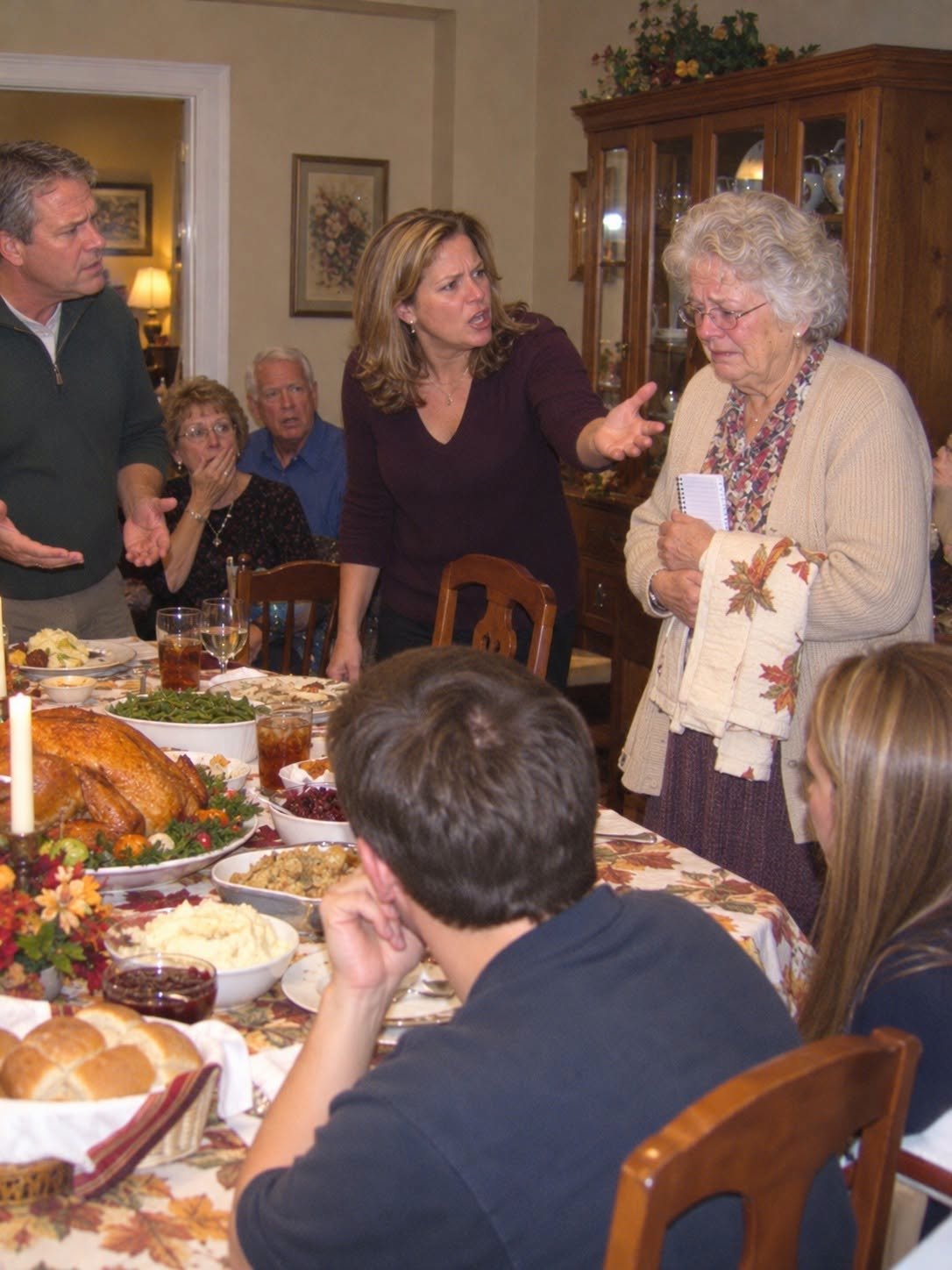
“We think you should start giving us most of your pension.”
My daughter-in-law said it over the shrimp cocktail. On my sixtieth birthday. In my own dining room.
She said it the way you’d mention the weather. She didn’t even lower her voice. She just picked up
a shrimp by the tail, dipped it in the cocktail sauce I’d made from scratch that afternoon, and said it.
“In exchange,” Megan went on, “you can stay here.”
Across the table, her parents nodded along. Doug and Patricia Hale, up from Cincinnati for the weekend. Patricia had a sympathetic little frown on her face. Like they were all discussing what to do about a leaky gutter.
My son Ryan was sitting at the head of the table. In his father’s chair. He didn’t look up from his plate.
“It just makes sense, Mom,” he said. “You don’t need much money anymore. We cover the roof
over your head.”
The roof over my head.
I looked down at the table. At the shrimp platter I’d arranged at four o’clock. The lobster tails I’d
driven forty minutes to the Kroger Marketplace in Westerville to buy, because Megan’s father once mentioned he liked lobster. The salmon with dill sauce. The roasted asparagus. The good china, the wedding china, that Arthur and I got in 1987.
I had cooked every bite of it.
I had paid for every bite of it. A hundred and eighty-four dollars at the Kroger. I still had the receipt in my apron pocket.
And sitting between the wine bottle and the shrimp platter was Arthur’s old digital recorder. A little silver Sony, about the size of a deck of cards.
Its tiny red light was on.
Nobody at that table had noticed it.
“And honestly, Helen,” Megan said, reaching for another shrimp, “if you can still do all the cooking and cleaning and watching Leo, you should hurry up and be useful while you can. Before it gets
harder. You know?”
Her mother laughed a little. Nervously. Doug cleared his throat and looked at his phone.
My seven-year-old grandson, Leo, was tapping away on his tablet at the end of the table. He
looked up, grinned, and said, “Grandma’s the maid!”
Megan laughed.
Ryan said, “Leo. Come on, buddy.” Softly. So softly that Leo knew he didn’t mean it.
Nobody at that table had said happy birthday.
Not one of them.
My name is Helen Marshall. I turned sixty years old that day.
And I want to tell you how I ended up sitting at my own dining room table, listening to my family divide up my pension. And what was in the folder I’d hidden under my chair.
That morning, I woke up at five o’clock. Like I had every single morning for five years.
I lay there in the dark for a minute. Sixty, I thought. Sixty years old today.
Then I got up and went downstairs to make three breakfasts.
Ryan likes two eggs over easy, wheat toast, and black coffee. Megan doesn’t eat eggs. She has a
protein smoothie with frozen berries, almond milk, a scoop of vanilla powder, and half a banana. Not a whole banana. Half. Leo wants chocolate chip pancakes in the shape of Mickey Mouse, with the ears touching.
Three different breakfasts. Every single morning. For five years.
By six-thirty, Ryan came down in his work clothes. He sells insurance for State Farm. He was checking his phone.
“Morning, Mom. Coffee?”
I handed him his coffee.
He took it without looking up from his phone. He drank it standing by the counter. He ate his
eggs in six bites.
“Can you grab Leo from school today? I’ve got a late meeting.”
“I can.”
“And the plumber’s coming between twelve and four for the upstairs toilet. Megan’s in the office all day.”
“I know.”
“Great. Thanks, Mom.”
He kissed the top of my head on his way out the door. The way you’d pat a dog.
He didn’t say happy birthday.
I told myself he’d forgotten in the rush. That he’d remember later. That there’d be a cake tonight. Maybe that’s why Megan’s parents were coming up from Cincinnati. Maybe it was a surprise.
Megan came down at seven in her yoga pants. She took her smoothie off the counter without a
word. She looked at the kitchen floor.
“Helen, did you mop yesterday? There’s something sticky by the fridge.”
“Leo spilled juice last night.”
“Well, can you get it before my parents come? They’re getting here at five. And we’re doing a nice dinner. Seafood. Dad loves lobster.”
“I know.”

“So you’ll handle it?”
“I’ll handle it.”
“Great.”
She took her smoothie and left.
She didn’t say happy birthday either.
At seven-forty, I put Leo’s Mickey Mouse pancakes in front of him. Ears touching. He looked at
them. He said, “You burned the left ear.”
I hadn’t. But I made him another one.
At eight o’clock, I drove him to Highland Elementary in Arthur’s old Buick. He sat in the back seat
playing a game on his tablet.
At the drop-off line, he climbed out without saying goodbye.
I sat there in the car for a minute with the engine running.
Sixty years old.
And not one person in my own house had said happy birthday.
I need to tell you about the house. Or none of this will make any sense.
It’s a white two-story colonial on Linden Avenue in Westerville, Ohio. Just outside Columbus. Four bedrooms. A big oak tree in the front yard. A porch with a swing that Arthur hung himself in 1996.
Arthur and I bought that house thirty-two years ago. In 1994. Ryan was six. Small enough to fall
asleep in the back seat on the way home from Little League games, with his glove still on his hand.
We paid a hundred and twelve thousand dollars for it. We put down twelve thousand. Every penny we had. Arthur was an electrician with IBEW Local 683. I managed the cafeteria at Hanby
Elementary for the Westerville City Schools.
We refinanced twice. Once in 2003 to fix the foundation. Once in 2012 when the interest rates dropped. We replaced the roof in 2009 after the big windstorm. We redid the whole kitchen
ourselves, the summer of 2015. Arthur did the wiring. I did the tile.
We paid off that mortgage in March of 2020. Arthur and I drove down to the Huntington Bank branch on State Street and signed the final papers. Then we went to Bob Evans and split a piece
of pie to celebrate.
Six months later, Arthur’s heart started failing.
Congestive heart failure. The cardiologist at Riverside said it was probably from a virus he never
even knew he had. His heart was just wearing out. Like an old motor.
He had two more years. Good ones, mostly. Then not so good.
When he got sick, Arthur insisted we go see an estate attorney.
I didn’t want to. I fought him on it for months. Sitting in a lawyer’s office talking about deeds and beneficiaries and probate felt like admitting he was going to die.
Arthur was more practical. He was always the practical one.
We went to see Mr. Walter Collins in his office on the second floor of an old brick building on Main Street. Mr. Collins is seventy-four. He did the closing on our house in 1994. He’s been the family’s lawyer ever since.
Arthur sat in that leather chair across from Mr. Collins with his oxygen tank on wheels beside him. And he said something I’ve never forgotten.
“Helen,” he said. “Grief makes people vulnerable. Paperwork keeps vulnerable people from being
cornered.”
I thought he meant strangers. Scam artists. Telemarketers. The man who calls about the car warranty.
It took me five years to understand that Arthur meant anyone.
Mr. Collins set everything up so Arthur’s half of the house went straight to me when he died. A survivorship deed. Recorded with the Franklin County recorder. No probate. No dispute. No
automatic share for Ryan.
The life insurance, a hundred and fifty thousand dollars from the union policy, went to me. Arthur’s pension from the electricians’ union went to me as his surviving spouse.
My own pension, from thirty-one years in the Westerville schools, is two thousand, eight hundred and sixty dollars a month. Through the School Employees Retirement System of Ohio.
Arthur died on a Tuesday morning in October of 2021. In our bedroom. Holding my hand.
The house became mine. Only mine. Sole owner.
Two weeks after the funeral, Ryan came over with Megan.
They sat on my couch. Megan held my hand. She had tears in her eyes.
“Helen, we just don’t want you to be alone in this big house,” she said. “It’s too much for one person. All the stairs. All the yard work. And what if something happens to you? What if you fall?”
“We were thinking,” Ryan said. “What if we moved in? Just for a while. To help you out. We’d give
up our apartment. Leo could have his own room. And we’d all be together. Like a family.”
They were renting a two-bedroom apartment in Gahanna for nineteen hundred dollars a month. Leo was two.

I was so lonely that fall. So lonely I couldn’t breathe some nights. Arthur’s coffee mug was still on the drying rack. His boots were still by the back door.
So I said yes.
They moved in on the first of December, 2021.
“Just for a while,” Ryan said.
That was five years ago.
I’ll tell you how it happened. Because it didn’t happen all at once. It never does.
The first month, Megan helped with dinner. She bought groceries twice. Ryan mowed the lawn. They thanked me for everything.
By spring, Megan had stopped helping with dinner. “I’m so wiped out after work, Helen. You don’t mind, do you? You’re so much better at it anyway.”
By summer, I was doing all the grocery shopping. With my own money. On my own debit card
from the Huntington account.
“We’ll pay you back,” Ryan said. “We’re just saving up for a house of our own.”
They never paid me back.
By the second year, I was doing all their laundry. Cleaning their rooms. Picking Leo up from daycare every single day. Making three breakfasts.
By the third year, Megan was calling me “the help” when she thought I couldn’t hear. On the phone
with her sister.
“Oh, the help will watch Leo. It’s fine.”
By the fourth year, Leo was calling me “the maid.” Because he’d heard it so many times.
And Ryan would say, “Leo. Come on, buddy.” Softly. With a little smile. So softly that Leo knew it was okay.
I paid the property taxes on the house. Every year. Six thousand, four hundred dollars, in two
installments to Franklin County.
I paid the homeowner’s insurance. Eighteen hundred a year to Nationwide.
I paid the gas and electric. I paid the water. I paid most of the groceries.
They paid the internet bill. And Ryan’s car payment. And Megan’s gym membership.
They renovated the upstairs bathroom in 2024. Fourteen thousand dollars. Ryan asked me to “cover it for now” until his bonus came through.
His bonus came through. He bought a new TV.
I never said anything.
That’s the thing I want you to understand. I never said one word. Not in five years.
Because every time I almost did, I’d look at Leo. And I’d think about Arthur. And I’d think, they’re all I have left.
So I made three breakfasts.
On the morning of my sixtieth birthday, after I dropped Leo off at school, I didn’t go straight home.
I don’t know why. I just didn’t.
I drove to the Saturday farmer’s market on Main Street instead. It was a Friday, but in the summer they do Fridays too. I parked Arthur’s Buick by the library and walked.
The sun was out. There were tables of tomatoes and sweet corn and honey and those little zinnias
in Mason jars.
I was standing at the peach stand, holding a peach I wasn’t going to buy, when somebody said my name.
“Helen? Helen Marshall?”
I turned around.
It was Ruth Abernathy. We worked together in the cafeteria at Hanby Elementary for twenty years.
She was the baker. She made the best cinnamon rolls in the state of Ohio. The kids used to line up out the door on cinnamon roll Fridays.
I hadn’t seen her since Arthur’s funeral.
“Ruth,” I said. And then, to my complete horror, I started to cry. Right there at the peach stand.
Ruth didn’t ask any questions. She just put her arms around me.
Then she bought two cups of coffee from the cart by the fountain, and she sat me down on a
bench, and she said, “Okay. Talk.”
So I talked.
For an hour. About the three breakfasts. About “the help.” About “the maid.” About the bathroom
and the property taxes and the groceries. About how nobody in my house had said happy birthday that morning.
Ruth listened to the whole thing without saying a word.
When I finally stopped, she sat back on the bench.
“Helen,” she said. “Whose name is on that house?”
“Mine.”

“Just yours?”
“Just mine. Arthur made sure.”
Ruth was quiet for a moment.
“Then why are you the one asking permission to live in it?”
I didn’t have an answer for that.
Ruth pulled a folded flyer out of her tote bag. It was bright yellow. She smoothed it out on her
knee and handed it to me.
WILLOW CREEK SENIOR COMMUNITY CENTER. Line dancing, Tuesdays and Thursdays. Book club. Woodworking. Community kitchen, volunteers needed.
“I go every Tuesday,” Ruth said. “They do line dancing in the park when it’s nice. Over there.”
She pointed across Main Street to Alum Creek Park. There were maybe twenty people out on the grass in sneakers and sun hats, laughing, stepping and turning to some country song I could just
barely hear.
“Come with me on Tuesday,” Ruth said.
“I can’t. I have to pick up Leo.”
Ruth looked at me for a long moment.
“Helen,” she said. “Do you hear yourself?”
I drove home at eleven.
And I sat in the driveway for a long time with the engine off.
Then I went into the house. Past the sticky spot on the kitchen floor. Past Megan’s yoga mat in the living room. Past the new TV.
I went upstairs to my bedroom. I opened the closet. I got down on my knees. And I pulled out the fireproof lockbox Arthur bought at Sears in 1998.
I opened it with the little key I keep on my keychain.
Inside was a blue folder. Arthur had written on the tab in his blocky electrician’s handwriting.
HOUSE. HELEN.
I sat down on the floor of my bedroom and opened it.
The deed. A certified copy from the Franklin County recorder’s office. HELEN R. MARSHALL. Sole owner.
The final mortgage payoff letter from Huntington Bank. March 2020. Paid in full.
Mr. Collins’s estate summary. Three pages.
And a sealed white envelope. With Mr. Collins’s law firm printed in the corner. And across the front, in Arthur’s shaky handwriting from the last year:
For Helen. Only if you ever feel pressured about the house.
I’d never opened it. I’d forgotten it was there.
I almost opened it right then. On my bedroom floor.
But I didn’t. Something told me to wait.
Instead, I went downstairs to the kitchen. I opened the drawer by the back door. The one where Arthur used to keep the batteries and the flashlights and the rubber bands.
I took out a stack of manila envelopes. Labeled in my own handwriting.
PROPERTY TAX 2022. PROPERTY TAX 2023. PROPERTY TAX 2024. PROPERTY TAX 2025.
INSURANCE. NATIONWIDE.
UTILITIES. AEP OHIO. COLUMBIA GAS. CITY OF WESTERVILLE WATER.
GROCERIES 2022. GROCERIES 2023. GROCERIES 2024. GROCERIES 2025.
BATHROOM RENO. $14,000. RYAN.
Arthur used to tease me about my envelopes. “Helen, you’re the only woman in Ohio who files her receipts for Kroger.”
“You never know,” I’d say.
I’d always just done it. Habit. Thirty-one years running a school cafeteria on a state budget will do that to you. Every dollar accounted for.
I put every one of those envelopes in the blue folder with the deed.
Then I picked up the phone. And I called Mr. Collins.
“Helen,” he said. “Happy birthday.”
I had to sit down on the kitchen stool.
“You remembered?”
“Arthur made me put it in my calendar,” he said. “Five years ago. He said, ‘Walt, somebody has to remember her birthday when I’m gone. I don’t trust Ryan to do it.’”
I couldn’t say anything for a minute.
“Mr. Collins,” I said finally. “I need to ask you some questions. About the house. And about my rights.”

Mr. Collins talked to me for forty minutes on the phone.
He told me what I already knew. And some things I didn’t.
The house was mine. Only mine. Free and clear. No mortgage. No liens.
Ryan and Megan had no ownership interest. None. Not a fraction of a percent. Not because they lived there, not because they renovated a bathroom, not because they had a child.
“They’re occupants by your permission, Helen,” he said. “Nothing more. You can sell. You can lease.
You can ask them to leave with proper notice. The decision is yours.”
“What about my pension?”
“Your pension is yours. Your survivor benefits are yours. Nobody has any claim to a single dollar
of it. Not your son. Not anyone.”
He paused.
“Helen. Is someone asking for your pension?”
“Not yet,” I said.
But I had a feeling.
After I hung up, I called one more number. A real estate agent named Diane Kowalski. She’d sold
my neighbor Bev’s house the spring before.
“I’m not selling,” I told her. “I just want to know what it’s worth. And I’d like to see the paperwork. What it would look like. If I ever did.”
“I can be there at two,” Diane said.
She came at two. The plumber came at two-thirty. I let him into the upstairs bathroom while Diane walked through the downstairs with her tablet.
“Four bedrooms, two and a half baths, updated kitchen, renovated upstairs bath, Westerville schools,” Diane said. “In this market? You’re looking at four-sixty-five. Maybe four-eighty.”
Four hundred and eighty thousand dollars.
For a house we bought for a hundred and twelve.
She left a preliminary listing agreement on the kitchen table. Just a draft. Nothing signed.
I put it in the blue folder too.
At three-fifteen, I picked up Leo from school.
At three-forty-five, I started cooking.
Shrimp cocktail. Lobster tails. Salmon with dill sauce. Roasted asparagus. Twice-baked potatoes. A
Caesar salad with homemade dressing.
A hundred and eighty-four dollars at the Kroger in Westerville.
I set the table with the good china. The wedding china.
And at four-fifty, right before Megan’s parents pulled into the driveway, I went upstairs to Arthur’s dresser. I opened the top drawer. And I took out his little silver Sony recorder.
He used it for job estimates. Talking through wiring plans while he walked through a house. After
he got sick, he used it to record little notes for me. Reminders. Jokes.
I hadn’t touched it since the funeral.
I put in new batteries. I carried it downstairs.
And I set it on the dining room table. Between the wine bottle and where the shrimp platter would go.
And I pressed record.
Megan’s parents got there at five-oh-five.
Doug Hale is a retired dentist. Tall, bald, very serious. Patricia Hale does charity work for her church. She wears pearls to the grocery store.
They’d been to the house maybe six times in five years.
Patricia hugged me at the door. “Helen. You look tired, dear. Are you managing all right?”
“I’m fine, Patricia. Come in.”
Nobody mentioned my birthday.
We sat down at six. I brought out the shrimp first. Then the salad.
Megan started talking about her job. She’s a marketing manager for a medical device company.
Then about Leo’s soccer team. Then about how expensive everything is now. Groceries. Gas. Daycare.
“Honestly, it’s hard,” she said. “Ryan and I are carrying so much. With the house and everything.
And Helen, of course.”
Patricia gave me a sympathetic look across the table. “It must be such a comfort, Helen. Having them here to look after you.”
I set down my fork.
“Look after me?”
“Well, you know,” Patricia said. “At your age. Living alone would be so hard. Megan’s told us how
much they do for you.”
I looked at Megan.
Megan smiled at me.

“Speaking of which,” Megan said. She picked up a shrimp. “Ryan and I have been talking. And we think we have a solution that makes things easier for everybody.”
That’s when she said it.
“We think you should start giving us most of your pension. In exchange, you can stay here.”
Then Ryan said his part. The roof over my head.
Then Megan said, “be useful while you can.”
Then Leo said, “Grandma’s the maid.”
And then Megan laughed. And Ryan said, “Leo. Come on, buddy.”
I sat there with my hands in my lap.
For thirty minutes, I didn’t say anything. I let them talk. About how much my pension was. About how I “barely spend anything.” About how Megan’s sister pays her mother-in-law’s assisted living, so really, this was a bargain.
About how I should be grateful.
The little red light on Arthur’s recorder blinked. Steady. Patient. Collecting every word.
And finally, when Megan said, “So we’ll set up the transfer on the first of the month, okay, Helen?
Two thousand a month. You can keep the rest for your little expenses,” I reached under my chair.
I picked up the blue folder.
And I set it on the table.
Right on top of the lobster.
“What’s that?” Megan said.
I opened the folder. I took out the first page. The certified copy of the deed, from the Franklin
County recorder’s office.
I laid it flat on the table. Facing her.
Megan’s face lost all its color the second she saw the name on it.
HELEN R. MARSHALL.
Sole owner.
For several seconds, nobody at that table moved.
The only sound was the faint hum of the refrigerator from the kitchen. And Leo tapping on his tablet, too young to understand why every adult had suddenly stopped breathing normally.
Ryan leaned over the table.
“Mom. Let me see that.”
I closed the folder halfway.
“No.”
His eyebrows went up.
I couldn’t remember the last time I’d refused him anything. Anything at all. So simply.
Megan reached out next.
“Helen, don’t be dramatic. It’s a deed, not a state secret.”
I pulled it completely out of her reach.
“Then you shouldn’t be worried, Megan.”
Her hand stayed hanging over the table for a long moment. Then she slowly pulled it back.
Arthur’s recorder sat between the wine bottle and the shrimp platter. I reached over and pressed the stop button. The tiny red light went dark.
For thirty minutes, it had collected every single word. The comments about my pension. The jokes about my age. Ryan telling me I should be grateful for the roof over my head.
My roof.
That was the one thing none of them had ever bothered to check.
Ryan rubbed his forehead.
“Dad always said the house would stay in the family.”
“It has,” I said.
“You know what I mean, Mom.”
“Yes,” I said. “I do.”
Megan gave a short laugh.
“Okay. So the paperwork says the house is yours. Fine. What does that change? We’re still the ones paying for everything around here.”
That made me look at her.
“You are?”
“Obviously.”

I opened the folder again. And I took out another sheet.
Property tax receipts. Franklin County Treasurer. Four years of them. Six thousand, four hundred dollars a year.
My name.
Homeowner’s insurance statements. Nationwide. Eighteen hundred a year.
My name.
Utility bills. AEP Ohio. Columbia Gas. City of Westerville. Paid from my checking account at Huntington Bank.
My name.
Then I took out the grocery envelopes. Four of them. Fat with receipts. Bundled by month with rubber bands.
I stacked them on the tablecloth. One on top of the other.
Megan’s confidence faltered. I watched it happen.
Ryan stared at the stack.
“Why do you have all that?”
“Because after your father died, I started keeping records,” I said.
That wasn’t entirely true. I’d always kept records. Arthur used to tease me about it.
At the time, it seemed like a harmless habit.
Now those envelopes were evidence.
Megan’s father finally put down his phone.
“Megan,” Doug said slowly. “You told your mother and me that you and Ryan were carrying Helen
financially.”
Megan snapped her head toward him.
“We are. In other ways.”
“Which ways?” I asked.
She ignored me.
Her mother shifted in her chair. An hour earlier, Patricia had talked about my “situation” like I was
some elderly dependent whose care required a family meeting.
Now she was reading the property tax receipts. In silence.
Ryan tried another approach.
“Mom, nobody said you were a burden.”
I touched the recorder.
“Should we listen?”
He stopped.
Megan’s eyes narrowed.
“You recorded us? Without telling us?”
“I recorded a conversation,” I said, “in my own dining room.”
Her father looked at her.
“Megan. What exactly did you say?”
“Nothing.”
I pressed play.
Megan’s recorded voice filled the dining room. Tinny and small from the little speaker. But every
word was clear.
“We think you should start giving us most of your pension. In exchange, you can stay here.”
Then Ryan’s voice.
“You don’t need much money anymore. We cover the roof over your head.”
Then Megan again.
“If you can still do all the cooking and cleaning and watching Leo, you should hurry up and be
useful while you can.”
Then a little boy’s voice. “Grandma’s the maid!”
Then Megan’s laugh.
I stopped the recording.
Nobody touched their food.
Doug Hale looked furious now. But not at me.
“You told us Helen depended on you.”
“She does,” Megan said. “Emotionally. Practically. We’re the family here, Dad.”
I almost laughed.
For five years, I’d cooked breakfast before sunrise. Three of them. I’d packed Leo’s lunches. Sat up with him through ear infections and the stomach flu. Picked him up from school every single day. Waited for every repairman. Cleaned every room. Paid for the groceries. Paid the utilities. Paid
the taxes. Paid the insurance. Paid for the bathroom.
Apparently, that was dependence.
My dependence on them.
I reached into the folder. And I slid out the sealed white envelope.
Ryan recognized the name printed in the corner. Walter J. Collins, Attorney at Law.
“What’s that?” he said.
“A letter your father had Mr. Collins prepare,” I said. “For me to open if I ever felt pressured about the house.”
Ryan stared at me.
“Dad wrote something about me?”
“About the house.”
“Open it,” Ryan said.

Megan shot him a look. But it was too late.
I broke the seal.
Inside was a short typed letter on Mr. Collins’s letterhead. And underneath it, a folded sheet of
yellow legal paper.
I read the typed letter out loud.
It confirmed that I, Helen R. Marshall, held sole title to the property at 418 Linden Avenue. With full authority to sell, lease, occupy, or otherwise dispose of it as I saw fit.
It also stated that no adult occupant of the property held any ownership or tenancy interest. Beyond whatever permission the owner chose to grant.
I put the letter down on the table.
In plain English: Ryan and Megan lived in that house because I allowed them to.
Not because they owned it.
Not because Arthur promised it to them.
Not because having a child turned them into permanent residents.
Because I said yes.
Ryan picked up the letter. He read it twice.
“But we’ve been here five years.”
“Yes.”
“We renovated the upstairs bathroom.”
“With fourteen thousand dollars I paid for,” I said. I pulled out the envelope marked BATHROOM RENO. “You were going to pay me back with your bonus. You bought a seventy-five-inch
television instead.”
His eyes dropped to the table.
Megan folded her arms across her chest.
“So what? Are you threatening to evict your own family? Because nobody remembered your birthday?”
That one sentence made everything clear.
Even now. Even after the deed, and the receipts, and the recording. She still thought this was about a cake.
Doug turned and looked at his daughter.
“It’s her birthday?”
Nobody answered him.
“No, Megan,” I said. “I’m responding to five years of being treated like staff in my own home.”
Ryan’s voice hardened.
“Mom. That’s not fair.”
I looked at him.
“Who made your breakfast this morning, Ryan?”
He didn’t say anything.
“Who bought tonight’s lobster?”
Silence.
“Who waited four hours for the plumber today?”
Silence again.
“Who watches Leo every time you work late?”
Megan cut in.
“You’re his grandmother. Grandmothers help.”
“Help is given, Megan,” I said. “It isn’t assigned.”
Patricia Hale put down her wine glass.
“Helen has a point, honey.”
Megan’s face went tight.
“Mom. Stay out of this.”
“You invited us into it,” Patricia said, “when you told us she was financially dependent on you.”
Doug leaned back in his chair.
“And you certainly never mentioned that she owned the house.”
“I thought Ryan did,” Megan said.
Everybody turned and looked at Ryan.
Ryan’s f

ace went red. From the collar up. The way his father’s used to.
“I never said that exactly.”
Megan stared at her husband.
“You told me this was basically your inheritance. You said your dad left it to you.”
“I said eventually.”
“Eventually?”
“Dad always talked about keeping it in the family,” Ryan said. He wouldn’t look at anybody.
I unfolded the yellow legal paper. The one from inside the envelope.
It was Arthur’s handwriting. From the last year. The letters shook in places. By then, his heart was so weak that even holding a pen was hard work.
I read it out loud.
“Helen. Home is supposed to be where you are safe. If anyone ever makes you feel like a guest in the place we built together, remember this. The house is yours. Not Ryan’s. Not anyone else’s. Yours. Do not trade peace for guilt. Live for yourself. Arthur.”
My voice broke on the last line.
For the first time that evening, I didn’t care who noticed.
Ryan looked down at the table.
Megan looked annoyed. Not moved. Annoyed.
“He was sick when he wrote that,” she said.
Ryan snapped his head toward her.
“Megan.”
“What? He was! Maybe he was paranoid. Heart patients get paranoid. It’s from the medication.”
The whole room changed.
Even Leo looked up from his tablet.
Ryan pushed back from the table so hard his chair scraped across the hardwood floor.
“Don’t you talk about my dad like that.”
Megan stared at him. Astonished.
“Oh, now you have a backbone?”
Her father closed his eyes.
“Megan. Stop.”
But she was cornered now. And cornered pride doesn’t usually turn humble.
It turns reckless.
She stood up.
“Fine. Helen owns the house. Helen pays some bills. Helen cooks. Congratulations, Helen.”
She threw her napkin on the table.
“But without us, what does she have? She’s sixty years old. She barely goes anywhere. Her friends all have their own lives. She needs this family a lot more than this family needs her.”
For five years, that exact sentence had been my greatest fear.
That morning, I might have believed it.
But then I thought about Ruth. At the peach stand. Holding me while I cried.
The yellow flyer. Willow Creek. The community kitchen.
Twenty people laughing in the park, stepping and turning in their sun hats.
A whole life out there. A life that didn’t begin and end at my stove.
I reached into the blue folder one last time.
This paper was newer than the others. Crisp. Still smelling like a printer.
A preliminary listing agreement from Diane Kowalski at Coldwell Banker.
Ryan recognized the logo. Everybody in Westerville knows that logo.
“What is that?”
“I called someone this afternoon,” I said.
His mouth fell open.
Megan stopped breathing.
“You’re selling the house?”
“I’m considering it.”

“You can’t.”
“I can,” I said. “Mr. Collins confirmed it this morning. Four hundred and sixty-five to four hundred and eighty thousand dollars. That’s what it’s worth.”
“Where are we supposed to live?”
The irony was so sharp that Patricia Hale actually looked away.
One hour earlier, Megan had proposed taking two thousand dollars a month from my pension. In
exchange for allowing me to keep living in my own house.
Now she was asking where she’d live if I stopped allowing her to stay in it.
Ryan stood up and came around beside her.
“Mom. Please. Don’t make some huge decision just because tonight got emotional.”
“This decision didn’t start tonight, Ryan.”
I looked at my son carefully. My only child.
“It started every morning you walked into my kitchen and talked to me like an employee. Every time Megan insulted me, and you decided keeping the peace with her mattered more than protecting me. Every time Leo repeated something he heard, and you corrected him so softly he
knew you didn’t mean it.”
Ryan’s eyes filled up.
I’d imagined this moment a hundred different ways, on a hundred different sleepless nights.
In some versions, I screamed. In some versions, I threw them out that same night. In some versions, I demanded apologies. On my knees, they’d beg.
But standing there in my dining room, with the lobster getting cold, I realized I didn’t need to
punish him.
I needed boundaries.
“I’m not selling tomorrow,” I said. “And I’m not putting anybody out on the street tonight.”
Megan relaxed. Too fast.
“But things change now,” I said.
Her face froze again.
“Starting tomorrow morning, I don’t cook separate breakfasts. I don’t clean your rooms. I don’t do your laundry. I don’t provide automatic childcare. I don’t buy your groceries. And you do not get one dollar of my pension. Not one.”
Megan laughed nervously.
“This is ridiculous.”
“You and Ryan will pay a fair share of the household expenses,” I said. “Utilities. Groceries. Starting
the first of the month. While you arrange for your own place.”
Ryan stared at me.
“Our own place?”
“Yes.”
“How long do we have?”
“Ninety days.”
Megan exploded.
“Ninety days? With a seven-year-old?”
Her father spoke before I could.
“You’re two employed adults, Megan. You both make good money. You’ve been living here rent-free for five years. What have you been doing with it?”
She spun around on him.
“Whose side are you on?”
“I’m on the side of reality,” Doug said.
Megan grabbed her purse off the sideboard.
“This family is unbelievable.”
She stormed out toward the front hallway.
Leo sat frozen in his chair. He looked at the doorway his mother had disappeared through. Then
at the shrimp on his plate. Then at me.
“Grandma?”
“Yes, sweetheart?”
“Is it really your birthday?”
I had to swallow before I could answer.
“Yes, sweetheart. It is.”
His little face changed. I watched it. Something working its way through.
“Why didn’t we get you a cake?”
No adult at that table answered him.
Then Leo slid down off his chair. He ran into the living room. And he came back a minute later with a sheet of white printer paper and a blue marker.
He knelt on his chair at the dining room table. He wrote very slowly, with his tongue pressed
between his teeth. Letter by letter.
When he was done, he slid it across the table to me. Right next to the deed.
HAPY BIRTHDAY GRANDMA.
The spelling was wrong.
There was a drawing underneath. A stick figure with gray hair and a big smile, holding what was either a spatula or a magic wand.
It was the only birthday present I got that day.
And it nearly broke me.
Megan was standing in the hallway doorway, watching him.
For once in five years, she didn’t say anything at all.
Megan’s parents left about twenty minutes later.
At the front door, Patricia hugged me. Awkwardly. Stiffly. But she held on longer than she needed
to.
“I’m sorry, Helen,” she said quietly. “For taking part in a conversation I didn’t understand. I should have asked you. Instead of just listening to Megan.”
Doug shook my hand. Very formally. Like a dentist at the end of an appointment.
“The salmon was excellent,” he said.
I almost laughed out loud at that.
Of course it was excellent. I’d spent forty years learning how to feed people. Thirty-one years in a school cafeteria feeding six hundred kids a day on a dollar-fifty a plate. Five years feeding a family that called me the maid.
After they were gone, I went into the kitchen and started putting the leftovers in containers. The way I always do.
Ryan came in a few minutes later.
“Mom.”
I kept working. Lobster in one container. Salmon in another.
“Mom. Please look at me.”

I turned around.
He looked younger, suddenly. Standing there in the kitchen doorway in his work shirt with his tie loose. Not like the impatient man grabbing coffee at six-thirty in the morning. Like the little boy
who used to make me crooked birthday cards out of construction paper and glitter glue.
“I forgot,” he said.
“I know.”
“I don’t mean just your birthday.”
I waited.
“I forgot you had a life before us,” Ryan said.
That hurt more than anything Megan had said all night.
He sat down at the kitchen table. At Arthur’s spot.
“When Dad died, you did everything,” he said. “Everything. The funeral. The insurance. The house.
And I think I just got used to it. Then Megan got used to it. Then Leo saw all of us doing it.”
“Yes.”
“I should’ve stopped it.”
“Yes,” I said.
He nodded. Accepting it.
“I’m sorry, Mom.”
I believed him. I believed he was sorry.
But that didn’t erase five years.
“An apology can be real, Ryan,” I told him. “And still not be enough to make things go back to
the way they were.”
He rubbed his eyes with the heels of his hands.
“So the ninety days are real?”
“Yes.”
He gave a sad little laugh.
“You sound like Dad.”
“No,” I said. “I finally sound like me.”
The next morning, I woke up at five o’clock. Out of habit.
For several minutes, I lay there in the dark listening to the silence.
Then I started to get up. My feet touched the cold floor.
And then I remembered.
I didn’t have to make three breakfasts.
I climbed back under the blanket. I pulled it all the way up to my chin.
And I went back to sleep.
At seven-ten, I woke up to the sound of kitchen cabinets opening and closing downstairs. And
somebody swearing under their breath.
When I came into the kitchen in my old fleece robe, Ryan was standing over the griddle, burning pancakes. The smoke detector was about to go off. Leo was sitting at the counter eating
Cheerios out of the box.
Megan was nowhere to be seen.
Ryan looked down at the blackened pancake on his spatula. Then at me.
“Don’t say it,” he said.
“I wasn’t going to.”
He smiled. Reluctantly.
“Happy birthday, Mom. One day late.”
He reached behind the coffee maker. And he set a small cake on the counter. A grocery store cake from the Kroger bakery. White frosting. Pink roses. HAPPY BIRTHDAY MOM written across it
in blue gel. The price sticker still on the plastic lid. $12.99.
It wasn’t enough to fix us.
But it was a beginning.
Three days later, on Tuesday, I went to Willow Creek with Ruth.
I’d been dreading it. I expected beige hallways. A TV room full of lonely people in wheelchairs watching game shows. Bingo.
Instead, I found gardens. Raised beds full of tomatoes and zinnias. Exercise classes. A woodworking shop where an old man named Harold was building a birdhouse shaped like Wrigley Field. A book club arguing about a mystery novel.
And a big, bright community kitchen. Full of residents and volunteers arguing at the top of their lungs over whether cinnamon belongs in chili.
It doesn’t. I settled it. Everybody agreed.
The kitchen manager, a cheerful woman named Rosa, found out I’d run a school cafeteria for thirty-one years. She practically grabbed me by the arm.
“Would you ever consider helping with our weekend cooking workshops? For the residents?
Basic cooking. Budget meals. We’ve been looking for someone for a year.”
I laughed.
“You don’t even know if I can cook.”

Ruth grinned at me across the kitchen.
“I told her,” she said.
For the first time in five years, somebody wanted my cooking without treating it like an obligation.
Without expecting it. Without assigning it.
I signed up for the following Saturday.
And then I followed Ruth outside to the park. Where twenty people in sneakers and sun hats were
lining up on the grass while a man with a Bluetooth speaker played “Boot Scootin’ Boogie.”
I joined the line dancing group.
I was terrible. I turned left when everybody turned right. I stepped on Harold’s foot twice.
I loved every single second of it.
Over the next three months, the house changed.
Ryan and Megan cooked their own meals. Mostly takeout, the first month. Then Ryan learned to
make spaghetti. Then tacos. He’s actually not bad at tacos.
They arranged after-school care for Leo at the YMCA. Two hundred and twenty dollars a week. Megan complained about it every single day for a month.
On the first of every month, Ryan put a check on the kitchen table. Utilities and groceries. Nine hundred dollars. Every month. On time.
Megan barely spoke to me. But when she did, her tone was careful.
Not warm. Careful.
Careful was enough.
Leo stopped calling me “the maid” within about two weeks. Once he figured out that none of the
grown-ups laughed anymore when he said it.
One afternoon in September, he wandered into the kitchen while I was baking oatmeal cookies for my Saturday class at Willow Creek.
“Grandma? Can I help?”
I handed him an apron. One of mine. It came down to his ankles.
“Wash your hands first.”
He looked embarrassed.
“Because I have germs?”
“Everybody has germs,” I said.
He smiled.
Then he went to the sink and washed his hands. Twice. Very thoroughly. Up to the elbows.
We made three dozen cookies. He ate six of them. He told me about a kid in his class named
Brayden who can burp the alphabet.
At the end of ninety days, Ryan and Megan moved into a townhouse in Lewis Center. Fifteen minutes north. Three bedrooms. Two thousand, one hundred dollars a month.
Megan wanted Ryan to fight me for the house. She talked to a lawyer. A woman in Dublin. She paid her four hundred dollars for a consultation.
The lawyer read the deed and Mr. Collins’s letter and told her there was nothing to fight about.
Ryan told me that part himself. He laughed when he said it. Sort of.
I didn’t sell the house.
Not then.
The house felt different after they left. Bigger. Quieter.
For the first week, the silence frightened me. I kept listening for footsteps on the stairs. For somebody calling from the kitchen. I made too much coffee every morning.
Then, slowly, the silence became peaceful.
I turned the upstairs bedroom, the one with the renovated bathroom, into a sewing room. I bought a new Singer machine at the Jo-Ann Fabrics in Polaris. I started making aprons for the
cooking class at Willow Creek. Bright ones. With pockets.
I put fresh flowers from the farmer’s market on the dining room table. Every week. Instead of serving platters.
I stopped setting my alarm for five.
I joined Ruth’s book club. We read a mystery set in Scotland and argued about the ending for two hours.
On Sundays, Ryan brings Leo over for lunch. I make whatever I want. Not three different things. One thing. And they eat it.
Sometimes Megan comes. Sometimes she doesn’t.
When she does, she brings a dish. A salad, usually. Once, a pan of brownies from a box.
They were a little dry.
I told her they were delicious.

At Thanksgiving, Megan stood in my kitchen doorway for a long time while I was basting the turkey. Leo was in the living room with Ryan, watching the Lions game.
“Helen,” she said.
I turned around.
“My mom asked me if I’d apologized to you yet.” She looked down at her shoes. “I told her I was working on it.”
“Okay,” I said.
“I’m still working on it.”
“That’s okay too, Megan.”
She nodded. Then she picked up a potato peeler from the drawer. And without being asked, she started peeling potatoes at the sink.
We didn’t talk. But we stood next to each other for twenty minutes.
It was the best conversation we’d ever had.
Six months after my sixtieth birthday, I took out Arthur’s old recorder one more time.
I was sitting alone at the kitchen table on a Sunday evening in February. Snow falling outside. The
house quiet. The sewing machine humming upstairs where I’d left it on.
I wanted to delete the dinner conversation. I didn’t need it anymore. I didn’t want it sitting there in that little silver box.
So I scrolled back through the files. To delete it.
And I found an older file. Dated September 2021. One month before Arthur died.
I’d forgotten it was there. I’d never listened to it.
I pressed play.
Arthur’s voice came through. Thin, from the illness. Short of breath. But unmistakably, completely amused.
“Helen. If you’re listening to this, you’re probably sitting at the kitchen table organizing something that doesn’t need organizing.”
I laughed before I could stop myself. Out loud. Alone in my kitchen.
Then his voice got softer.
“I’ve been watching you take care of me for a year now. And Ryan. And everybody. You’ve been taking care of everybody your whole life, El. Six hundred kids a day at that school. Me. Our boy.”
He stopped to catch his breath. I could hear the oxygen machine hissing in the background.
“Promise me something. When I’m gone, promise me you’ll save some of that care for yourself. Just a little. You’ve earned it a hundred times over.”
A long pause.
“And go dancing. You always said you wanted to learn. Go learn. I’ll be watching. Don’t step on anybody.”
The recording ended.
I sat alone at the kitchen table. Snow falling. The afternoon light going gold across the place where I used to stand every morning, waiting for somebody to need me.
For most of my life, I’d mistaken being needed for being loved.
They’re not the same thing.
Love can include service. And sacrifice. And cooking, and childcare, and patience, and forgiveness.
Love can include three breakfasts on a hard morning.
But love does not require disappearing.
I didn’t delete the dinner conversation. I decided I’d keep it. Right next to Arthur’s.
Both of them. Side by side. On his little silver recorder.
The night I stopped disappearing. And the night he asked me to.
Then I turned the recorder off. I put on my sneakers. I put on my coat and the bright red scarf
I’d sewn myself.
And I drove to the Willow Creek community center through the snow.
Ruth was waiting for me in the parking lot, stomping her boots.
So was the music.
Harold had his Bluetooth speaker going in the big room. “Achy Breaky Heart.” Twenty people in a line.
I took my place at the end. Between Ruth and Harold.
And I stepped on Harold’s foot. Just once.
And this time, nobody in the whole world was calling from the kitchen for me to hurry up.