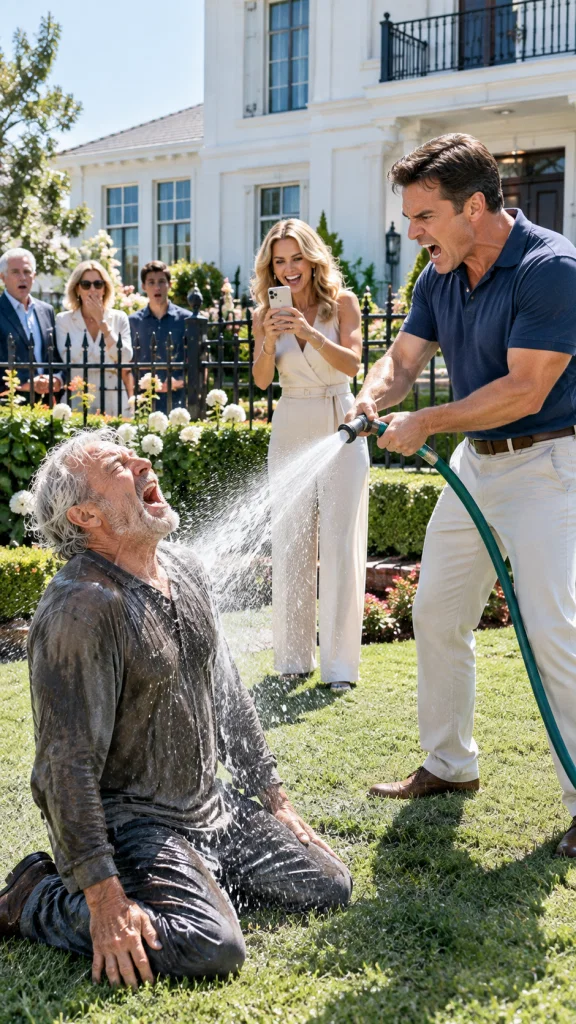
“If I offend you so much, then wash me yourself where everyone can see,” I told my son… and I never believed he would actually grab the garden hose.
My name is Walter Hayes. I’m sixty-eight years old, and for forty-three years I worked at the municipal meat-processing plant in Dayton, Ohio. It wasn’t respectable work in the way people usually mean that word. There was no office, no polished desk, no pressed shirt waiting for me every morning. My hands carried the smell of meat, industrial disinfectant, cold dawns, and honest fatigue. But those same hands raised my only son, Brandon.
When my wife, Margaret, died, I believed Brandon would be the person I could lean on.
I had worked my entire life so he wouldn’t have to lift heavy crates or come home with a back that felt broken the way mine often did. I paid for college, professional courses, business suits, textbooks, and even his first car.
And he succeeded.
Brandon became a lending manager at a prestigious financial firm in Columbus and married Vanessa, an elegant woman who always smelled expensive, always looked perfectly composed, and always smiled in that polished way some people do while making you feel unwelcome without ever raising their voice.
One Sunday afternoon, Brandon showed up at my modest house wearing the expression of a worried son.
“Dad, I need your help. This opportunity may never come again,” he said, sitting at my kitchen table the same way he had when he was a boy asking for another biscuit.
He told me about a beautiful house in Dublin, Ohio, inside an exclusive gated community. It had an enormous yard, high ceilings, marble floors, large windows, and private security.
According to Brandon, if they could make the down payment that week, the house would finally be theirs.
“How much do you need?” I asked.
“About two hundred twenty thousand dollars,” he answered without looking away. “I know you have your retirement payout, your savings, and the money from selling Grandpa’s land. But don’t think of it as giving the money away. You’ll live with us. You’ll have the large bedroom downstairs. You’ll never have to be alone again.”
Then he took my hands.
The same cracked, rough hands Vanessa usually avoided looking at.
“I swear on Mom’s memory, Dad. It’ll be your home too.”
That promise broke through every bit of caution I had.
The next morning, I went to the bank and withdrew nearly everything I had put aside for retirement.
On top of that, the lender required me to sign as the primary borrower because Brandon couldn’t qualify for the mortgage by himself.
He told me it was only paperwork.
A technical requirement.
Normal bank documents.
So I signed.
I didn’t know then that those papers would eventually become the only protection I had left when my own son stopped treating me like his father.
At first, the house looked like everything Brandon had promised.
White walls.
Huge windows.
A gleaming kitchen.
A backyard that looked as though it belonged in a luxury magazine.
But I was never given the large downstairs bedroom.
Instead, they put me in a small room beside the laundry entrance.
“It’s nothing against you, Mr. Hayes,” Vanessa said in that sweet, frozen voice of hers. “You’ll actually have more privacy back there.”
I accepted it.
That was what I had always done.
I woke early, swept the patio, watered the plants, and tried to make myself useful without being noticed.
Then the rules started.
I wasn’t allowed to sit in the living room when Vanessa had friends over.
I couldn’t cook sausage because she said the smell “soaked into the curtains.”
I wasn’t allowed to wash my work clothes in their washing machine because, according to her, “the odor stayed inside the drum.”
Eventually, she asked me to eat alone in my room because she didn’t want me damaging the upholstered dining chairs.
One night, I went into the kitchen for water and heard Vanessa talking to Brandon.
“Your father still smells like that factory no matter how often he showers. I can’t have my friends seeing him wandering through the house. He makes us look cheap.”
I stood in the hallway, waiting for my son to defend me.
Brandon only sighed.
“I’ll talk to him tomorrow.”
The next morning, he handed me a bar of blue medicated soap.
“Dad, please shower twice a day. Vanessa says the smell is pretty bad.”
So I did.
I scrubbed until my skin turned red.
My arms.
My neck.
My hands.
But you can’t wash away forty years of honest labor with a bar of soap purchased to make a man ashamed of himself.
The worst humiliation came one evening when Brandon hosted several executives from his firm for dinner.
Vanessa decided I couldn’t remain inside.
“They’re important people, Mr. Hayes,” she said while handing me a blanket. “You’ll probably be more comfortable in the garden shed tonight.”
The garden shed was at the far end of the property.
It contained fertilizer, an old lawn mower, rakes, buckets, and one folding cot.
I slept there that night.
Then another.
Then many more.
One January morning, the cold seemed to bite directly into my bones.
My heavy winter coat was still hanging in the closet of my old room inside the house, so I quietly went in to get it.
I thought everyone was asleep.
Vanessa saw me in the hallway and screamed as though she had caught a thief.
“I told you not to come through here! You’re bringing that smell through the whole house!”
Brandon came downstairs wearing a robe, already angry.
“Dad, we’ve talked about boundaries.”
“I only came in for my coat, son. It’s freezing in the shed.”
Vanessa covered her nose with a white handkerchief.
“He smells terrible, Brandon. Get him outside before the smell gets everywhere.”
My son grabbed my arm.
Hard.
Not the way a son holds his father.
The way someone removes something unwanted.
“Get outside.”
“Brandon, think about what you’re doing.”
He shoved me into the wet grass, grabbed the garden hose, and shouted:
“If you want to live like an animal, then I’ll wash you like one!”
The freezing water hit my chest.
I dropped to my knees.
Neighbors began coming to their windows.
Vanessa pulled out her phone and started recording.
And while the water knocked the breath out of me, my son shouted so everyone could hear:
“Maybe this will finally get that trash smell off you!”
I looked up at him.
I was soaked.
Shaking.
Mud stuck to my pants.
And at that exact moment, I remembered the paperwork Brandon had forgotten I signed.
The cold water struck my face, chest, and hands.
Every drop seemed to carry another memory with it.
Sacrifice.
Hunger.
Double shifts.
Paid bills.
Tuition.
New shoes for Brandon while I wore mine until the soles cracked apart.
“This is how you wash away embarrassment!” he shouted, sweeping the hose across me as though I were dirt on his lawn.
Vanessa laughed from the patio.
“Make sure you get all of it on video,” one neighbor called from behind a fence.
I still don’t know whether she said it because she was angry or because she wanted to watch.
Several people had gathered near the sidewalk.
A delivery driver had stopped with his helmet still on, holding up his phone.
No one stepped forward.
“I’m your father,” I managed to say.
Brandon squeezed the spray nozzle tighter.
“A father doesn’t walk into my house smelling like that.”
My house.
That was what he said.
Not our house.
Not the house purchased with my retirement money.
Not the house where he had promised I would grow old with dignity.
When he finally turned off the water, I was lying in the grass, struggling to breathe.
Vanessa stepped close enough to record my face.
“So he can’t say later that we mistreated him,” she whispered.
That sentence finished something inside me.
I crawled back to the shed.
With stiff hands, I peeled off my soaked clothes, wrapped myself in a thin blanket, and sat on the folding cot.
I didn’t cry.
Something worse happened.
I stopped hoping my son still loved me.
I stayed awake the entire night.
At five in the morning, when the sky was only beginning to lighten, I opened a metal box beneath the cot.
Inside was a safe-deposit-box key and an old business card belonging to my longtime friend, attorney Henry Collins.
Years earlier, when Brandon asked me to sign the mortgage papers, Henry had told me:
“Walter, keep certified copies of everything. Families may sign documents with ink, but sometimes betrayal is written in something far uglier.”
I had listened.
I took the first bus downtown.
I walked into the bank wearing old clothes, my throat sore and my back still aching from the cold.
The branch manager, Mrs. Parker, welcomed me with respect.
She had known me for years.
She managed an investment account no one in my family knew existed.
The money wasn’t luck.
It came from bonuses, retirement savings, interest, the sale of land, and a lifetime of living modestly.
I placed the certified documents on her desk.
“I need to know what happens if I pay off the entire mortgage today.”
She went through the papers carefully.
Then she called the legal department.
Forty minutes later, she returned with a different expression.
“Mr. Hayes, you didn’t simply sign as financial support. You’re listed as the primary borrower, the person who provided the down payment, and the party holding preferential ownership rights if you satisfy the remaining debt.”
“Tell me what that means in plain English.”
“If you pay off the full mortgage balance, you can request full possession of the property. The house can legally become yours.”
For the first time since the night before, I felt as though I could breathe properly.
“How much is left?”
“One million two hundred eighty thousand dollars.”
“And what do I have available?”
“One million six hundred ninety thousand.”
I closed my eyes.
I saw Brandon holding the hose.
Vanessa filming me.
Neighbors standing silently behind their windows.
“Pay it off.”
Mrs. Parker studied me.
“That’s a major decision.”
“No. The major decision was raising a child for decades and then learning he was capable of hosing down his father in front of the neighborhood. This is simply putting ownership where it belongs.”
I signed until my hand hurt.
The bank processed the payoff.
Attorney Collins coordinated with the appropriate property and civil authorities.
A petition was prepared to enforce my ownership and possession rights based on the financing documents and the treatment I had received as the primary contributing occupant.
They explained that Brandon and Vanessa would know nothing until the formal notice arrived.
I still had to spend one final night in that shed.
That evening, I could hear them laughing through the windows while they ate dinner inside.
Vanessa said the video had turned out “perfect.”
She told Brandon he had finally taught me where I belonged.
I lay down coughing and shivering.
But for the first time in months, I felt calm.
The following morning, my son would wake up believing he owned his palace.
But the documents were already coming.
And when he read the first page, he would finally understand that he hadn’t humiliated a powerless old man.
He had humiliated the man who still held the legal keys to everything.
At seven the next morning, Brandon entered the shed without knocking.
He pushed the door open with his shoe, as though I were no different from the tools stored beside the buckets.
“Get up,” he ordered. “A real estate consultant is coming today to take photos for one of Vanessa’s events. I don’t want you walking around the property looking like that. Stay in here until two. If you need the bathroom, go to the park.”
I was already dressed.
I wore the dark charcoal suit I had worn to Margaret’s funeral.
It hung a little loosely on me now, but it was clean, pressed, and respectable.
“What if I feel like walking through the yard?” I asked.
Brandon laughed.
“Don’t test me, Dad. Yesterday showed you what happens when you forget your place. I can wash you again.”
I looked straight at him.
“That’s what I thought.”
He walked away irritated.
He didn’t notice that for the first time in months, I wasn’t afraid.
At eleven thirty, I sat on the stone bench near the main entrance.
The security guard looked at me strangely but said nothing.
Maybe because I wasn’t hiding anymore.
Maybe because waiting for something is different from enduring something.
At eleven forty-five, three vehicles entered the community.
A black bank sedan.
A county civil enforcement vehicle.
And a police cruiser.
Mrs. Parker stepped out first.
Attorney Collins followed her.
Then came a court officer carrying a sealed folder.
Vanessa opened the front door wearing a cream silk blouse with her phone in her hand.
The moment she saw the police, her face went pale.
“Brandon!” she screamed. “There are police outside!”
My son appeared, buttoning his jacket.
He had the same expression he always wore at work, the look of a man convinced that raising his voice gave him authority.
“What is this?” he demanded. “Dad, are you making a scene because we washed you yesterday?”
The court officer ignored the remark.
He opened his folder and read aloud:
“Mr. Brandon Hayes and Mrs. Vanessa Hayes are hereby notified that the outstanding mortgage associated with this property has been paid in full by its primary borrower and principal contributor, Mr. Walter Hayes.”
Brandon laughed nervously.
“Paid in full? With what money? My father doesn’t have that kind of money.”
Mrs. Parker stepped forward.
“Your father had more than sufficient funds. Under the financing and property agreements you signed, full satisfaction of the debt by the primary borrower allows Mr. Hayes to enforce his preferential ownership and possession rights.”
Vanessa clutched her phone.
“No. That’s impossible. This is our house. We chose the furniture. The lighting. The marble.”
“Furniture doesn’t purchase dignity,” I said.
Brandon looked down at the paperwork.
His hands began shaking.
“Dad… we should talk. We’re family.”
That word sounded colder coming from him than the hose water had felt against my skin.
“Family?” I asked. “Was I family when you made me sleep beside fertilizer and garden tools? Was I family when you took away the living room, the dining table, the washing machine, and even the right to come inside for my winter coat? When you knocked me into the mud and told the neighborhood I smelled like garbage, was I your father then?”
No one spoke.
Neighbors watched through curtains and gates.
The same people who hadn’t stepped forward the day before now wanted to see what happened next.
The court officer handed Brandon the order.
“You have two hours to remove personal documents, clothing, medication, and essential belongings. Possession of the property is being transferred to Mr. Walter Hayes. Larger household items will remain pending inventory.”
“Two hours?” Vanessa shrieked. “You can’t throw us out like criminals!”
One of the officers answered:
“Yesterday, you left a sixty-eight-year-old man soaking wet outside in freezing weather. Two hours sounds generous.”
Then came a scene Vanessa would never have chosen to record.
The woman who had mocked my smell stuffed expensive dresses into black trash bags.
Brandon ran up and down the stairs carrying suits, shoes, watches, files, chargers, and boxes.
Each time he tried to approach me, an officer stepped between us.
“Dad, please,” he begged. “We don’t have anywhere to go. Vanessa’s car payments drained our savings. I can fix this. I can apologize.”
“An apology and understanding are not the same thing.”
Vanessa heard me and exploded.
“You told me he was broke! You told me you had already gotten everything you could out of him!”
Her words stripped away the final excuse.
Brandon froze.
Now he couldn’t pretend it had all been a misunderstanding.
It wasn’t his wife pressuring him.
It wasn’t a difficult family arrangement.
It wasn’t a house that had become too crowded.
It was greed.
When the two hours ended, the officers escorted them toward the gate.
Vanessa dragged two suitcases and several black garbage bags.
Brandon carried a cardboard box against his chest.
Before stepping through the gate, he looked back at me.
His eyes were red.
“Dad, don’t do this.”
I slowly stood.
“No, son. I didn’t do this to you. You did it to yourself the day you decided the smell of work was something to be ashamed of.”
The gate closed behind them.
The court officer handed me the keys.
“The property is yours, Mr. Hayes.”
I looked at the enormous white house.
At the windows.
At the perfect lawn.
I didn’t feel victorious.
I felt exhausted.
The mansion had never really been a home.
It was a monument to appearances built partly from the savings of a man they had eventually tried to hide in a shed.
Two weeks later, I listed it for sale.
It sold quickly.
With the money, I did three things.
First, I bought back my old house.
The simple place with the small yard where Margaret had grown roses.
I repaired the roof, painted the exterior, and built a large covered patio so my old coworkers from the plant could come over for Sunday cookouts.
Second, I created a scholarship in Margaret’s name for the children of meat-processing workers, sanitation workers, construction laborers, cooks, custodians, and anyone else who goes home smelling like honest work.
Third, I met with Attorney Collins and rewrote my will.
Six months later, Brandon received a certified envelope at the small apartment he was renting in an ordinary neighborhood far removed from the life he used to show off.
Vanessa had already left him.
She took the car and left him with several of the debts.
Inside the envelope was a notarized document.
And a small transparent plastic bag.
Inside the bag was a blue bar of medicated soap.
The same kind he had once forced into my hand.
The letter said:
Brandon:
For months, you tried to wash the smell from my hands without remembering that those hands paid for your books, your suits, your shoes, and the life you were so proud to display.
You confused humility with shame.
You confused old age with uselessness.
You confused a father’s love with an available bank account.
I have decided that all my remaining property will go to a scholarship trust and a shelter for children.
You will inherit nothing.
I’m not doing this because I hate you.
I’m doing it because perhaps the only inheritance I can still give you is the chance to begin again with nothing and finally learn to earn your own living with your own hands.
Only then will you understand what an honest man smells like.
Your father,
Walter
Brandon let the letter fall onto the table.
Then he stared at the blue soap and began to cry.
Not because he had lost the mansion.
Not because Vanessa had left.
Not because of the car.
Not because of the money.
He cried because he finally understood that he had tried to scrub out of his life the one man who had spent decades making sure his son never knew what hunger felt like.
Meanwhile, I was sitting in my backyard beneath the shade of Margaret’s roses.
My friends were laughing around the grill.
Smoke from the meat drifted slowly into the evening air.
Familiar.
Warm.
Honest.
My hands were still rough.
Still cracked.
Still marked by forty-three years of work.
But I wasn’t ashamed of them anymore.
Because some hands smell like labor.
And others, no matter how much expensive perfume covers them, can never completely wash away the smell of ingratitude.