My name is Dominic Vale.
In Boston, people knew that name before they knew my face.
It appeared on skyscrapers, shipping companies, charitable foundations, and buildings whose ownership changed hands under circumstances nobody questioned twice.
But beneath those respectable names lived another world.
My father’s world.
Vincent Vale had ruled it for forty years.
And for the last fourteen months of his life, while cancer slowly stripped the strength from his body, I had refused to visit him.
Now he was dead.
And I had nothing left to say to him.
Saint Augustine’s Chapel smelled of candle wax, rain-soaked wool, and white lilies.
Sixty-three armed men occupied the pews.
Some had worked for my father since before I was born.
Others had spent their careers trying to earn a place at his table.
Every one of them had come to pay respects to a man they feared more than they loved.
I stood beside the coffin, my hands clasped behind my back.
I had inherited his empire.
His enemies.
His fortune.
And the terrible talent of making people afraid.
But standing there, looking at his photograph, I felt strangely empty.
The last time we spoke, we argued about a shipment I refused to authorize.
He called me stubborn.
I called him a dying man who couldn’t surrender control.
Then I walked out.
He never raised his voice.
That was what bothered me now.
He had only said, “Someday you’ll understand why I kept certain doors closed.”
I told him I didn’t want to understand.
Those were the last words I ever spoke to my father.
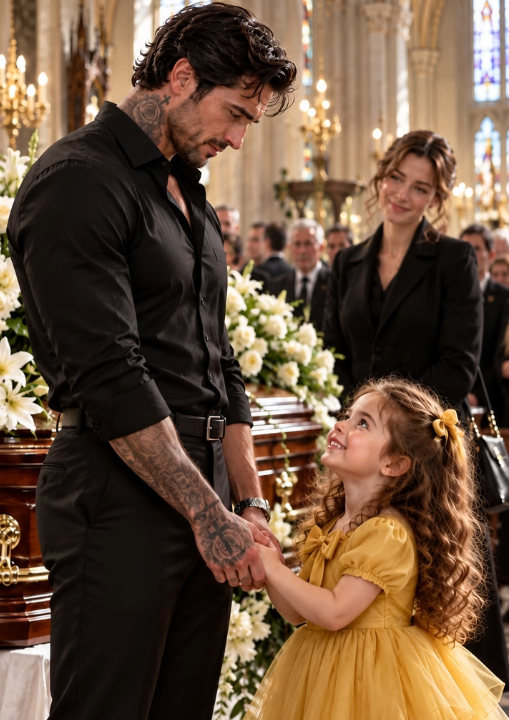
The priest was halfway through a prayer when something touched my hand.
Small fingers.
Warm despite the cold air.
I looked down.
A little girl stood beside me in a yellow raincoat.
Rainwater glittered in the long brown curls spilling over her shoulders.
She had round cheeks, enormous dark eyes, and a pair of white shoes that squeaked faintly against the polished floor.
She couldn’t have been older than five.
My security chief, Marco, immediately moved forward.
Another guard followed.
“Sir—”
“Don’t.”
Both men stopped.
The little girl watched them with mild curiosity.
Then she looked back at me.
“Your hand is cold.”
I stared.
“Is it?”
She nodded solemnly.
“Mine isn’t.”
And before I could respond, she slipped her other hand around mine.
No one moved.
A few men looked away.
Somewhere behind us, a woman gasped softly.
I had been threatened by killers, betrayed by men who once called me brother, and shot twice before my thirty-fifth birthday.
But nothing in my life had prepared me for a small child holding my hand in front of my father’s coffin.
For thirty-seven minutes, she stood beside me.
She didn’t fidget.
She didn’t ask questions.
Sometimes she leaned against my leg.
Once, when the priest’s voice trembled, she squeezed my fingers as though she thought I needed encouragement.
When the service ended, she tilted her head.
“You’re very still.”
“So are you.”
“I’m not scared.”
“I know.”
She studied me with an expression so serious it almost hurt.
Then she whispered, “You look sadder than everyone else.”
My throat tightened.
I looked at my father’s coffin.
“I’m not sure what I feel.”
She thought about that.
Then she said, “Sometimes sad doesn’t come out right away.”
I turned toward her.
“Who told you that?”
“Mr.
V.”
Before I could ask another question, a woman’s voice cut across the chapel.
“Sophie!”
A young woman hurried toward us, her cream-colored coat open over a simple blue dress.
She was beautiful in an unpolished, exhausted sort of way.
Her brown hair had escaped its clip, and genuine panic showed in her eyes.
“Oh, sweetheart.”
She dropped to one knee and pulled the girl close.
“I told you to stay beside me.”
Sophie pointed at me.
“But he was alone.”
The woman looked up.
Recognition flickered across her face.
I knew that expression.
Most people followed it with an apology.
She didn’t.
“I’m Claire Bennett,” she said.
“I’m sorry she wandered off.”
“Dominic Vale.”
“I know.”
She helped Sophie stand.
“We brought a sympathy card from Harbor House Children’s Center.
Your father was one of our donors.”
I frowned.
“My father didn’t donate to children’s charities.”
Claire’s expression changed almost imperceptibly.
“Then someone used his name.”
She straightened Sophie’s raincoat.
“Come on, sweetheart.”
The girl waved.
“Bye, Mr.
Quiet.”
I watched them walk toward the chapel doors.
Just before disappearing, Sophie turned around.
She raised her hand again.
Then she smiled.
It was a small, unguarded smile.
And something about it made my chest ache.
Not because I recognized her.
Not yet.
But because I couldn’t remember the last time anyone had looked at me without expecting something in return.
Three hours later, I sat in the back of my black sedan outside Vale Holdings.
Rain slid down the tinted windows.
Beside me lay an envelope from Miriam Hart, my father’s private estate attorney.
Vincent had ordered her to deliver it after his burial.
I opened it with my thumb.
Inside were bank statements.
Dozens of them.
I skimmed the first page.
Then the second.
Then I stopped breathing normally.
For fifty-seven consecutive months, my father had transferred $25,000 to Harbor House.
Every month.
Without interruption.
The payments passed through three legitimate companies before reaching a nonprofit account.
A total of $1,425,000.
An additional schedule referenced a $2.3 million charitable trust.
Nearly four million dollars.
Hidden from his own accountants.
Hidden from his associates.
Hidden from me.
At the bottom of the final statement was a handwritten note.
Dominic,
I never knew how to tell you.
Go see what I was protecting.
Try to understand it before you judge me.
Then decide what kind of man you intend to become.
—Dad
I stared at the word.
Dad.
He hadn’t signed anything that way since I was a child.
My phone rested beside the papers.
Seven missed calls from Vincent Vale remained in the call history.
All from his final week.
The first arrived on a Monday afternoon.
The last came at 2:17 a.m., three days before he died.
I remembered watching the screen light up.
Remembered turning it facedown.
I had spent my entire adult life waiting for my father to apologize, and when he finally reached for me, I refused to pick up.
“Noah.”
My chief aide turned from the front passenger seat.
“Yes, sir?”
“Find everything about Harbor House.”
“Financial records?”
“Everything.
Staff.
History.
Funding.
The children.”
He glanced at me through the mirror.
“May I ask why?”
I looked down at the note.
“Because my father left me a question.”
By 6:45 the following morning, a thick folder waited on my desk.
Harbor House occupied a renovated brick building in Dorchester.
It provided food, tutoring, counseling, and emergency support to vulnerable children.
Forty-one children currently participated in its programs.
Its director was Claire Bennett.
Thirty-two years old.
Former public-school counselor.
No criminal record.
No significant debts.
No connection to organized crime.
I turned the page.
Then stopped.
There was a photograph clipped to a child welfare summary.
Sophie Carter Bennett.
Five years old.
Adopted.
Her biological mother, Danielle Carter, had died from heart complications when Sophie was eleven months old.
The father’s name was absent from her original birth certificate.
I frowned.
“Danielle Carter.”
Noah looked up.
“Something?”
“Find out who she was.”
“Her background is ordinary.
Hospital administrative employee.
Later worked at a community clinic.
No serious financial problems until the year before her death.”
“Did my father know her?”
“We haven’t found a connection.”
I examined the dates again.
Danielle died on January 14.
Vincent made his first secret payment on February 15.
Thirty-two days later.
Coincidence was something men in my profession learned not to believe in.
I set the report aside.
Then looked again at Sophie’s picture.
She stood in a classroom, laughing while holding a crooked paper bird.
Her dark curls framed her face.
Her left cheek held a small dimple.
Her eyes were an unusual shade of brown, almost amber near the center.
Something about them troubled me.
I opened the bottom drawer of my desk and took out an old photograph.
It showed my parents and me in the garden of our first house.
I was five.
My mother stood behind me, her hands resting on my shoulders.
My father was smiling.
A real smile.
One I could barely remember.
I placed Sophie’s photograph beside it.
And felt the room tilt.
The same dark eyes.
The same small dimple.
The same slightly uneven smile.
It wasn’t proof of anything.
But it was enough to awaken a memory I had spent years trying to bury.
A woman standing beneath a bookstore awning in the rain.
Six years earlier.
A woman named Danielle.
“Noah.”
He looked up.
“Cancel every meeting.”
“All of them?”
“Every one.”
I stood.
“Get the car.”
I met Danielle Carter when I was thirty-two.
She was twenty-seven.
It happened outside a small bookstore on Charles Street during a thunderstorm.
I had gone inside to escape a meeting that left blood on another man’s expensive carpet.
She was standing by the front window, arguing with the owner about a leaking ceiling.
The owner kept apologizing.
Danielle kept saying apologies didn’t keep books dry.
Then she turned and found me watching her.
“Something funny?”
“No.”
“Then why are you smiling?”
“Because you’re the first person I’ve seen all day who isn’t afraid to argue.”
She raised an eyebrow.
“Should I be afraid?”
I remember thinking about that question.
Then answering honestly.
“Probably.”
She laughed.
Not politely.
Not nervously.
She actually laughed.
We spent the next hour talking about books neither of us had finished.
She told me she worked at a hospital, that she hated elevators, and that she wanted to live somewhere with a little garden.
I told her almost nothing about myself.
She didn’t seem to mind.
For three weeks, I became someone I barely recognized.
I bought coffee.
I walked through parks.
I learned she preferred inexpensive diners to expensive restaurants because the waitress remembered her name.
One evening, she asked why I always chose seats facing the entrance.
“Bad habit.”
“From what?”
“Life.”
She reached across the table and turned my hand over.
There was a fresh cut across my knuckles.
She touched it gently.
“Dominic, I don’t need you to tell me everything.”
I looked at her.
“But I need you to tell me when something is dangerous.”
I should have told her the truth.
Instead, I kissed her.
Three days later, someone tried to kill me outside my apartment.
Danielle saw the aftermath.
Broken glass.
Blood on the pavement.
Two men with guns guarding the elevator.
She stood in my kitchen, shaking.
“Is this your life?”
I said nothing.
“Dominic.”
“Yes.”
Her face crumpled.
“Then where would I fit?”
I offered to put guards around her apartment.
I offered to move her somewhere safe.
I offered money.
Everything except the one thing she wanted.
A different life.
She stepped backward.
“I won’t spend my life loving someone I have to be afraid for.”
“Danielle—”
“And I won’t raise a child someday in a house where every door locks from the outside.”
At the time, I thought she was speaking hypothetically.
I let her leave.
Two days later, she vanished from Boston.
My security people told me she had moved west.
I never questioned them.
I had convinced myself that letting her go was an act of love.
Now, nearly six years later, I sat in the back of my car staring at a little girl’s photograph.
And wondered whether I had mistaken abandonment for protection.
Harbor House was smaller than I expected.
The building stood between a laundromat and an old church, its red bricks darkened by years of coastal weather.
Yellow paper birds decorated the windows.
A hand-painted sign above the entrance read:
Every child deserves somewhere safe to land.
When I stepped out of the car, a boy on a bicycle stopped to stare.
Noah followed me toward the door.
“Do you want security inside?”
“No.”
“Dominic—”
“Stay with the car.”
I entered alone.
The smell hit me first.
Warm bread.
Crayons.
Disinfectant.
Something sweet baking in an old oven.
Children’s drawings covered the walls.
A small boy sat on the floor assembling a wooden train.
Two girls argued over a purple marker.
Nobody stopped when I entered.
Nobody lowered their eyes.
Nobody knew who I was.
For one strange moment, I felt invisible.
And relieved.
Then a familiar voice spoke behind me.
“Mr.
Vale.”
Claire Bennett stood in the hallway holding a stack of picture books.
She wasn’t smiling.
“Can I help you?”
“I need to talk to you.”
“About your father?”
“About Sophie.”
Her expression hardened.
“She’s five.”
“I know.”
“Whatever questions you have, you ask me.
Not her.”
I held her gaze.
“Agreed.”
For several seconds, she studied my face.
Then she nodded toward her office.
“Five minutes.”
Her office was barely large enough for two chairs.
There were folders stacked on the windowsill, a broken desk lamp, and a coffee mug decorated with tiny painted flowers.
Above the filing cabinet hung a photograph of Danielle Carter.
My knees nearly weakened.
She was standing beside Claire outside a hospital.
Her hair was longer than I remembered.
Her smile was exactly the same.
Claire watched me notice it.
“You knew Danielle,” she said.
It wasn’t a question.
“Yes.”
“How well?”
I couldn’t make myself answer immediately.
“Enough to regret losing her.”
Claire’s jaw tightened.
“She waited for you.”
The room seemed to shrink.
“What?”
“She waited for months.”
I took a step toward her.
“Nobody told me she was pregnant.”
Claire closed her eyes.
When she opened them, anger glittered beneath the exhaustion.
“She wrote to you.”
I stared.
“That’s impossible.”
“She wrote twice.
Once before Sophie was born.
Once after.”
“I never received anything.”
“That’s what she eventually believed.”
Claire walked to her desk and unlocked the bottom drawer.
Inside was a blue envelope.
Old.
Soft around the edges.
My name was written across the front in Danielle’s handwriting.
Dominic Vale.
Below it, in smaller letters:
Please.
This is about our baby.
My heart slammed against my ribs.
Claire handed me the envelope.
“Danielle kept the copy.
The original came back unopened.”
I turned it over.
A security stamp crossed the back.
VALE HOLDINGS — PERSONAL CORRESPONDENCE DECLINED.
Underneath was a signature.
One I recognized.
My father’s.
I gripped the desk.
“No.”
Claire’s voice broke.
“Your father knew.”
I looked at her.
She was crying now, but she didn’t look away.
“He knew from the beginning.”
I shook my head.
“Why wouldn’t he tell me?”
Claire swallowed.
“Because Danielle made him promise something after Sophie was born.”
“What promise?”
Before she could answer, the office door creaked open.
Sophie stood there holding a yellow paper bird.
“Mommy Claire?”
Claire wiped her cheeks.
“Yes, sweetheart?”
Sophie pointed at me.
“Is Mr.
Quiet crying?”
I touched my face.
My fingers came away wet.
I hadn’t even felt the tears.
Sophie walked closer.
She held out the bird.
“Mr.
V said these help people find their way home.”
I crouched slowly.
“Who was Mr.
V, Sophie?”
She smiled.
“The old man with the blue blanket.”
I couldn’t breathe.
“He used to come here and read stories.
He said his son was lost.”
I looked at Claire.
She was watching me with an expression that made my stomach turn.
Sophie placed the bird in my hand.
Then she whispered, “He said I might be able to help.”
Claire finally spoke.
“Dominic, Sophie isn’t just a child your father helped.”
Her voice trembled.
“She’s your daughter.”
PART 2 — THE SECRET MY FATHER TOOK TO HIS GRAVE
For several seconds, I couldn’t speak.
The words seemed to hang between us, suspended in the warm, ordinary air of a children’s center.
She’s your daughter.
My daughter.
I had signed contracts worth hundreds of millions without hesitation.
I had walked into rooms knowing someone intended to kill me.
I had buried friends.
I had watched men beg.
But I had never been so terrified of four simple words.
Sophie looked from Claire to me.
“Did I do something wrong?”
I tried to answer.
Nothing came.
Claire immediately crouched beside her.
“No, sweetheart.
Not at all.”
“Then why is everybody sad?”
Claire brushed a curl away from Sophie’s forehead.
“Because grown-ups sometimes find out things they should have known a long time ago.”
Sophie considered this.
“Like when you forgot my birthday cake?”
Despite herself, Claire laughed.
“Something like that.”
I was still kneeling.
My knees ached against the wooden floor.
Sophie turned toward me.
“Do you need a hug, Mr.
Quiet?”
I looked at the little girl whose entire existence had been hidden from me.
I wanted to gather her into my arms.
I wanted to ask a thousand questions.
I wanted to scream at my dead father.
Instead, I whispered, “Only if you want to give me one.”
She stepped forward.
Her arms went around my neck.
Tiny.
Warm.
Trusting.
And something inside me that had survived decades of violence finally broke.
I had missed her first breath, her first steps, her first words, and five birthdays.
But she gave me her first hug without knowing I was the man who should have been there for all of them.
I closed my eyes.
She smelled like strawberry shampoo and crayons.
I held her carefully, afraid that if I tightened my arms, I might frighten her.
Then she whispered into my ear.
“You’re not very good at hugging.”
A broken laugh escaped me.
“No.”
“Mommy Claire can teach you.”
I looked over Sophie’s shoulder.
Claire was crying again.
This time, she didn’t hide it.
Claire sent Sophie to the playroom with a volunteer named Mrs.
Alvarez.
Then she closed the office door.
I stood beside the window, staring into the courtyard.
A little boy was trying to teach another child how to skip.
He kept falling.
The other child kept helping him up.
I suddenly wondered how many ordinary moments I had lost.
How many mornings Sophie had awakened with a fever.
How many nights she had cried for a mother who never came back.
How many times she had asked why other children had fathers.
“Tell me everything,” I said.
Claire sat behind her desk.
“Danielle found out she was pregnant six weeks after you disappeared from her life.”
“I didn’t disappear.”
Claire looked up sharply.
“From where she stood, you did.”
I swallowed.
She continued.
“She tried calling your office.
Someone told her you didn’t accept personal calls.
She went to your building twice.
Security wouldn’t let her upstairs.”
I remembered the period.
My father’s rivals were closing in on our shipping business.
Three men had been killed in eleven days.
I had ordered Noah’s predecessor to eliminate unnecessary contact.
Nobody approached me without authorization.
Not even people I loved.
“Then she wrote the letters,” Claire said.
“Why didn’t she come to my apartment?”
“Because armed men were standing outside it.”
I closed my eyes.
“She was afraid of me.”
“No.”
Claire’s voice softened.
“She was afraid of what loving you would cost her child.”
I turned.
“How did my father find out?”
Claire hesitated.
“Danielle went to him.”
I stared.
“She went directly to Vincent?”
“She thought a father might understand what his son wouldn’t.”
I almost laughed at the cruelty of it.
“My father understood nothing about children.”
“That’s what she thought at first.”
Claire folded her hands.
“Vincent offered her money.
She refused.
He offered security.
She refused that too.
Then he promised that Sophie would never become part of the Vale family’s business.”
My throat tightened.
“What did she ask in return?”
“That he keep Sophie safe.
And that he tell you the truth only after you were no longer living the life that made her leave.”
I looked out the window again.
“She made that decision for me.”
“Yes.”
“Both of them did.”
“Yes.”
Claire didn’t try to defend it.
That made the truth harder to fight.
“Your father could have told you,” she continued.
“He knew that.
Danielle knew it too.
But every time someone threatened your family, she became more certain.”
I remembered those years.
The attacks.
The disappearances.
The bomb found beneath one of my cars.
I had called myself powerful.
Danielle had looked at my life and seen a child who would need protection from it.
“Did she hate me?”
Claire shook her head.
“She never stopped loving you.”
I gripped the windowsill.
“Then why didn’t she come back?”
“Because loving someone isn’t always the same as trusting him.”
Silence settled between us.
Outside, a child began singing.
Claire opened another drawer.
This time, she took out a small notebook.
Its blue cover was frayed.
A dried flower rested between two pages.
“Danielle kept this during her pregnancy.”
She passed it to me.
I opened it.
Her handwriting filled the pages.
Some entries were ordinary.
Complaints about swollen ankles.
Cravings for oranges.
A list of possible baby names.
Then I found a page dated three weeks before Sophie was born.
She kicks when I play music.
Sometimes I put my hand against my stomach and imagine Dominic doing the same.
I wonder if he would laugh.
I wonder if he’d be frightened.
I wonder whether the little boy inside that terrifying man might finally have something gentle to hold.
My vision blurred.
I turned another page.
If she has his eyes, I’ll probably cry every time I look at her.
Below that sentence was a name.
Sophie.
And underneath it:
Because she deserves a name that sounds like sunlight.
I lowered the notebook.
“How did Danielle die?”
Claire’s face changed.
“She had a heart condition.
The doctors discovered it when Sophie was a few months old.”
“Congenital?”
“Yes.
It had never caused serious problems before, but it deteriorated after childbirth.”
“Why wasn’t she treated?”
“She was.
Your father paid for specialists.
She had medication, monitoring, everything we could arrange.”
Claire looked down.
“But the treatment couldn’t stop what was happening.”
I swallowed.
“Was she alone?”
“No.”
Claire’s eyes filled again.
“I was holding her hand.”
I waited.
“She asked me to promise Sophie wouldn’t grow up thinking she’d been abandoned.”
My chest tightened.
“And?”
“Then she asked me to put a photograph of you beside Sophie’s crib.”
I looked up.
Claire’s voice broke.
“She said, ‘I couldn’t give her the life I wanted with him.
But please don’t let her grow up believing he wouldn’t have loved her.’”
I pressed my fist against my mouth.
For the first time in twenty years, I wished I could go back and become a different man.
Not richer.
Not stronger.
Just different.
A man who answered the telephone.
A man who went after the woman he loved.
A man who understood that protecting someone sometimes meant putting down everything that made him dangerous.
I stayed at Harbor House until late afternoon.
Claire didn’t invite me to stay.
She simply stopped asking when I intended to leave.
I helped Mrs.
Alvarez carry boxes into a storage room.
I repaired a loose wheel on a toy wagon.
I watched Sophie argue with a seven-year-old boy about whether dinosaurs could swim.
Apparently, the answer depended on which dinosaur.
I knew nothing about dinosaurs.
Sophie found this shocking.
“Everybody knows about dinosaurs.”
“Not everybody.”
“Did you go to school?”
“Yes.”
“Did you listen?”
I smiled.
“Not enough.”
She shook her head with profound disappointment.
“You need to learn things.”
For the first time since my father’s death, laughter came easily.
Then Sophie asked whether I had children.
The question hit me so hard I nearly dropped the wagon wheel.
I looked at Claire.
She was standing in the doorway.
We had not discussed how to tell Sophie.
I wasn’t going to steal that moment from her.
“I haven’t been very good at being around children,” I answered.
Sophie thought for a moment.
“That’s okay.”
“Is it?”
“Mr.
V wasn’t good at playing either.”
My hands stilled.
“What did you play with him?”
“Tea party.”
I imagined Vincent Vale, the most feared man in Ne
w England, holding a plastic teacup.
It seemed impossible.
“Was he any good?”
“No.”
She giggled.
“He kept saying the tea was too expensive.”
I laughed.
Then my eyes burned.
Sophie leaned closer.
“He got better.”
She touched my wrist.
“You can too.”
At six o’clock, Noah called.
His voice was unusually tense.
“We have a problem.”
I stepped outside.
“What?”
“Leonard Price.”
The name made my jaw tighten.
Price had served as chief financial officer of Vale Holdings for eleven years.
He handled legitimate investments, tax structures, subsidiary accounts, and the money my father preferred I never examined too closely.
“What about him?”
“He’s been accessing the Harbor House accounts.”
“Since when?”
“Since the funeral.”
I looked toward the building.
“Explain.”
“Your father established a $2.3 million charitable trust two years ago.
The trust is supposed to support Harbor House permanently.”
“I know.”
“But Price is claiming several of the funding transfers were unauthorized distributions.”
“On what grounds?”
“He’s producing an internal resolution your father supposedly signed before he died.”
“Was it genuine?”
“I haven’t seen the original.”
“What else?”
Noah hesitated.
“Harbor House doesn’t own its building.
A Vale subsidiary does.”
My blood went cold.
“And Price controls the subsidiary.”
“Yes.”
I looked through the window.
Sophie was sitting at a little table, carefully coloring a paper bird.
“What does he want?”
Noah took a breath.
“He wants the money returned to Vale Holdings.
He’s also requested an inspection of the building.”
“An inspection?”
“Emergency structural and fire-safety review.
If the property fails, the children could be displaced immediately.”
My fingers tightened around the phone.
“How much time?”
“Inspectors are coming tomorrow.”
I stared at the darkening sky.
My father had spent years building something hidden from his own empire.
And now, barely two days after his burial, someone inside that empire was trying to destroy it.
“Find Miriam Hart.”
“Your father’s attorney?”
“Yes.
And obtain the original trust documents.”
“What should I tell Price?”
I watched Sophie hold her drawing up to Claire.
“Tell him nothing.”
Leonard Price arrived at Harbor House the following morning.
He wore a tailored gray suit and a smile that never reached his eyes.
I had known him for over a decade.
He was the sort of man who remembered birthdays, sent expensive Christmas presents, and somehow managed to be absent whenever the consequences of his decisions appeared.
He entered Claire’s office without knocking.
“Miss Bennett.”
Claire stood.
“Mr.
Price.”
“I’m afraid we have an unfortunate situation.”
He placed a folder on her desk.
A formal notice.
Financial review.
Occupancy reassessment.
Emergency inspection.
Claire read the first page.
Her face drained of color.
“You can’t do this.”
“I’m not doing anything.
These are compliance requirements.”
“You’ve never raised these concerns before.”
“Your previous funding arrangement was highly irregular.”
I stepped into the doorway.
“Leonard.”
His expression froze.
“Dominic.”
“Explain why you’re threatening a children’s center.”
He recovered quickly.
“Nobody is threatening anyone.”
“Then you won’t mind withdrawing the notice.”
“I’m afraid it’s more complicated.”
“Make it simple.”
His smile vanished.
“Your father moved nearly four million dollars through channels that weren’t properly disclosed.
It creates liability for the entire company.”
“My father’s personal trust isn’t yours to recover.”
“There are issues concerning ownership.”
I moved closer.
“Then discuss them with our attorneys.”
Price glanced at Claire.
“This woman may have been receiving funds without understanding their source.”
The implication was clear.
He was threatening her reputation.
Possibly her license.
Possibly her ability to keep Sophie.
I felt something cold and familiar rise inside me.
The old instinct.
The one that had made grown men tremble.
For a moment, I wanted to use it.
Then I saw Sophie standing in the hallway.
Watching.
I unclenched my fists.
For the first time in my life, I understood that winning a confrontation could mean refusing to become the man everyone expected.
“You’ll leave,” I told Price.
He opened his mouth.
“Now.”
He gathered his folder.
At the door, he paused.
“Vincent was sentimental at the end, Dominic.
Don’t let that sentiment destroy what he built.”
I looked at him.
“What exactly do you think he built?”
Price didn’t answer.
He simply walked away.
That afternoon, I asked Claire why my father had chosen Harbor House.
She led me into a narrow room behind the library.
Inside were old shelves filled with donated clothing, school supplies, and boxes of children’s artwork.
Against the far wall stood a wooden cabinet.
Its top drawer contained photographs.
Vincent reading to children.
Vincent serving soup.
Vincent sitting in a tiny plastic chair while a little girl placed a cardboard crown on his head.
I stared at the pictures.
The man in them looked painfully familiar.
And completely unknown.
In one photograph, he was holding Sophie when she was barely two.
His face was thinner than I remembered.
His hair mostly silver.
But he was smiling.
That same rare, unguarded smile from the photograph on my desk.
“He came every Thursday,” Claire said.
“Even when he was sick?”
“Especially then.”
I looked at her.
“He brought blankets.
Paid for repairs.
Sometimes he just sat and listened.”
“Why didn’t he tell me?”
Claire didn’t answer immediately.
Then she said, “Because I think he was afraid you’d ask him what had changed.”
I studied the photograph.
The father I remembered had never read me bedtime stories.
He had taught me how to identify lies.
How to negotiate.
How to recognize a threat before it reached the door.
He taught me everything necessary to survive his world
.
Nothing necessary to live outside it.
“Did he ever explain why he helped all these children?”
Claire nodded.
“Once.”
I turned.
“He told me he’d spent his life teaching powerful men how to take things from people who couldn’t fight back.”
Her voice softened.
“And he wanted to spend whatever time he had left giving something back.”
I looked around the room.
“That’s not enough.”
“No,” she said.
“It isn’t.”
Her honesty startled me.
“Good deeds don’t erase bad ones, Dominic.”
“I know.”
“But people should still be allowed to do them.”
I looked down.
For a long time, neither of us spoke.
Then Claire opened the cabinet’s bottom drawer.
“There was something else he wanted you to see.”
She removed a narrow black ledger.
The leather cover was worn.
Inside were names.
Dates.
Addresses.
Amounts.
I recognized some immediately.
A dockworker whose union had been broken by one of my father’s companies.
A family displaced during a property acquisition.
A driver killed during a dispute between rival organizat
ions.
Beside each name was a record of financial assistance.
Medical bills.
Housing deposits.
School fees.
University tuition.
And sometimes a single handwritten word.
Sorry.
I turned the pages.
There were dozens of entries.
Then hundreds.
My father had been documenting the lives damaged by his business.
Not just his enemies.
Their children.
Their wives.
Their parents.
People who never held a weapon.
People whose lives had become collateral damage in a war they never agreed to fight.
Harbor House wasn’t simply a charity.
It was the beginning of a debt my father knew he could never fully repay.
I kept turning pages.
Then found a familiar name.
Danielle Carter.
Underneath was a photograph of a newborn Sophie.
Beside it, in my father’s handwriting:
Her mother asked me to protect her from the life I taught my son to live.
I stared until the letters blurred.
Then I noticed something else.
On the facing page was a company name.
A subsidiary I recognized.
One Leonard Price controlled.
Beneath it were repeated transfers from a fund I had never authorized.
Millions moved out of accounts meant for restitution.
The amounts had been concealed within property expenses and consulting fees.
I looked at Claire.
“Did my father know about this?”
“I don’t know.”
I turned to the final page.
A folded note had been tucked beneath the binding.
I recognized Vincent’s handwriting immediately.
Dominic,
If Leonard Price tries to take the house, do not negotiate with him.
Ask Miriam for the blue folder.
The truth isn’t in what he stole.
It’s in whose names he used to steal it.
And please, before you make another decision about Sophie, remember that her mother never wanted her to be afraid of you.
I read the note twice.
Then a third time.
My father had anticipated this.
He had known Price would come.
And instead of warning me directly, he had left a trail.
I reached for my phone.
But before I could call Noah, Claire’s office telephone rang.
Mrs.
Alvarez answered.
Her voice sounded normal at first.
Then it changed.
“Claire?”
We hurried into the hallway.
Mrs.
Alvarez held the receiver with a shaking hand.
“The inspectors are here early.”
Claire frowned.
“They aren’t scheduled until tomorrow.”
“They say there’s been a report of a gas leak.”
I turned toward the front entrance.
Two men in work jackets stood outside.
Behind them was an unmarked white van.
Neither man looked like a utility technician.
I recognized one of them.
He had once worked security for Leonard Price.
“Claire,” I said quietly, “get the children into the main room.”
She looked at me.
“Why?”
“Please.”
Something in my voice made her move.
I called Noah.
“Send Marco.
Now.”
Then the building’s fire alarm sounded.
A harsh mechanical scream filled the hallway.
Children began shouting.
Teachers rushed toward the exits.
I moved through the crowd, searching for one small yellow raincoat.
“Sophie?”
Nothing.
I entered the playroom.
Empty.
The paper birds fluttered near the open window.
“Sophie?”
I checked beneath the tables.
Behind the shelves.
Inside the reading corner.
No sign of her.
Claire ran into the room.
“Where is she?”
“I don’t know.”
Her face went white.
“She was just here.”
We searched again.
Then I noticed a yellow paper bird lying beside the back door.
On one wing, in shaky children’s handwriting, were three words.
Don’t be mad.
I lifted it.
Something inside me turned to ice.
Beyond the window, the white van’s engine started.
And for one terrible moment, I believed I had lost my daughter before she ever knew I was her father.
PART 3 — THE LAST PROMISE
“Marco, where are you?”
My voice barely sounded human.
“Three minutes out.”
“Make it one.”
I ended the call.
Claire was running through the hallway calling Sophie’s name.
Children cried.
The alarm continued screaming.
Teachers struggled to keep everyone together.
I stepped outside.
The white van was reversing toward the street.
I ran.
“STOP!”
The driver accelerated.
I reached the vehicle and slammed my hand against the passenger window.
The man inside turned.
I recognized him.
Daniel Keene.
Former Vale Holdings security contractor.
Dismissed eighteen months earlier after an internal investigation into missing cash.
He looked at me.
For one second, his face showed unmistakable panic.
Then he reached beneath his jacket.
I didn’t wait to see what he was reaching for.
I stepped backward as the van swerved past me.
Its side mirror struck my shoulder.
Pain shot down my arm.
But I barely felt it.
Because through the small rear window, I saw something yellow.
A raincoat.
And behind it, two enormous dark eyes.
Sophie was inside.
I ran after the van until my lungs burned.
Then it turned the corner and disappeared.
I stood in the street, shaking.
Five years.
I had been a father for five years without knowing it.
And now someone had taken my daughter.
I called Noah.
“Find that van.”
“Dominic—”
“White commercial van.
Massachusetts plates.
Keene is driving.”
“I’m pulling traffic cameras now.”
“Call Miriam.
Get the blue folder.”
“Why?”
“Because Leonard Price just made the biggest mistake of his life.”
Claire found me standing beside the curb.
“Where is she?”
I couldn’t answer.
Her face changed.
“No.”
“Claire—”
“No!”
She grabbed my coat.
“Tell me you didn’t let someone take her!”
The accusation struck harder than the van.
“Keene has her.”
She stepped backward.
Her hand flew to her mouth.
For a moment, she looked like someone who had forgotten how to breathe.
Then she whispered, “I promised Danielle.”
I reached for her.
She pulled away.
“I promised her Sophie would be safe.”
“Claire.”
“I promised.”
Her knees buckled.
I caught her before she hit the pavement.
She clutched my arm.
“Bring her home.”
I looked into her face.
All the fear she had carried alone for years was there.
The hospital nights.
The adoption hearings.
The birthdays with an empty chair.
The nights Sophie cried because she couldn’t remember he
r mother’s voice.
And now this.
I put my hand over hers.
“I will.”
Claire shook her head.
“Don’t promise me something just because you’re powerful.”
I swallowed.
“Then listen carefully.”
She looked up.
“I will bring her home because she’s my daughter.
And because she’s yours.”
Forty-one minutes later, Noah traced the van to an abandoned printing warehouse near the waterfront.
The building had belonged to one of my father’s companies.
Leonard Price had purchased it through a private holding entity two years earlier.
Of course he had.
I stood beside my car as Marco opened the trunk.
Inside were weapons.
The sight was familiar.
Comforting, once.
I reached toward one.
Then stopped.
I remembered Danielle standing in my kitchen six years earlier.
Is this your life?
I remembered Sophie asking whether I needed a hug.
I remembered the fear in Claire’s voice.
Slowly, I closed the trunk.
Marco stared.
“Sir?”
“No guns inside.”
“That’s suicide.”
“Not with my daughter in there.”
“Dominic, Keene is armed.”
I looked at him.
“Then don’t give him a reason to use it.”
Noah approached with his phone.
“Boston police have been notified.
They’re coordinating with investigators from the attorney general’s office.
We’ve given them the van footage and the location.”
I nodded.
“Good.”
Marco frowned.
“You called the police?”
I turned toward him.
“Yes.”
“But this is Vale business.”
I looked at the warehouse.
That sentence had justified more violence in my family than I cared to remember.
Vale business.
As though the name itself made us exempt from ordinary morality.
“No,” I said.
“This is a little girl who needs to go home.”
Leonard Price was waiting inside.
He stood beneath a flickering industrial light.
Daniel Keene leaned against a loading door.
And in the corner, sitting on an overturned wooden crate, was Sophie.
She was crying quietly.
Her yellow raincoat had fallen open.
She held her stuffed rabbit so tightly that one of its long ears was twisted around her fingers.
When she saw me, she stood.
“Mr.
Quiet!”
Every instinct in my body demanded that I run to her.
I forced myself to remain still.
“Hello, sweetheart.”
Her face crumpled.
“I want Mommy Claire.”
“I know.”
“That man said she sent him.”
I looked at Keene.
His eyes dropped.
“Did he hurt you?”
Sophie shook her head, then nodded uncertainly.
“He pulled my arm.”
My hands curled into fists.
Price stepped forward.
“Let’s keep this civilized.”
I turned toward him.
“Let her go.”
“Of course.
As soon as we settle the misunderstanding.”
“What misunderstanding?”
He smiled thinly.
“Your father made arrangements that should never have been made.”
“You mean he discovered you were stealing.”
Price’s face darkened.
“Vincent lost his judgment.
He became obsessed with those children.”
I said nothing.
“He was giving away assets built over forty years.”
“His assets.”
“Assets that belonged to the organization.”
I stared at him.
“And that bothered you?”
“What bothered me was that he began keeping records.”
There it was.
The truth.
He wasn’t afraid of losing the money.
He was afraid of what the records contained.
Price pointed toward the black ledger in my hand.
“Give me that.”
I looked down.
“That’s what you want?”
“The original.
And whatever copies you’ve made.”
I almost smiled.
Because somewhere behind me, Noah had already delivered digital copies of the ledger to Miriam Hart and the investigators.
But I didn’t tell Price.
“Let Sophie come to me first.”
“No.”
I felt the familiar surge of rage.
Then Sophie’s voice trembled from the corner.
“Mr.
Quiet?”
I looked at her.
She was trembling.
“Please don’t get angry.”
Something in me went still.
I remembered the note.
Don’t be mad.
She had written it because she believed leaving with Keene would upset Claire.
She was afraid of being blamed.
Five years old.
Terrified.
And apologizing for something adults had done to her.
I crouched slowly.
“Listen to me, Sophie.”
Her lower lip quivered.
“You haven’t done anything wrong.”
“But I got in the car.”
“He lied to you.”
She wiped her nose.
“Are you mad?”
I looked directly at her.
“Not at you.
Never at you.”
Price stepped closer.
“Enough.
The ledger.”
I placed it on the floor.
Then pushed it toward him.
“Take it.”
He watched suspiciously.
“Just like that?”
“Just like that.”
“Your father wouldn’t have done that.”
I looked at Sophie.
“You’re right.”
Price bent toward the ledger.
At that moment, police vehicles appeared outside the warehouse windows.
Blue lights flashed across the ceiling.
Keene reached toward his jacket.
“Don’t,” I said.
He hesitated.
Through the loading-bay windows, he could see officers taking positions.
“Daniel,” I said quietly, “there’s a five-year-old girl standing ten feet from you.”
His hand stopped.
“Don’t make her remember this day for the rest of her life.”
The words seemed to reach him.
Slowly, he raised his empty hands.
Price turned toward the exit.
“Dominic, what have you done?”
I looked at him.
“Something I should have done years ago.”
The warehouse doors opened.
Officers entered.
Keene surrendered.
Price shouted that he had done nothing wrong, that the child had been brought there voluntarily, that the financial records were property of Vale Holdings.
Nobody listened.
An officer moved between him and Sophie.
I remained where I was until another officer told me it was safe.
Then I crossed the room.
Sophie ran toward me.
I dropped to my knees.
She collided with my chest so hard it knocked the breath from me.
I wrapped both arms around her.
“I’m sorry,” she sobbed.
“No.”
“I’m sorry I went with the bad man.”
“No, sweetheart.”
I held her face between my hands.
“You never have to apologize for someone else hurting you.”
She began crying harder.
And so did I.
Right there.
On the dirty floor of an abandoned warehouse.
While police officers walked past us.
I held my daughter and cried without trying to hide it.
Claire was waiting at the hospital when we arrived.
Sophie was medically unharmed apart from minor bruising on her upper arm.
The doctor recommended rest, reassurance, and follow-up support because of the frightening experience.
When Claire saw us, she ran.
Sophie reached for her immediately.
“Mommy!”
Claire pulled her into her arms.
Her entire body shook.
She kissed Sophie’s forehead.
Her cheeks.
Her curls.
Again and again.
“I’ve got you.”
Sophie buried her face against Claire’s neck.
“I’m sorry.”
Claire went still.
Then she held her tighter.
“Oh, baby.”
She looked at me.
I shook my head slightly.
Claire understood.
She kissed Sophie’s hair.
“You don’t need to be sorry.”
“But I left.”
“Someone tricked you.”
“I wanted to be good.”
Claire closed her eyes.
“You don’t have to be good to deserve coming home.”
That sentence hit me with the force of a physical blow.
Because it was something nobody had ever told me as a child.
I had grown up believing love was earned through obedience.
Respect through fear.
Safety through power.
My father taught me how to survive a dangerous world.
But Claire Bennett, sitting on a hospital bed with a frightened child in her arms, had just taught me something he never could.
Home wasn’t a reward for behaving correctly.
It was somewhere you were supposed to be allowed to return.
Even when you made mistakes.
Especially then.
Three days later, Miriam Hart came to my office carrying a blue folder.
It was thick.
Its corners were reinforced with tape.
She placed it on my desk.
“Your father asked me to keep this separate from the estate.”
I studied her.
“Why?”
“Because he believed there was a possibility you would destroy it.”
I looked down.
“Perhaps he was right.”
Miriam sat.
“Vincent spent the last two years preparing these documents.”
Inside were sworn statements.
Financial records.
Witness names.
Signed acknowledgments of wrongdoing.
And evidence connecting Leonard Price to a scheme that diverted money intended for injured families and vulnerable children.
The scale of it was staggering.
Price had used false consulting agreements and property transactions to steal from the restitution fund.
But the evidence revealed something else.
My father had known.
Not everything.
Not at first.
But enough.
He had spent the final year of his life building a case against a man he once trusted.
I turned another page.
There were records of old crimes.
Not just Price’s.
Vincent’s.
And mine.
I looked at Miriam.
“He documented everything.”
“Enough to start a very serious investigation.”
“He knew what that meant.”
“Yes.”
I stared at the signatures.
My father had spent forty years building an empire that existed because people were afraid to speak.
At the end of his life, he had begun creating the evidence that could destroy it.
“Why didn’t he go to the authorities himself?”
“He was preparing to,” Miriam said.
“But his health deteriorated faster than expected.”
She paused.
“He also worried about what would happen to the children if Price discovered the investigation before protective arrangements were in place.”
I looked at the files.
“Did he expect me to finish it?”
Miriam nodded.
“He hoped you would.”
I closed the folder.
“Then I’ll give them everything.”
She studied me carefully.
“Dominic, you understand that includes your own involvement.”
“Yes.”
“There could be serious consequences.”
“I know.”
She leaned forward.
“Your father’s records won’t protect you from prosecution.”
I looked through the glass wall of my office.
Beyond it, Boston stretched toward the harbor.
The towers.
The companies.
The empire.
Everything I had spent my life believing would make me untouchable.
I thought about Sophie hiding her face against Claire’s shoulder.
About Danielle’s handwritten notebook.
About forty-one children whose parents had been hurt by decisions made in rooms like mine.
Then I looked back at Miriam.
“I don’t want to be untouchable anymore.”
The investigation began quietly.
Price was arrested and charged in connection with the kidnapping while financial investigators examined his transactions.
Keene agreed to cooperate.
The charitable trust was protected through an emergency court order.
Independent trustees took control of Harbor House’s funding.
The building’s emergency inspection found minor repairs but no grounds for closing the center.
The children stayed.
The paper birds remained in the windows.
My father’s criminal records went to investigators too.
So did mine.
I resigned from Vale Holdings’ executive leadership and began cooperating through my attorney.
I didn’t know what the coming months would cost me.
I only knew that, for the first time, I wasn’t spending every waking hour trying to preserve a kingdom built on fear.
And I had something worth returning to each evening.
At first, I visited Harbor House for an hour.
Then two.
Then entire afternoons.
I learned how to make peanut butter sandwiches without cutting them into triangles when Sophie specifically requested squares.
I learned she hated peas.
Loved strawberries.
Needed a night-light.
And believed every stuffed animal should have a birthday.
I learned she spoke to her dead mother sometimes.
Usually when she was alone.
Once, I found her sitting beneath a tree in the courtyard.
She was holding a photograph of Danielle.
I sat beside her.
For several minutes, neither of us spoke.
Then Sophie asked, “Did you know my first mommy?”
I looked at the photograph.
“Yes.”
“Was she nice?”
“The nicest person I ever knew.”
Sophie smiled faintly.
“Mommy Claire says she sang when she cooked.”
“She did.”
“Was she good?”
I remembered Danielle singing off-key while making pasta in my apartment.
I smiled.
“Not particularly.”
Sophie giggled.
Then she looked at me.
“Did you love her?”
I swallowed.
“Very much.”
“Do you still?”
My throat tightened.
“Yes.”
Sophie considered this.
Then she leaned against my shoulder.
“I love her too.
But I don’t remember her voice.”
I closed my eyes.
That hurt more than anything.
A child who remembered the absence of her mother more clearly than the mother herself.
I slipped my arm around her.
“She used to sing a song about a little bird.”
Sophie looked up.
“What song?”
I hesitated.
Then I began singing.
Quietly.
Badly.
Just as Danielle had.
Sophie listened with enormous concentration.
When I finished, she whispered, “Again.”
So I sang it again.
And again.
Until the afternoon sunlight faded and Claire came outside to tell us dinner was ready.
Six weeks after the funeral, Claire asked me to come to Harbor House after closing.
When I arrived, the children had gone home.
The building was quiet.
Warm light spilled from the library.
Claire sat at a small table beside a wooden box.
Sophie was upstairs with Mrs.
Alvarez, finishing a drawing.
“What’s wrong?”
I asked.
“Nothing.”
But Claire’s face suggested otherwise.
She slid the box toward me.
“Your father left this with me about a month before he died.”
I stared.
“Another secret?”
“A personal one.”
I opened the lid.
Inside was an old photograph.
A tiny gold bracelet.
A folded piece of paper.
And a small envelope addressed to me.
The photograph showed Vincent Vale sitting on a bench outside Harbor House.
Sophie stood beside him in her yellow raincoat.
He had a blue blanket across his knees.
They were both smiling.
I touched the edge of the picture.
“She loved him.”
Claire nodded.
“He loved her too.”
I picked up the bracelet.
Its gold surface had been polished smooth with age.
There was a tiny heart engraved near the clasp.
I recognized it instantly.
My mother had worn it.
Not as a bracelet.
As an anklet when she was younger.
After she died, my father kept it in a small wooden box beside his bed.
I hadn’t seen it in decades.
“He gave this to Sophie?”
Claire nodded.
“He said it belonged to someone who loved his son very much.”
I turned the bracelet over.
Inside the clasp were two letters.
E.V.
Elena Vale.
My mother.
My hands began shaking.
I looked at Claire.
“Why didn’t you give me this earlier?”
“Vincent asked me not to.”
“Why?”
She swallowed.
“He wanted you to meet Sophie before you heard the rest.”
I picked up the envelope.
The paper was thin.
My father’s handwriting crossed the front.
For Dominic, when he understands why she came to the chapel.
My chest tightened.
I broke the seal.
Inside was a letter.
Only two pages.
I unfolded them.
Son,
If you’re reading this, then Sophie has found you.
I hope she wasn’t afraid.
I don’t think she will be.
She’s braver than both of us.
I stopped.
Looked toward Claire.
Then continued.
You probably think she approached you by accident.
She didn’t.
My eyes widened.
I told her about you.
I showed her photographs.
I told her you were a quiet boy who grew into a quiet man.
And I told her that sometimes quiet people are the ones hurting most.
I gripped the paper.
Last month, Sophie asked me why you never visited.
I didn’t know how to explain that I had helped build the walls keeping you away.
So I told her you were lost.
She asked whether someone could find you.
I said I hoped so.
Then she asked what she should say if she met you.
My breath caught.
Dominic, there’s something you’ve forgotten.
But I never did.
I turned the page.
You were five years old when your mother died.
At her funeral, you stood beside me in a little black coat.
You didn’t cry.
Everyone thought you were being brave.
But I knew you were frightened.
You took my hand while I stared at her coffin.
Then you looked up at me and said something I have carried for thirty-three years.
I stopped reading.
A memory stirred.
Rain.
Church bells.
My mother’s perfume on a scarf.
My father’s enormous hand.
I heard the words before I saw them.
“You look sadder than everyone else.”
My knees weakened.
I sat down.
The letter trembled in my hands.
Those were your words, Dominic.
Not Sophie’s.
Yours.
You said them to me the day we buried your mother.
And I was so broken by losing her that I didn’t know how to comfort you.
I simply stood there.
I let you hold my hand.
Then I went home and became a man who believed grief was something to punish out of himself.
I taught you the same terrible lesson.
My vision blurred completely.
I kept reading.
I spent decades thinking I had made you strong.
But strength without tenderness is only another kind of fear.
When Danielle came to me, I made a choice I had no right to make.
I decided you weren’t safe enough to know your daughter.
I told myself I was protecting Sophie.
I was also protecting myself from admitting what I had turned you into.
A sob escaped me.
I kept telling myself there would be time.
Time to undo the damage.
Time to tell you.
Time to become the father I should have been.
Then the doctors told me how much time remained.
I called you seven times during my final week.
I wanted to tell you everything.
About Danielle.
About Sophie.
About the children.
About the men who had stolen from them.
But most of all, I wanted to apologize.
Not for dying.
For teaching you how to live without love.
I pressed the letter against my forehead.
For years, I had believed my father was incapable of regret.
Now I sat holding two pages of it.
And I couldn’t decide whether I wanted to forgive him or scream at him.
Perhaps both.
The final paragraph waited below.
I asked Sophie what she would say if she ever found you looking sad.
She thought about it.
Then I told her what you said to me when you were five.
She practiced the words.
She said she would hold your hand, because that’s what people should do when someone is lonely.
So if she came to you at the chapel, understand this: she wasn’t sent to fix you.
She was simply giving you the kindness you once gave me.
I hope you know how to accept it better than I did.
And I hope, one day, you can forgive me for all the years I made you believe you had to face the world alone.
I love you, son.
I always did.
Dad.
The room disappeared.
I was five again.
Standing in a chapel.
My mother inside a coffin.
My father beside me.
I remembered how enormous he looked.
How frighteningly still.
I remembered reaching for his hand.
And I remembered that he hadn’t squeezed it back.
Not because he didn’t love me.
Because he didn’t know how.
For thirty-three years, I had mistaken that silence for the absence of love.
And perhaps, in some ways, it had been.
Love that never reached a child could leave wounds as deep as hatred.
But now, through the cruel distance of death, my father had finally reached back.
I folded over the letter.
And I cried.
Not quietly.
Not with the controlled dignity expected of Dominic Vale.
I bent forward and wept with my hands over my face.
Claire came around the table.
She knelt beside me.
For a moment, she said nothing.
Then she placed her hand on my shoulder.
“He wasn’t a good man in every part of his life,” she whispered.
I shook my head.
“No.”
“But he was trying.”
I looked at the photograph of Vincent and Sophie.
“He should have told me.”
“Yes.”
“He stole five years from me.”
“Yes.”
“I don’t know if I can forgive him.”
Claire’s eyes softened.
“You don’t have to decide today.”
I looked toward the ceiling.
Somewhere upstairs, Sophie was laughing.
The sound floated through the quiet building.
A small, ordinary miracle.
And suddenly I understood the terrible beauty of what my father had done.
He had spent his last years protecting a child he couldn’t publicly claim as his granddaughter.
He had built a refuge for children harmed by the world he helped create.
He had begun tearing apart his own empire.
And in the final weeks of his life, when I refused every telephone call, he had placed his last hope in a five-year-old girl with yellow rain boots and a heart that didn’t know how to be afraid.
My father had not left me a kingdom.
He had left me a chance to become the man my daughter deserved
Eight months later, Harbor House held its annual autumn celebration.
The courtyard glowed beneath strings of warm lights.
Children ran between tables decorated with paper birds.
Teachers laughed.
Parents carried plates of food.
The building had been repaired.
The trust was independently managed.
And for the first time in its history, Harbor House had enough funding to plan several years ahead.
The legal proceedings surrounding Vale Holdings continued.
I had surrendered my executive authority, provided testimony, and accepted that some consequences of my old life might still be waiting for me.
There were people who would never forgive what my family had done.
I didn’t expect them to.
Some debts weren’t settled with money.
Some wounds couldn’t be repaired by an apology.
I was learning to live with that.
I was also learning something else.
How to make pancakes.
How to untangle curly hair without hurting the person whose hair it was.
How to sit through school performances without checking my phone.
How to stay.
Claire remained Sophie’s mother.
Nothing about our growing family required changing that.
We worked through awkward questions together.
We disagreed about bedtime.
We learned how to share the responsibilities and small joys neither of us had expected to share.
Some evenings, Claire and I sat on the porch after Sophie fell asleep.
We talked about Danielle.
About Vincent.
About the future.
Sometimes we talked about nothing important at all.
Those were becoming my favorite conversations.
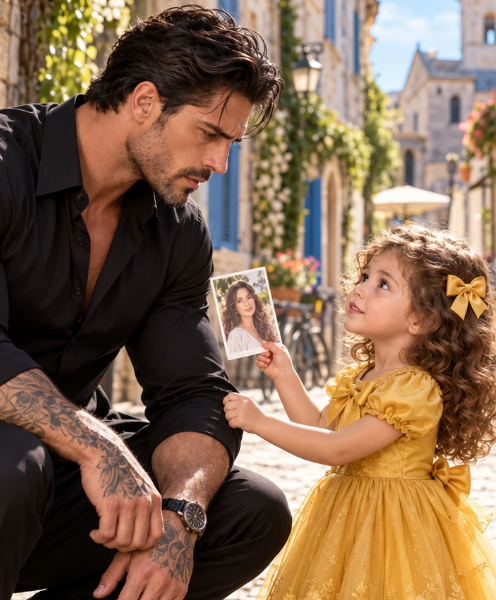
That evening, I stood beneath the courtyard lights watching Sophie attempt to balance three cookies on a paper plate.
She wore a golden-yellow dress.
Her curls bounced around her shoulders.
A little matching bow sat crookedly in her hair.
When she noticed me, she waved.
“Mr.
Quiet!”
I waved back.
She ran toward me.
Then stopped.
She looked suddenly nervous.
“Can I ask you something?”
I crouched.
“Anything.”
She twisted the ribbon on her dress.
“Mommy Claire says people can have different kinds of families.”
“That’s true.”
“And she says my first mommy loved me.”
“Very much.”
“And you knew my first mommy.”
“Yes.”
Sophie looked down.
Then back up.
“Mommy Claire told me you’re my daddy.”
My heart seemed to stop.
Claire stood several feet behind her.
She gave me a small, encouraging nod.
Sophie continued.
“But you didn’t know about me when I was little.”
I swallowed.
“That’s right.”
“Why?”
I could have lied.
I could have said something easy.
Something that would make me look better.
Instead, I told her the truth in words she could understand.
“Because the grown-ups made some very big mistakes.”
She thought about that.
“Was I a mistake?”
The question struck me like a knife.
I took her tiny hands.
“No.”
I leaned closer.
“Sophie, you are the most beautiful thing that ever happened in my life.”
Her eyes filled.
“Even though you didn’t know me?”
“Even then.”
She studied my face.
Then she whispered, “Will you go away?”
I looked at Claire.
Her eyes were wet.
I turned back to Sophie.
“There may be days when I have to go somewhere for work or important things.
But I will always tell you where I’m going.
And I will always do everything I can to come back.”
Sophie nodded slowly.
“Even if I’m bad?”
“You don’t have to be perfect for me to love you.”
“Even if I spill juice?”
“Even then.”
“Even if I break something?”
“We’ll clean it up.”
She smiled.
Then her expression became serious again.
“Can I call you Daddy?”
The world seemed to go silent.
I looked at the child I had once been.
At the child my father had failed.
At the little girl standing before me, offering a kind of love I hadn’t earned through fear or power.
I opened my arms.
“If you want to.”
She stepped into them.
Wrapped her arms around my neck.
And whispered one word.
“Daddy.”
I held her close.
I closed my eyes.
Somewhere behind me, Claire began crying.
I did too.
Sophie leaned back.
She touched my cheek.
“You’re doing the wet-face thing again.”
I laughed through my tears.
“I know.”
“Are you sad?”
I looked at her.
“No, sweetheart.”
She studied my face.
“Then why are you crying?”
I kissed her forehead.
“Because sometimes people cry when they finally find something they didn’t know they’d lost.”
She considered that.
Then she nodded.
“Like when I found Bunny behind the washing machine?”
I laughed harder.
“Exactly like that.”
She smiled proudly.
Then she took my hand.
“Come on, Daddy.”
“Where are we going?”
She pointed toward the garden.
“There’s something I want to show you.”
I followed.
Past the paper birds.
Past the children laughing beneath the lights.
Past the brick wall where my father’s photograph now hung beside a modest plaque.
The plaque didn’t call him a hero.
It didn’t list his titles.
It simply acknowledged his contributions to Harbor House and his hope that children would always find safety there.
Sophie stopped beneath a small maple tree.
Its leaves had turned gold.
She pointed toward a little wooden bench.
On the bench was a photograph.
Vincent and Sophie.
The same picture from the wooden box.
Beside it stood a tiny vase of white lilies.
Sophie picked up the photograph.
“That’s Mr.
V.”
“I know.”
“He used to sit with me here.”
I nodded.
She looked at the image.
“He told me he had a little boy once.”
My throat tightened.
“He did.”
“He said the little boy was sad when his mommy died.”
I couldn’t speak.
Sophie traced Vincent’s face with one finger.
“He said he didn’t know how to make the little boy happy.”
I closed my eyes.
Then Sophie looked up.
“But he said the little boy grew up.”
“Yes.”
“And he said maybe the little boy needed someone to hold his hand again.”
I knelt beside her.
She placed the photograph carefully on the bench.
Then she took my hand.
“That’s why I found you at the church.”
I stared at her.
She smiled.
“Mr.
V said you’d look very serious.”
A laugh caught in my throat.
“He was right.”
“And he said you might not remember what to say.”
I swallowed.
“He was right about that too.”
Sophie squeezed my fingers.
“So I said the words for you.”
Tears slipped down my cheeks.
She reached up and wiped one away.
Then she whispered, “Did it help?”
I looked at my father’s photograph.
At the white lilies.
At the child standing beside me.
For thirty-three years, I had believed the boy who reached for his grieving father’s hand had disappeared beneath the weight of the Vale name.
But he hadn’t disappeared.
He had been waiting.
Waiting for someone to reach back.
I looked at Sophie.
“Yes, sweetheart.”
My voice broke.
“It helped.”
She smiled.
Then she stepped closer.
“Good.”
I held her against my chest.
The autumn wind moved softly through the maple leaves.
Somewhere behind us, Claire called that dinner was ready.
Sophie slipped her hand into mine again.
And as we turned toward the warm lights of Harbor House, I finally understood the last gift my father had left me.
Thirty-three years after I reached for my father’s hand beside my mother’s coffin, he had sent my daughter to hold mine—and this time, neither of us let go.