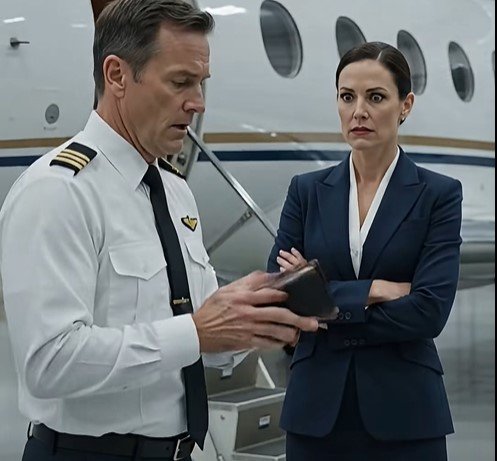
“Raven Six… is that really you?”
The voice coming through the Gulfstream’s headset did something Victoria Hail’s ridicule had failed to do.
It rattled Caleb Reed.
Only for a second.
His right hand stopped above the engine-start control.
His eyes remained on the instrument panel, but the muscles along his jaw tightened.
Mason Cole, seated in the right seat as the company’s qualified check captain, looked from Caleb to the radio.
Victoria sat behind them in the observer seat.
She had insisted on coming along after issuing the challenge, despite Frank’s warning that the aircraft was being prepared as a maintenance check flight rather than transportation to Washington.
Now she leaned forward.
“Who called you that?”
Caleb ignored her.
He keyed the microphone.
“Ground, Meridian Seven.
Ready for taxi when cleared.”
The controller seemed to understand the boundary.
“Meridian Seven, taxi Runway Two-Seven via Alpha.
And… welcome back, sir.”
Caleb released the transmit switch.
Victoria stared at him.
“Welcome back from where?”
Mason answered before Caleb could.
“From a cockpit.”
Victoria gave him an irritated look.
“I gathered that.”
“No,” Mason said.
“You didn’t.”
He picked up the faded black-and-silver insignia Caleb had brought from his toolbox.
“These are experimental flight-test wings.”
Victoria’s expression changed slightly.
Mason continued.
“I saw a photograph of these when I was in test-pilot school.
Different name under the picture, though.
Major Caleb Reed.”
Caleb brought the left engine online.
The turbine whine rose behind them.
“Past tense,” he said.
Victoria looked at the grease still embedded around his fingernails.
“You were military?”
“Once.”
“A test pilot?”
Caleb glanced at the engine indications.
“Once.”
Mason seemed unable to leave it there.
“He was more than that.”
Caleb finally looked at him.
“Mason.”
The warning in his voice was gentle but unmistakable.
Mason nodded and returned to the checklist.
For several minutes there was nothing except procedure.
Flight controls verified.
Trim checked.
Sensor channels compared.
Test card loaded.
Caleb did not rush a single item, even when Victoria looked repeatedly at her cracked phone.
That irritated her more than an argument would have.
“My meeting starts in ninety minutes.”
Caleb looked over his shoulder.
“This aircraft is not going to Washington.”
“I own it.”
“Right now, the maintenance release owns it.”
Mason lowered his eyes to hide a reaction.
Victoria’s face tightened.
“You became brave very quickly after putting on a headset.”
Caleb faced forward again.
“No.
I became responsible for an aircraft.”
They taxied.
Outside, employees had gathered near the hangar doors.
Frank stood at the front, arms folded, watching the G700 roll toward the runway.
He knew more than Victoria did.
Not everything.
But enough to understand why Caleb’s return to a cockpit was not a stunt.
Ten years earlier, Caleb Reed had been assigned to a joint experimental aerospace program testing a high-altitude research vehicle designed to operate at the boundary between atmospheric flight and spaceflight.
The program was small enough that most Americans had never heard of it.
The pilots had.
Its aircraft climbed above eighty kilometers, where the blue drained from the sky and the curve of Earth became visible beneath a canopy.
Caleb had flown there twice.
On his final mission, a disagreement between redundant flight-control sensors appeared during descent.
One channel told the computer the aircraft was stable.
Another
said it was approaching a dangerous attitude.
Caleb had reported similar discrepancies during ground testing three days earlier.
The mission had launched anyway.
During recovery, the fault cascaded.
Caleb fought the aircraft manually through violent control reversals while a chase aircraft flown by his closest friend, Major Daniel Mercer, stayed beside him to relay attitude references.
Caleb landed.
Daniel did not.
His chase aircraft suffered a separate systems failure during the recovery sequence and crashed miles from the runway.
The investigation eventually cleared Caleb completely.
It also found that a supplier had concealed inconsistent sensor-test results before the mission.
Caleb testified.
People were disciplined.
Contracts were canceled.
Procedures changed.
None of it brought Daniel home.
Three months later, Caleb left the program.
Within a year he had left military flying entirely.
When his life eventually narrowed to raising Owen alone and repairing business aircraft at Meridian, Caleb found he could sleep again.
Mostly.
He never told his coworkers what altitude he had reached.
He never displayed the commendations packed inside a box at home.
And he never sat in the front seat of an aircraft that intended to leave the ground.
Until Victoria Hail laughed at him in front of the hangar.
“Meridian Seven, cleared for takeoff Two-Seven.
Maintain three thousand.
Remain in the test area.”
Caleb read back the clearance.
Mason looked at him.
“Your airplane.”
Caleb’s hand settled on the thrust levers.
For the first time in ten years, a runway stretched directly ahead of him.
The memories arrived exactly as he had always feared they would.
Daniel’s voice.
A black sky.
Warning tones.
A funeral flag folded into a triangle.
Then Caleb pictured a yellow school bus passing a chain-link fence.
A small hand waving through the glass.
He advanced the thrust.
The Gulfstream accelerated.
“Eighty knots.”
“Checked.”
“V1.”
Caleb’s breathing remained steady.
“Rotate.”
He eased back.
The jet lifted.
For one suspended second, Meridian Airfield dropped beneath them and Caleb felt the exact sensation he had spent a decade avoiding.
The Earth letting go.
His hands did not shake.
Victoria had stopped checking her phone.
She was watching him now.
Caleb climbed through twelve hundred feet.
Then the caution appeared.
FLIGHT CONTROL DATA DISAGREE.
Mason sat forward.
“There.”
Caleb had been expecting it.
“Mark the time.”
Mason pressed the test-event marker.
A second caution flashed and vanished.
Victoria grabbed the edge of her seat.
“What does that mean?”
“It means Mr.
Reed was right,” Mason said.
Caleb made a shallow left turn while comparing channels.
The aircraft remained controllable, but one sensor value drifted away from the others under aerodynamic load.
On the ground, it had appeared only intermittently.
In flight, the defect was unmistakable.
Mason read the numbers aloud.
Caleb nodded once.
“Channel three is walking.”
Victoria said, “Can we continue to Washington?”
Both pilots looked at her.
“No,” Caleb said.
“It’s one sensor.”
“It’s one sensor lying to a computer that controls an airplane.”
Her tone sharpened.
“I have flown through warning lights before.”
“Then someone failed you before.”
The words landed harder than he intended.
Victoria’s face went cold.
“Land the airplane.”
“That was already the plan.”
Caleb requested vectors back to Meridian.
On final approach, the warning disappeared entirely.
Victoria noticed.
“It cleared.”
Caleb kept his eyes outside.
“No.
It hid.”
The
landing was almost impossibly smooth.
The main wheels touched, the nose lowered, and the aircraft decelerated without drama.
But when Caleb taxied back toward the hangar, nobody outside was laughing anymore.
Frank was waiting beside the painted safety line with the diagnostic tablet in his hand.
As soon as the engines shut down, Victoria came down the stairs.
“What failed?” she demanded.
Frank handed the tablet to Caleb rather than her.
“Telemetry caught it.
Channel-three air-data reference drifted under load.”
Mason climbed down behind Victoria.
“That should have grounded the aircraft yesterday.”
Frank’s face hardened.
“It did.”
Caleb looked up.
“What?”
Frank opened the maintenance history.
Caleb’s discrepancy from Tuesday was there.
So was an electronic closure entered six hours later.
Operationally acceptable.
Monitor at next service interval.
Caleb stared at the authorization line.
“That isn’t my sign-off.”
“I know,” Frank said.
Victoria snatched the tablet.
“Who closed it?”
Frank tapped the screen.
The authorization belonged to a maintenance manager named Lewis Grant, one level above Frank.
Victoria exhaled sharply.
“Then Grant made a bad call.
Suspend him.”
Frank did not move.
“There’s more.”
He opened the procurement record for the sensor assembly.
The component had been installed two months earlier during an accelerated service event.
Its supplier was not the manufacturer normally used by Meridian’s maintenance team.
It came from a lower-cost vendor approved under a Hail Dynamics procurement initiative.
Victoria’s initiative.
Her eyes narrowed.
“Cost approval doesn’t make me responsible for a defective component.”
“No,” Caleb said.
“It doesn’t.”
For a moment she looked almost relieved.
Then he continued.
“Overriding the inspection requirement might.”
Frank turned the tablet around.
An email chain filled the screen.
Two months earlier, engineering had requested additional bench verification for the new supplier’s first batch.
Procurement objected to the delay.
The final message came from Victoria’s executive account.
We are not losing another operating week to redundant testing.
Use the approved vendor and keep the fleet moving.
Victoria read the sentence twice.
Around them, mechanics, pilots, dispatchers, and ground crew stood in uncomfortable silence.
She looked up.
“That email was about scheduling.
I did not tell anyone to ignore a safety requirement.”
“No,” Caleb said again.
His calm seemed to anger her more than accusation would have.
“You’re enjoying this.”
Caleb’s expression changed.
“No.”
He stepped closer to the tablet.
“I know exactly what it feels like when a management deadline and a bad sensor end up in the same investigation.
There is nothing enjoyable about it.”
Mason looked at him.
Victoria heard the change in his voice too.
Frank quietly asked, “Is that what happened to you?”
Caleb did not answer immediately.
Mason did.
“Ten years ago, Major Reed was flying an experimental vehicle near the edge of space when conflicting flight-control data nearly killed him.”
Every face turned toward Caleb.
Mason continued more softly.
“His chase pilot died during the recovery.”
Victoria’s anger disappeared.
Caleb looked at Mason, but this time he did not stop him.
“The investigation found suppressed sensor discrepancies,” Mason said.
“Reed was one of the people who warned them before launch.”
Frank closed his eyes for a second.
Now he understood the man who checked every connector twice.
The mechanic who refused to pencil-whip an inspection.
The employee who never cared whether executives were impatient.
Victoria stared
at the tablet in her hand.
Then at Caleb’s bleeding knuckles.
“You saw the same pattern.”
“Not the same failure,” Caleb said.
“The same attitude toward uncertainty.”
That distinction mattered to him.
He was not turning Daniel’s death into theater.
He was explaining why one intermittent warning had been enough to stop him.
Victoria glanced toward the G700.
“What happens now?”
Caleb answered like a mechanic again.
“The aircraft stays grounded.
The sensor assembly comes out.
Every component from that supplier gets traced.
Any aircraft carrying one gets inspected before its next flight.”
Frank added, “And we preserve every record.”
Victoria nodded slowly.
Her phone buzzed.
She ignored it.
That was the first thing she had done all morning that surprised Caleb.
Within an hour, Hail Dynamics issued a fleetwide stand-down for the affected components.
The Washington meeting became a video call.
The government program office connected remotely, and outside compliance counsel instructed Meridian to preserve the maintenance and procurement records.
Lewis Grant was removed from release authority pending investigation.
The investigation later showed that Grant had closed Caleb’s discrepancy after repeated pressure from operations to keep Victoria’s aircraft available.
No evidence showed Victoria had personally ordered him to falsify the record, but her demand to accelerate the vendor transition had helped create a culture in which delay was treated as failure and caution had to be defended.
She could not fire one manager and pretend that solved it.
To her credit, eventually she stopped trying.
Three days later, Victoria walked into the hangar at 5:40 in the morning.
No assistants.
No phone in her hand.
Caleb was underneath another aircraft.
He rolled out on a creeper and looked at her expensive shoes.
“You’re early.”
“I wanted to talk before everyone arrived.”
Caleb stood.
Victoria looked toward his toolbox.
“I owe you an apology.”
He waited.
“In front of the crew,” she continued.
“Not privately.
I mocked you because you challenged my schedule.
Then I tried to turn your caution into cowardice.”
Caleb said nothing.
She swallowed.
“I was wrong.”
He nodded once.
“Okay.”
Victoria almost laughed.
“That’s it?”
“What did you want?”
“I don’t know.
Anger, maybe.”
“I used most of mine ten years ago.”
That answer stayed with her.
At seven, when the full maintenance team assembled, Victoria apologized again where everyone could hear her.
She did not describe Caleb as a hero.
He had specifically asked her not to.
Instead she said the sentence he wanted employees to remember.
“No deadline outranks a documented safety concern.”
Then she announced that mechanics and pilots could stop a Hail Dynamics aircraft without executive approval whenever an unresolved safety discrepancy existed.
Retaliation for a legitimate stop-work decision would itself become a disciplinary offense.
Caleb cared more about that policy than the apology.
A week later, Victoria offered him a new position: director of flight safety, with authority independent of operations and procurement.
He refused the title at first.
“I fix airplanes.”
“You prevented one from leaving with a defect.”
“That’s part of fixing airplanes.”
She revised the offer.
He could remain attached to maintenance, build the company’s discrepancy-review program, and fly only if and when he chose.
Caleb took the papers home.
Owen found them on the kitchen table beside the old black-and-silver wings Caleb had finally removed from the
locked toolbox.
His son picked them up carefully.
“These are yours?”
Caleb nodded.
“You were really a pilot?”
“For a while.”
Owen studied him with the severe skepticism only a child could manage.
“Dad, you always tell me not to lie.”
“I didn’t lie.”
“You let me think the highest you ever went was on that ladder in Hangar Three.”
Caleb laughed for the first time in days.
Then Owen asked the question Caleb had feared more than Victoria’s challenge.
“Why did you stop?”
Caleb sat beside him.
He did not tell his son every detail.
But he told him about Daniel.
He told him about the warning that had been ignored.
He told him that sometimes surviving something did not mean you were immediately ready to return to it.
Owen listened without interrupting.
When Caleb finished, the boy looked at the wings again.
“Were you scared when you flew Ms.
Hail’s jet?”
“Yes.”
Owen seemed surprised.
“But you still did it.”
Caleb nodded.
“Being scared and being unable aren’t the same thing.”
Two months later, after the supplier review was complete and the affected aircraft had been cleared, Caleb stood beside another Gulfstream at dawn.
This time nobody had dared him to enter the cockpit.
Nobody laughed.
Mason was waiting in the right seat for a scheduled maintenance verification flight.
Caleb paused at the bottom of the stairs.
At 6:15, the school bus appeared beyond the perimeter fence.
A small hand rose behind one of the windows.
Caleb lifted his hand and waved back.
Then he climbed the stairs.
He did not return to the sky because Victoria Hail had mocked him.
He returned because ten years of silence had finally taught him something the old investigation never could.
Daniel’s death was not a debt Caleb had to keep paying by refusing the part of himself that had survived.
Inside the cockpit, Mason handed him the checklist.
“Your airplane?”
Caleb looked through the windshield at the runway glowing gold in the morning light.
For years, those words would have sounded like a threat.
Now he rested one hand on the controls.
“My airplane.”
And this time, when the wheels left the ground, Caleb Reed did not feel the past pulling him down.