The Boy Who Tried to Buy His Way Home
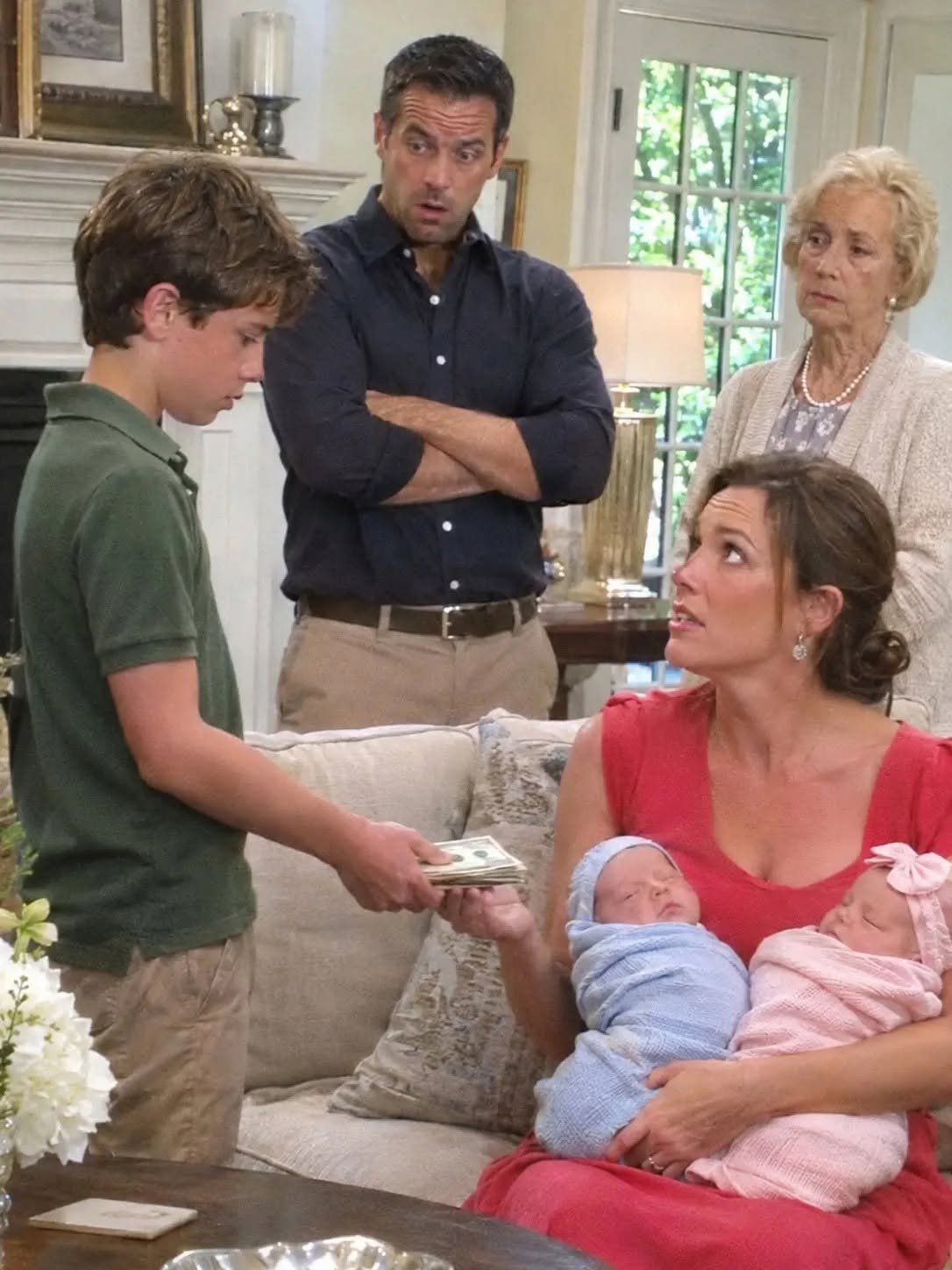
“Mom, I have $146. If I give it all to you, can I please stay here a little longer?”
My nine-year-old son, Austin, stood rigidly beside our kitchen table. His small hands trembled slightly as he carefully straightened seven twenty-dollar bills, a five, and a crumpled one across the worn wood. Across the kitchen from him, my husband, Peter, went absolutely pale. My mother-in-law, Gretchen, abruptly stopped pouring her morning coffee. The heavy silence in the room told me everything I needed to know: neither of them was surprised by what Austin was asking.
Then, my brave little boy reached deep into his faded backpack and pulled out a small, battered blue notebook.
“I wrote down some other things I can do,” he whispered, his voice cracking. “I promise I won’t cost so much anymore.”
Four weeks earlier, I’d given birth to twins after an exhausting and terrifying emergency C-section. I was still in the thick of a painful recovery, sleeping in jagged two-hour stretches, and trying desperately to remember when I had last eaten a proper, hot meal. My body ached, but my mind was crystal clear on one absolute certainty: I had never, ever told my oldest child that he needed to pay to live in our home.
“Austin, honey, put your money away,” I said softly, shifting his tiny baby sister, Hailey, higher against my shoulder. “Nobody is asking you to leave.”
Instead of looking relieved, he looked past me. He looked directly at his father.
That subtle shift of his eyes frightened me far more than the crumpled money on the table.
Peter sat frozen at the kitchen counter, his knuckles white as he gripped his coffee mug. His mother, Gretchen, who had been staying with us since the twins were born—supposedly to help while I recovered—set down the coffeepot. She flashed me the tight, patronizing smile she always deployed whenever she thought I was being overly emotional.
“Claire, don’t get yourself worked up,” she chided. “The boy has just misunderstood a perfectly sensible conversation.”
“Then explain it to me,” I demanded, my voice dropping to a low, dangerous whisper.
Peter cleared his throat, avoiding my gaze. “Mom thought Austin might enjoy staying with Aunt Joanie for a while. Just until things settle down here.”
Aunt Joanie was Gretchen’s younger sister, a kind widow who lived outside Columbus, nearly four agonizing hours away from our home near Cincinnati. Austin adored visiting her during summer vacations. She took him fishing and made incredible chocolate-chip pancakes, but she had never been anything other than a beloved distant relative.
“How long is a while?” I asked, feeling the air thin in the room.
Peter stared blankly into his dark coffee. “We hadn’t decided.”
Gretchen sighed dramatically. “Honestly, Claire, you are exhausted. The babies need constant, round-the-clock attention, and Austin is old enough to understand that growing families sometimes make adjustments.”
I looked at my sweet son. His favorite baseball shirt hung far too loosely over his narrow, tense shoulders, and the toes of his hand-me-down sneakers were worn almost white from use.
“Austin, did somebody tell you that you were going to live with Aunt Joanie?”
He nodded, a single, silent tear escaping down his cheek.
“Dad said you needed a break from me. Grandma said three kids were too expensive now, especially with the babies.”
Peter squeezed his eyes shut like a man bracing for an impact. “Buddy, that’s not exactly what I said.”
“You said Mom agreed,” Austin shot back, his voice betraying a deep, crushing betrayal.
The kitchen went dead quiet.
I had known Peter for thirteen years and had been married to him for eleven. I had seen him frightened, angry, disappointed, and utterly overwhelmed by life. But I had never seen him look at me the way he did in that terrifying moment—as though he was holding his breath, waiting for me to discover a landmine he had planted in the dark.
I placed baby Hailey carefully in her bassinet beside the counter.
“Peter, did you tell our son I wanted him gone?”
“I said you needed rest.”
“That is not what I asked.”
Gretchen stepped aggressively between us, a human shield for her son. “This is exactly why we didn’t want to bring this up while you were recovering, Claire. You take absolutely everything personally.”
I whipped my head toward her. “My child is standing in this kitchen offering me his birthday money just so he can sleep in his own bed tonight. How else on earth am I supposed to take it?”
Austin hurriedly reached for the bills, panicking at the rising tension. “It’s okay, Mom. I can help with the twins! I can make my own breakfast every day, and I don’t even need new baseball shoes yet.”
He swallowed hard, and then added something that will echo in my heart for the rest of my life:
“I just wanted to stay until your stomach stops hurting.”
Ignoring the sharp, burning sensation around my surgical incision, I knelt down onto the hard linoleum floor beside him.
“Sweetheart, listen to me closely. You are not going anywhere. Not for a month, not for a school year, not because we have two babies now. This is your home. Forever.”
He searched my face, looking for the lie. “Even if I can’t give you any more money?”
“You do not have to give me a single dollar.”
I gathered the crumpled bills, slid them back into their white envelope, and placed them securely in the kitchen drawer. I grabbed Austin’s trembling hand. “Come upstairs with me for a minute.”
Behind us, Peter called my name. I didn’t even pause to look back.
The Discovery in the Bedroom
Austin’s bedroom was situated at the far end of the hallway, right across from the new nursery. We had painted it a cheerful blue when he was six years old, and he had helped me stick little glow-in-the-dark stars all across the ceiling.
Now, my heart shattered. Three heavy cardboard boxes sat ominously beside his dresser.
His beloved baseball trophies were already missing from the wooden shelf.
I stopped dead in the doorway. “Who packed these?”
Austin looked down at his worn sneakers. “Dad said I should get a head start so Aunt Joanie wouldn’t have to wait when she comes on Saturday.”
Saturday. Saturday was exactly three days away.
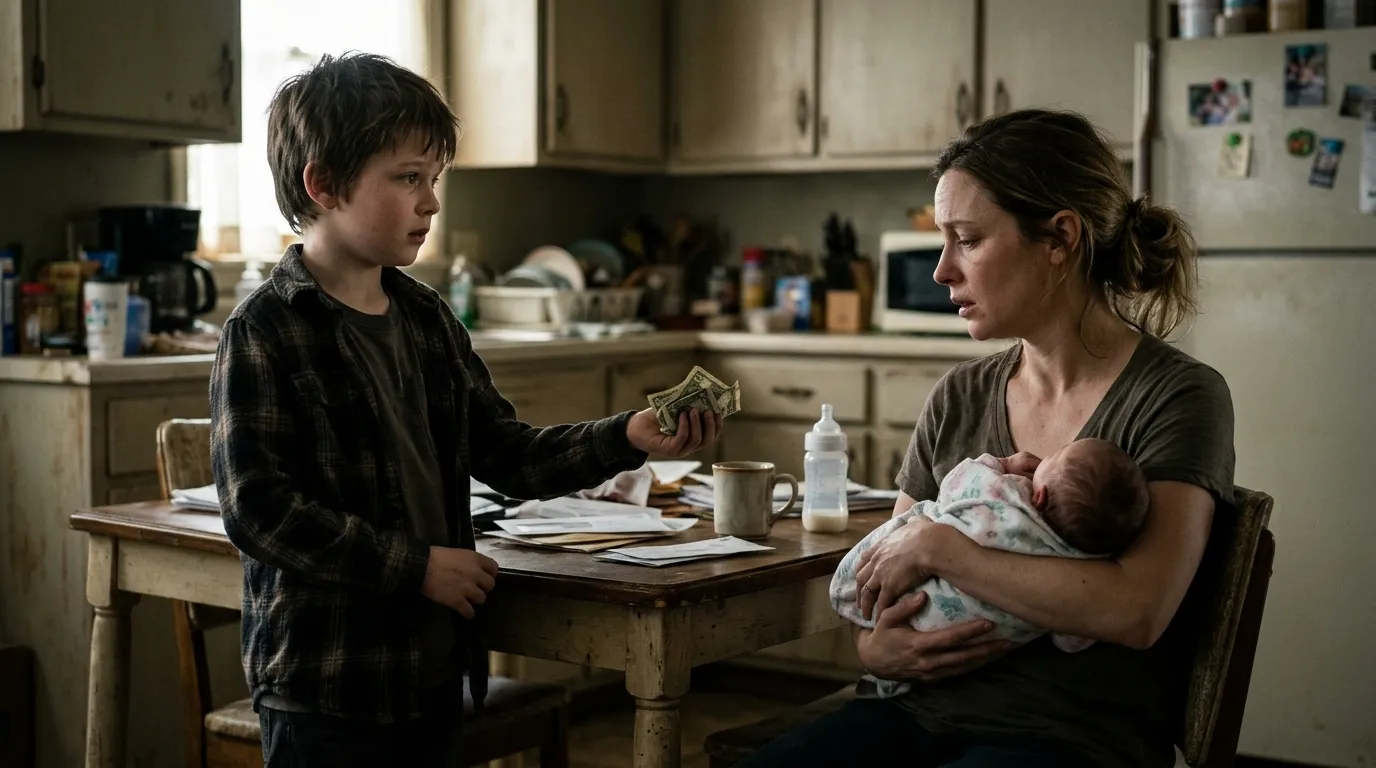 His whole life was being boxed away without my knowledge.
I dropped to my knees and opened the nearest box. Inside, carefully folded, were Austin’s thick winter sweaters, his recent school photographs, and the framed picture of the three of us taken at the county fair two summers earlier. Peter had already begun packing our son’s entire existence away while I was trapped upstairs recovering from major surgery.
“Did Dad say you were leaving this Saturday?”
Austin nodded numbly. “He said Aunt Joanie was coming to get me. I thought maybe… maybe if I helped out enough around the house, you could change your mind.”
I sat heavily on the edge of his bed and pulled him firmly against my side. “Austin, I didn’t know about a single piece of this. I never, ever agreed to send you away.”
He twisted his small fingers together, a nervous habit he’d had since toddlerhood. “Then why did Dad say you did?”
I couldn’t answer that question without making cheap excuses for a man who frankly had no right to them.
“I don’t know why he told you that. But I’m going to find out.”
Austin looked back at the bleak cardboard boxes. “Mom… is it because I’m adopted?”
My stomach twisted into a tight, sickening knot.
Peter and I had adopted Austin when he was an infant. We cherished the photographs from the courthouse, a beautiful little album of his first year, and a framed copy of his adoption decree in our family records. But we had made a grave, cowardly mistake. We kept putting off the hard conversations that should have naturally grown with him as he got older. We told ourselves we’d explain everything wonderfully when he was ‘ready to understand.’
Instead, our silence had created a void, and we had allowed his grandmother to fill it with poison.
“Who told you that, sweetheart?” I asked, struggling to keep my voice steady.
“Grandma. She told me the babies are your real children because they actually came from your tummy. She said you and Dad chose me before you knew you’d be able to have your own.”
I closed my eyes, letting a wave of blinding fury wash over me before looking back at my son.
“Austin, you are our real child. We adopted you because we wanted, more than anything, to be your parents. Nothing about that changed for a single second when Hailey and Mason were born.”
He studied his small hands. “Can adopted kids get sent back if their parents don’t have enough money?”
I threw both arms around him, pulling him as close as my healing body would allow. “No, honey. Adoption means you are our son, legally, permanently, and in every single way that matters in this universe. We should’ve talked to you about it a long time ago. I am so, so sorry we didn’t.”
“But Grandma said—”
“Grandma was wrong.”
He slumped against me in relief, and I held him there until his ragged breathing finally slowed. It was then that I noticed the battered blue notebook sticking out of his backpack.
“Is that what you were trying to show me downstairs?”
He hesitated, his cheeks flushing pink, before handing it over.
On the very first page, written in the careful, blocky handwriting of a third grader, was the title:
Things I Can Do So Mom Can Keep Me.
Beneath the heartbreaking title were eight numbered promises. He swore he would fold the babies’ clothes every day without complaining. He wouldn’t ask for new baseball shoes, even if his toes hurt when he ran. He would eat dry cereal so he wouldn’t bother me to cook breakfast. He wouldn’t ask for a birthday party next year, or ever.
The final line destroyed me:
Be really quiet so nobody gets tired of me.
I couldn’t read anymore. For weeks, Austin had been bringing me fresh water, fetching endless diapers, and quietly entertaining himself in the corner while I fed the twins. I had foolishly thought he was just adjusting beautifully to being a big brother. Now I realized he was desperately auditioning for a role he already owned—trying to prove he deserved to take up space in his own home.
“Did somebody ask you to make this list?” I choked out.
He shook his head. “I just thought it might help.”
I closed the notebook like it was a sacred text. “You do not have to earn your place here, Austin. You can be noisy. You can need things. You can have a terrible day. None of that makes you any less my son.”
He looked at me for a long time, processing the weight of my words. “Can I still play baseball?”
I laughed through a fresh wave of tears. “Of course you can.”
Confronting the Betrayal
After helping him unpack the first box, I asked him to stay upstairs with a book while I made a phone call. I retreated to my bedroom, locked the door, and called Aunt Joanie.
She answered cheerfully. “Claire, honey! How are those beautiful new babies?”
“They’re doing fine. Joanie, I need to ask you something important about Austin.”
Her warm tone shifted instantly. “Is everything all right?”
“Did Peter tell you Austin was coming to live with you?”
A long pause followed. “He said you both thought it would be best for the boy to stay here in the quiet while you recovered.”
“For how long, Joanie?”
“Well… he mentioned the whole school year. He thought moving him back and forth would be far too disruptive.”
I gripped the edge of my wooden dresser, my knuckles turning white. “The entire school year?”
“That’s exactly what he said. Claire, I assumed you’d discussed it together as a team.”
“I found out this morning. Austin walked into the kitchen and offered me his birthday money to pay to stay for another month.”
Joanie made a sharp, devastated sound. “Oh, that poor, sweet child.”
I poured out the whole story—the boxes, Gretchen’s cruel remarks, the heartbreaking notebook. She listened in stunned silence.
“Claire, I love that boy,” she finally said. “I truly thought I was offering him a fun place to stay while you got your feet under you. Peter told me Austin was excited about it.”
“He thinks we’re throwing him away because he isn’t biological.”
“Then somebody has done him a terrible, unforgivable wrong. I am not coming on Saturday. I will call Peter myself. Tell Austin his Aunt Joanie loves him, and he can visit whenever he wants—but my house is not a dumping ground for people who aren’t wanted.”
When I opened my bedroom door, Peter was waiting in the dim hallway like a ghost.
“You called Joanie,” he noted, his voice hollow.
“Yes.”
“Claire, you don’t understand how bad the money is right now.”
“Then you should have looked me in the eye and told me.”
I held up Austin’s blue notebook like a piece of damning evidence. “You didn’t want to put the burden on me, so you put it on a nine-year-old boy instead.”
We marched downstairs, and in front of his mother, I made Peter read the notebook. I watched the remaining color drain from his face as he reached the line about being quiet so we wouldn’t tire of him.
Gretchen tried to defend herself, claiming she was just being “practical” and that it was absurd to compare sending a nine-year-old away to sending a newborn away. That was the moment I told her to pack her bags and leave. She had drawn a line between my children, and in this house, there were no lines.
Once she was gone, Peter finally confessed the truth. We were drowning in medical debt from the complicated birth—just over five thousand dollars behind. His overtime had been slashed, and my unpaid leave was dragging on. In a panic, heavily influenced by his mother’s prodding, he decided eliminating a mouth to feed was the easiest mathematical solution.
“He’s a nine-year-old boy,” I told him, my voice devoid of pity. “He is not a line item you can just delete from a spreadsheet.”
I demanded all the bills be put on the table. We were going to face the storm together. But I also demanded something else.
“I need you to leave, Peter. You can ask your brother Luke for his spare room. You will still come here and help with these babies, but until I can look at you and trust you again, you cannot live in this house.”
Peter broke down, sobbing at the table. I wanted to cry with him, to fall into his arms and pretend it was all a bad dream. But the packed boxes upstairs were real. The notebook was real. The trauma inflicted on my son was real.
Rebuilding the Foundation
The next few months were grueling. Peter lived in Luke’s spare room and came over daily to help. He washed bottles in silence, folded tiny socks, and slowly faced the monumental task of proving his character.
We tackled our financial crisis honestly. We called the hospital, swallowed our pride, and applied for financial assistance. They reduced part of our debt and put us on a payment plan. I started working remotely on a reduced schedule. We ate cheap meals, ignored the broken dishwasher, and pinched every penny.
But we did it all without asking a little boy to give up his bedroom.
We also found Dr. Sarah Owens, a brilliant child counselor specializing in adoption. She gave Austin the space to process his fears. In one incredibly emotional session, Peter sat beside Austin and looked at the photos of the day we officially adopted him.
“Were you happy too, Dad?” Austin had asked, searching for a crack in the story.
Peter wept openly. “I was terrified I’d drop you because you were so little. But I was so, so happy. Sending you away was a terrible, cowardly mistake, Austin. I panicked about money, and I lied. I am so sorry.”
Austin didn’t forgive him that day. Dr. Owens reminded us he didn’t have to. Trust is a house built brick by brick, and Peter had swung a wrecking ball through ours. Now, he had to lay the mortar.
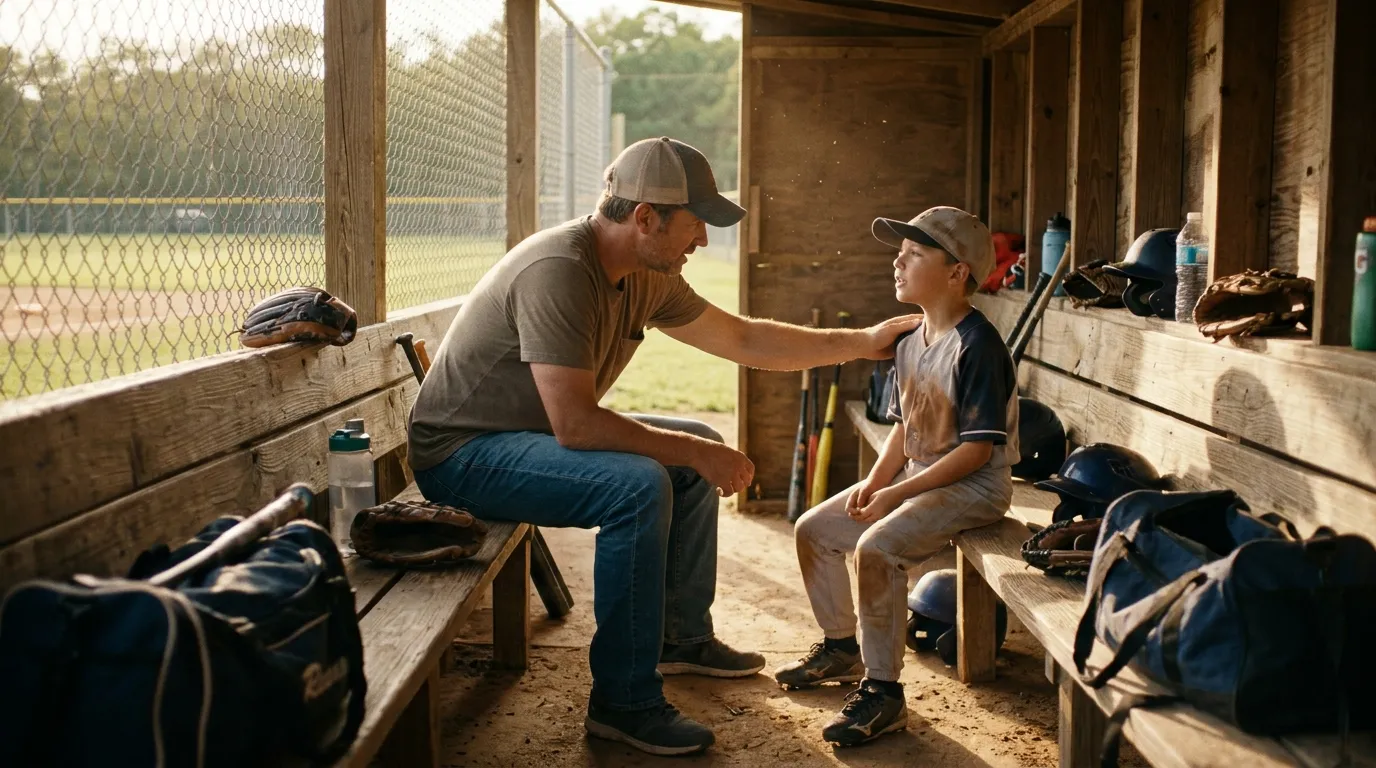
Slowly, the ice began to thaw. Peter invited Austin to the park for baseball practice. He told Austin he was allowed to say no. Austin said yes. When they returned, Austin was laughing, regaling me with a story about how his dad had tripped over his own feet trying to catch a pop fly. It wasn’t full forgiveness, but it was the start of something new.
The Investment That Mattered
By September, Peter had moved into his own small apartment nearby. We were still doing marriage counseling, still washing bottles together, still figuring out if we could survive this as a couple.
But the atmosphere in the house had completely transformed.
One bright Saturday afternoon, I grabbed my car keys. Austin was on the living room rug, happily assembling a plastic fire engine while the twins slept.
“Where are we going, Mom?” he asked.
“To get you new baseball cleats. Your old ones are squeezing your toes.”
He looked down, a flash of the old worry crossing his eyes. “They’re not that bad.”
I gave him a knowing look. “Go get some clean socks.”
While he ran upstairs, I opened the kitchen drawer. Tucked behind a stack of old takeout menus was the same white envelope he had placed on the table three months ago. I hadn’t touched a single dollar of it.
I walked up to his room—a room completely free of cardboard boxes—and handed it to him.
“Every dollar is there,” I told him as he stared in shock. “You never, ever needed money to stay here, Austin.”
He held the envelope tightly. “I think I know that now. Can I keep saving for a new bike?”
“Of course you can.”
At the sporting goods store, he found a perfect pair of bright blue-and-white cleats. As he tested them out with little hops in the aisle, he paused, looking at the price tag.
“Mom, are you sure we can afford these? We still have the bills.”
I knelt down and looked him right in the eye. “That is for the grown-ups to figure out. You do not have to make yourself smaller so our family can get by.”
He smiled—a real, wide, brilliant smile—and asked if I would come to his game. I promised him I wouldn’t miss it for the world.
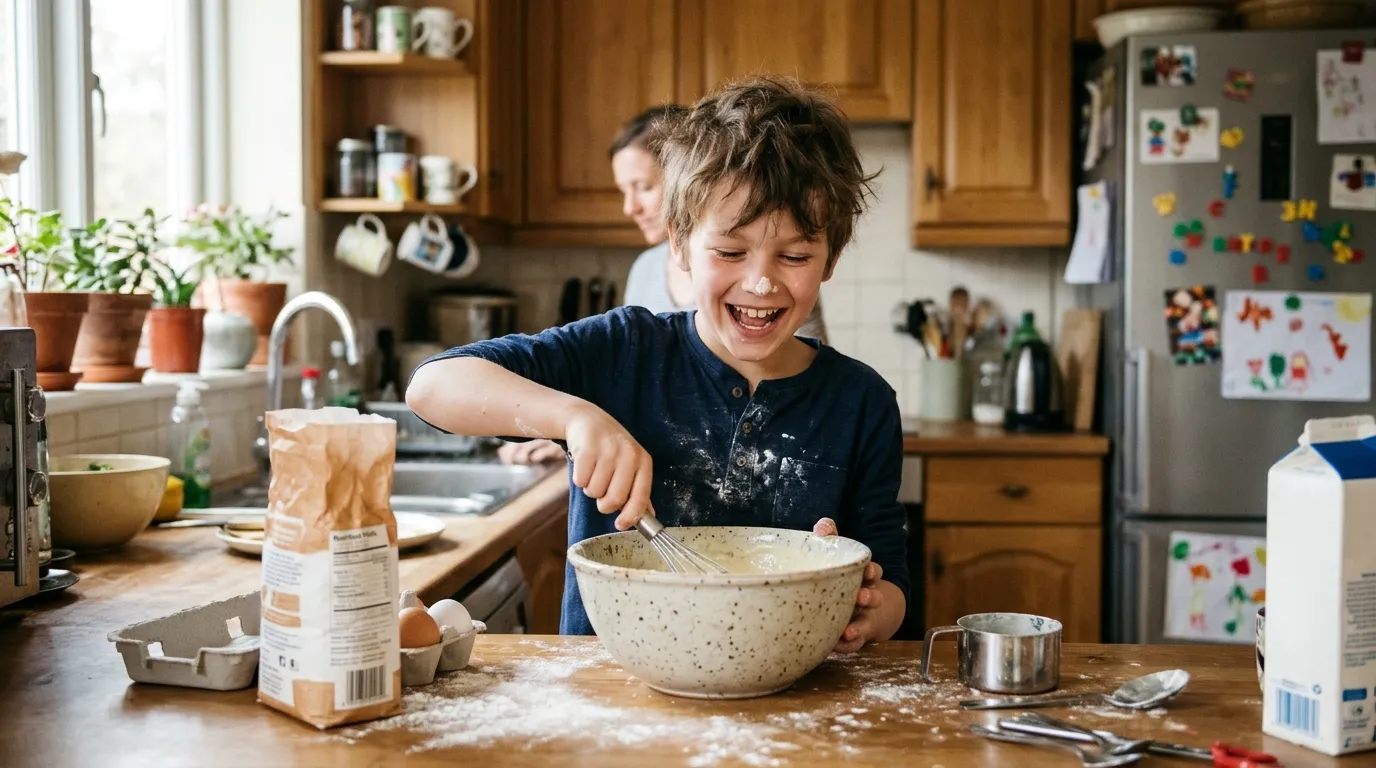 No more promises to be quiet. Just a kid making a mess in his own home.
When we got home, he put his envelope safely in his dresser drawer. Then he marched downstairs, dragged a chair to the kitchen counter, and asked for the biggest mixing bowl we owned to make pancakes. When he accidentally spilled a dusting of white flour across the counter, he froze for a split second.
I just handed him a towel and smiled.
He wiped it up, laughed when he noticed the flour on his shirt, and grabbed a massive handful of blueberries, dumping them into the batter without asking for permission.
When he sat down at the table that night, he didn’t bring crumpled dollar bills. He didn’t bring a blue notebook full of apologies for existing.
He just brought his appetite. And for the first time in months, our home felt entirely whole.